

Why Enterprise Software Implementations Go Over Budget and How to Prevent It



Ask any delivery lead when their last implementation went off the rails, and you rarely hear about one dramatic failure. What you hear instead is a slow accumulation. A client asks for one more approval step. A data field turns out to be formatted differently across regions. An integration that was supposed to take two days takes two weeks. None of it looks like a crisis in the moment. All of it adds up.
That accumulation is the real story behind implementation cost overruns, and it's worth naming directly: enterprise software implementations rarely go over budget because of one massive mistake. They go over budget because additional work keeps accumulating until the total no longer resembles the original plan.
This article breaks down where that additional work actually comes from, what it costs even when nobody notices it happening, and what enterprises, and increasingly AI, can do to keep it in check.
Why Do Enterprise Software Implementations Go Over Budget?
A budget is an estimate of work. It reflects a set of assumptions about scope, data, dependencies, and effort, made at a specific point in time. When those assumptions change, the amount of work required changes with them. Since implementation cost is fundamentally the cost of doing work, any shift in requirements, data quality, or scope eventually shows up as a shift in cost.
Recent research shows this is still the norm, not the exception. The Standish Group's 2024 CHAOS Report, which tracks IT project outcomes annually, found that only 31 percent of projects were completed on time, on budget, and with the full scope originally planned. Half were "challenged," meaning they ran over budget, ran over time, or delivered less than promised, and the rest failed outright. That distribution has barely moved over the past decade, which points to something structural rather than a run of bad luck on individual projects.
Research focused specifically on enterprise software tells a similar story. Panorama Consulting Group's 2026 ERP Report found that more than a quarter of organizations exceeded their implementation budgets, with additional technology needs and scope expansion cited as the leading causes, the same patterns this article walks through below.
A simple way to think about where that extra work comes from is to break it into five forces.
Change. Requirements evolve after the plan is locked.
Complexity. Integrations, customizations, and dependencies multiply the number of things that can behave unexpectedly.
Rework. Something built once has to be rebuilt, usually because a test failed or a requirement was misunderstood.
Delay. People and systems sit idle waiting on an approval, a data set, or a decision from another team.
Repetition. A team solves a problem that has already been solved on a previous project, because there was no way to reuse the answer.
That gives us a simple way to frame the rest of this article, not a formal industry formula, just a useful lens:
Implementation Cost = Planned Work + Additional Work
Additional Work = Change + Complexity + Rework + Delay + Repetition
What Causes Enterprise Software Implementation Cost Overruns?
Each of the five forces above shows up in practice as a specific, recognizable pattern. Here is where the money actually goes.
Scope Creep and Changing Requirements
A new requirement rarely creates just one additional task. It can mean new configuration, new test cases, updated documentation, additional user training, and sometimes revisiting work that was already considered finished. One "small ask" can touch five different parts of a project at once.
Poor or Incomplete Requirements Gathering
When requirements are vague or incomplete at the start, teams design against assumptions instead of facts. Gaps don't disappear. They resurface later, usually during testing or user acceptance, when they are far more expensive to fix than they would have been on a whiteboard.
Data Migration and Data Quality Issues
Legacy data is rarely as clean as anyone hopes. This is one of the most consistently underestimated risks in enterprise projects. In a frequently cited 2009 report on data migration risk, Gartner found that 83 percent of data migration projects either exceeded their budget and schedule or failed outright. The figure has aged, but the underlying pattern still shows up in newer industry benchmarking on cloud and ERP migrations: duplicate records, missing fields, and inconsistent formats tend to surface only once someone tries to move the data, triggering a new round of cleansing, validation, and remapping that wasn't in the original estimate.
Integration and Customization Complexity
Every system an implementation needs to connect to brings its own quirks: authentication requirements, rate limits, data formats, and edge cases that only appear under real usage. Customizations compound this, since a piece of custom logic built for one integration often has to be revisited when a second or third is added.
Extended Testing and Rework
Testing has a way of exposing everything upstream. A gap in requirements, a messy data field, or a fragile integration usually shows up first as a failed test case. Fixing that failure often means reopening work already marked complete, which pushes both timeline and cost.
Implementation Delays and Resource Costs
A delay rarely stays contained to the task that caused it. Waiting on an approval, a data set, or a decision from another team creates idle time for people scheduled to work on dependent tasks. That idle time doesn't vanish. It either shows up as cost, as a compressed and riskier schedule later, or both.
Change Management and User Adoption
Technology changes are only half of an implementation. The other half is getting people to actually use the new system the way it was designed to be used. Skipping or underestimating training and communication tends to generate support tickets and rework once the system goes live.
What Are the Hidden Costs of Enterprise Software Implementation?
Some of the cost created by these seven patterns is visible. It shows up as extra configuration hours, a second round of testing, additional consulting time, a formal change order. These are the costs a budget review usually catches.
A large share of the cost is invisible. It is the hour spent searching for an answer that already exists somewhere in a Slack thread. It is a decision made once that has to be re-litigated because nobody wrote it down. It is a consultant re-explaining the same integration logic to a new team member. It is one team waiting on another because nobody was clearly assigned to own a dependency.
Visible work gets scoped and tracked. Invisible work gets absorbed, usually by whoever on the team is already the most stretched. This is also where repeated work becomes a specific, preventable cost rather than a general inefficiency. A configuration decision, a troubleshooting fix, or a data mapping pattern solved on a previous implementation often gets solved again on the next one, simply because there was no reliable way to carry that knowledge forward.
That points to an opportunity beyond automating individual tasks: a system that can remember and reuse what has already been done. Platforms like Beacon.li are built around this idea, and we'll come back to it once the cost-control picture is complete.
How Can Enterprises Control Software Implementation Costs?
Cost control is not about predicting every task perfectly. Nobody can forecast every data quality issue or every stakeholder change of heart six months out. It is about reducing the amount of unpredictable and unnecessary work a project has to absorb.
Standardize configuration
Instead of configuring every project from scratch, identify what can be templated and reused. Every from-scratch configuration decision consumes delivery capacity that could go toward what is genuinely unique about that client.
Tighten requirements gathering upfront
The earlier a gap is found, the cheaper it is to fix. Validating requirements before development starts prevents a far more expensive version of the same conversation happening during user acceptance testing.
Start data profiling early
Profiling legacy data before migration day, checking for duplicates, missing fields, and format mismatches, surfaces problems while there is still time to fix them calmly instead of urgently.
Scope integrations realistically
Map every system an implementation needs to touch, and be honest about which ones are simple and which are likely to introduce complexity.
Build in continuous testing
Testing throughout an implementation, rather than saving it for one big phase at the end, catches problems while they are still small and isolated.
Track change requests formally
Logging every change, even the small ones, makes the accumulation of "minor" asks visible before it becomes a budget problem.
Protect against decision amnesia
Document key decisions as they are made, including the reasoning, not just the outcome. This prevents teams from re-litigating settled questions weeks later.
Plan for change management from day one
Treat user adoption as part of the implementation plan rather than an afterthought.
How to Prevent Software Implementation Cost Overruns
Individual levers help, but the real gains come from putting them into a process rather than applying them ad hoc. The controls above map onto three points in the project:
Before implementation: scope, requirements, data, and dependencies.
During implementation: standardization, testing, and change tracking.
Throughout: governance and accountability.
Increasingly, AI can play a role across each of those points too. Before implementation even begins, it can connect to pre-sales conversations, requirements workshops, RFPs, and other customer context to turn what was discussed into a preliminary scope of work. Once the project starts, it can translate those conversations into detailed business requirements, carry that context into solutioning, and use it to drive configuration, workflows, integrations, and permissions rather than making consultants reconstruct the requirements from scratch. It can generate client-specific test cases from the requirements and configuration, help produce UAT reports, and distinguish between something that is not working as designed and a genuinely new change in scope. It can also support data migration by mapping fields, applying transformations and validations, identifying failures, and helping retry them. And when the implementation goes live, the same context can carry into hypercare, helping teams troubleshoot workflows and resolve issues without starting from zero.
The bigger opportunity is not automating individual tasks. It is connecting these stages so that the context created in one becomes an input to the next. A requirement should not disappear into a document after it is signed off. It should flow through solutioning, configuration, testing, migration, and go-live, with a clear record of what happened along the way. That is what turns AI from a collection of point tools into an execution layer for implementation.
But there is an important caveat: AI cannot simply be pointed at an existing process and expected to make it better. If the underlying delivery process is inconsistent, AI can amplify that inconsistency. The repeatable parts of implementation need to be engineered and structured first; that is what gives AI something reliable to learn from and execute against. The AI itself then needs the same discipline: governed, predictable, and transparent, with human oversight and visibility into execution and token consumption. That is the idea behind the GPT framework discussed later in this article.
This is what separates teams that occasionally get lucky on a project from teams that consistently deliver close to budget. It isn't about eliminating every source of additional work. That isn't realistic. It is about making the work more structured, carrying context forward, and surfacing the next source of effort early enough to manage it.
Can AI Reduce Enterprise Software Implementation Costs?
AI is increasingly being applied across implementation work: drafting requirements documentation, accelerating configuration, generating test cases, producing documentation, mapping data fields, and speeding up troubleshooting. Each of these applications saves real time on its own.
But the more interesting shift isn't about making individual tasks faster. It's about making implementation knowledge reusable. A configuration decision made on one project, a troubleshooting fix discovered on another, a data mapping pattern solved for a prior client, all of that represents work that has already been done. The question is whether the next project can actually access it.
From Project-Based Implementation to Repeatable Execution
Here is a question worth sitting with. If the same implementation problems keep showing up across projects, is all of that work really new?
A configuration has usually been built before, on a different client's implementation. A data mapping pattern has usually been solved before. A test scenario has usually been written before. An integration quirk has usually been debugged before. Yet the next project frequently starts from a blank page, because there is no reliable way to carry that knowledge forward.
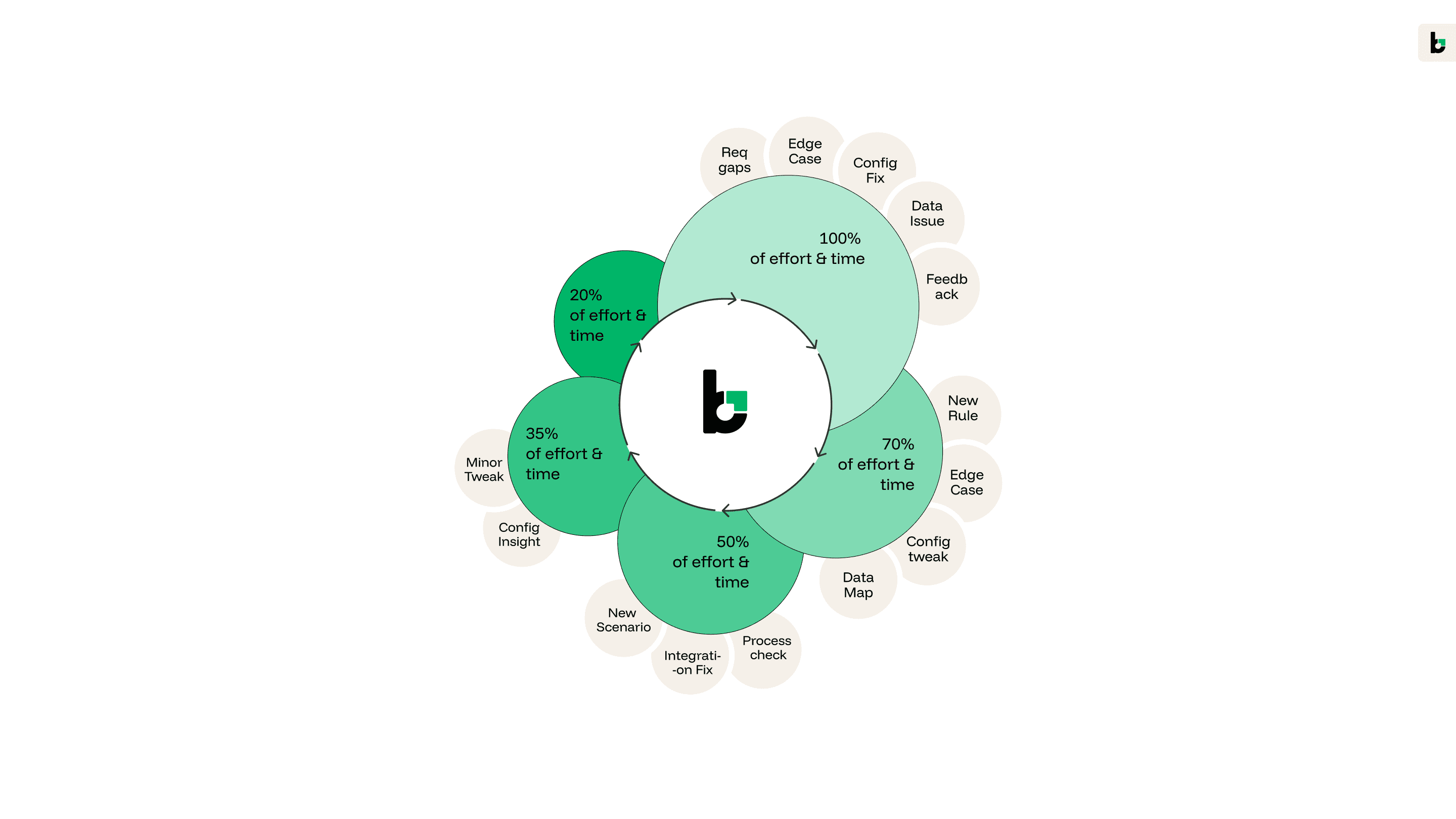
This is the difference between two models of delivery. In project-based execution, every implementation starts from scratch, regardless of what the organization has already learned. In repeatable execution, every implementation starts with what the organization already knows, and only the genuinely new parts require fresh work.
How Beacon.li Helps Control Implementation Costs
Beacon.li is one example of a platform built specifically to operationalize that shift, turning the principle of repeatable execution into part of how implementations actually run.
Implementation cost driver | How Beacon.li addresses it |
Repeated configuration | Applies proven configuration logic consistently instead of rebuilding it by hand for each client |
Data-related rework | Validates structure and completeness before migration begins, rather than discovering mismatches at cutover |
Testing effort | Generates test scenarios from each customer's real configuration and produces audit-ready documentation |
Knowledge loss | Builds a living map of configuration logic, dependencies, and customer-specific patterns that carries forward into future implementations |
Manual execution | Automates the repeatable parts of setup and validation so consultants can focus on judgment calls |
The point isn't to automate individual clicks. It's to make the implementation itself more repeatable, so less of the work has to be recreated for every new customer.
AI Consumption and Cost Control
Bringing AI into implementation work solves one cost problem, but recent research shows it introduces another that most organizations haven't planned for. The FinOps Foundation's 2026 State of FinOps report, drawn from over a thousand practitioners managing tens of billions of dollars in cloud spend, found that 73 percent of organizations reported their AI costs exceeded original projections. The reason is structural: per-token prices have fallen sharply over the past year, but usage has grown even faster, driven by multi-step agentic workflows and background processes that run continuously. The result is that AI bills keep rising even as the underlying technology gets cheaper.
It's worth pausing on one point before going further. Rising AI usage is not automatically a red flag. It can mean the opposite: more people relying on the system, more workflows depending on it, more of the organization deciding it's useful. Usage goes up because value is going up. The actual problem is different. It's that most organizations have no way to see that growth coming, or to watch it clearly while it happens.
The GPT Framework: Governance, Predictability, and Transparency
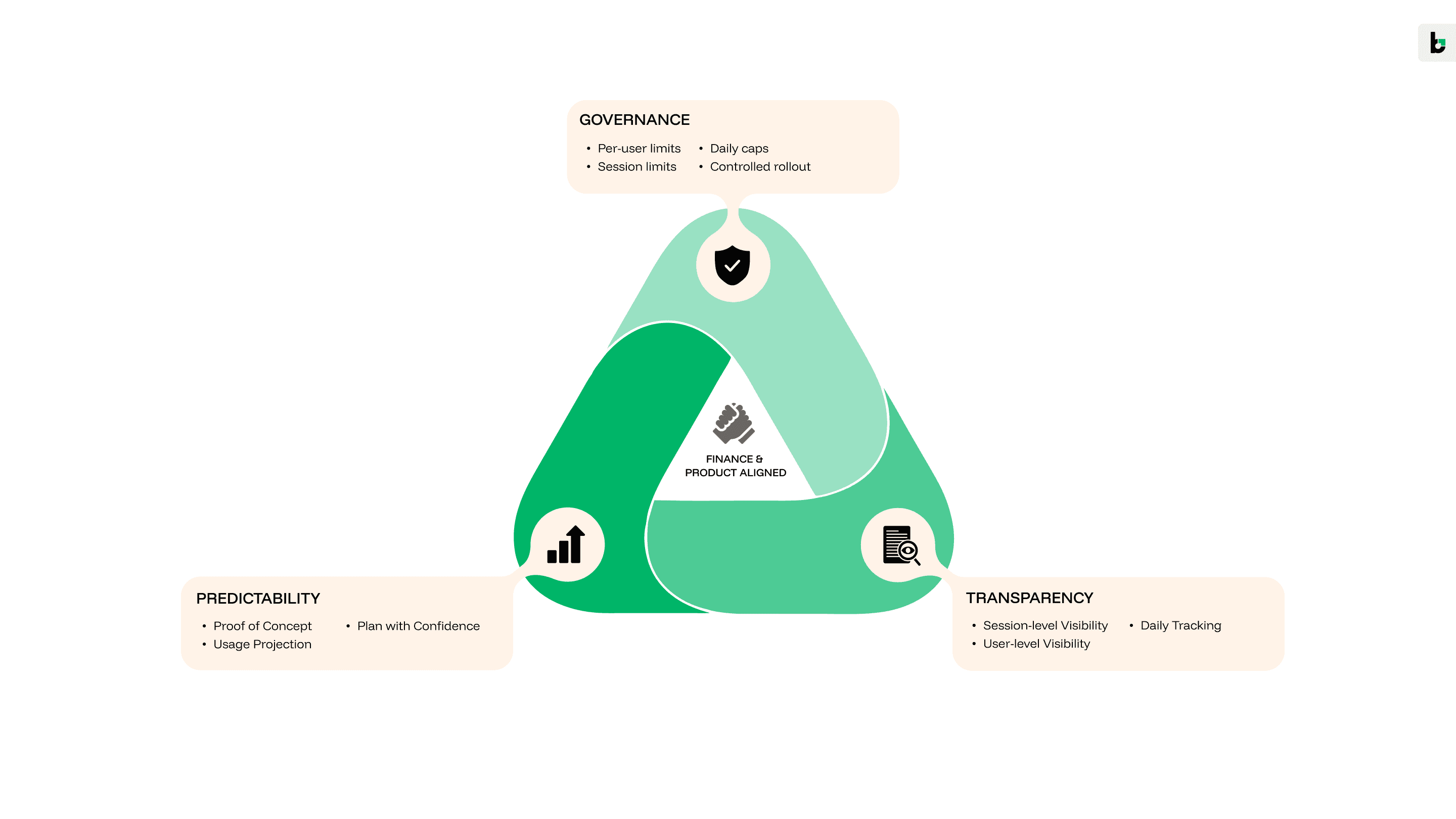
At Beacon.li, the view early on was that AI cost should never become a black box sitting between the product team and a customer's finance team. That thinking led to the GPT framework: Governance, Predictability, and Transparency.
Governance
Governance means putting real controls around how AI gets used, not just how it gets adopted. That includes per-user limits, session limits, daily caps, and a deliberate rollout rather than an open tap. Adoption should never quietly turn into uncontrolled spend.
Predictability
Predictability means estimating consumption before a system goes live, not after. Running a proof of concept before rollout and projecting realistic usage from that data gives finance a number to plan against instead of a surprise to react to.
Transparency
Transparency means consumption is visible while it happens, not reconstructed after the fact. Session-level visibility, user-level visibility, and daily consumption tracking mean finance sees usage as it accrues instead of discovering it on a monthly invoice.
Here is the line that ties it together: tokens are a technical metric, and budgets are a business language. Somebody has to translate one into the other.
Beacon.li applies this thinking directly to the AI layer of implementation work: its orchestration reduces the manual, repeated execution that drives delivery cost, and the GPT framework sits on top of that execution to keep the AI consumption behind it governed, forecastable, and visible rather than something finance discovers after the fact.
Enterprise Software Implementation Cost Checklist
Scope
Requirements validated before development starts
Change requests logged and reviewed, however small
Scope boundaries clearly documented and shared with stakeholders
Data & Technology
Legacy data profiled before migration begins
Integration points mapped and complexity realistically scoped
Customizations documented for future reuse
Delivery
Dependencies identified and owners assigned upfront
Effort tracked against the original plan in real time
Proven patterns reused instead of rebuilt from scratch
Testing
Testing happens continuously, not only at the end
Rework flagged and logged as soon as it's discovered
Governance
Decisions documented with context, not just outcomes
Clear accountability for cost drivers throughout the project
AI
Is expected AI usage estimated before go-live?
Are usage limits defined by user, session, or day?
Can consumption be monitored as it happens?
Is there a process for reviewing unexpected usage?
Conclusion
The answer isn't simply asking for a bigger implementation budget. A bigger number just gives the same problems more room to hide. The real answer is to reduce unnecessary work, reuse knowledge instead of rebuilding it, govern AI usage deliberately, and make cost drivers visible before they turn into overruns.
At its core, this is a problem of uncontrolled additional work. Repeatable execution is one of the biggest opportunities to reduce it, carrying what's already been learned into the next project rather than rebuilding it. Beacon.li is one example of that principle built directly into the implementation process, and the GPT framework extends the same discipline to the AI layer running underneath it.
The best implementation isn't necessarily the one with the lowest original estimate. It's the one that creates the least unnecessary work between the estimate and go-live.
Frequently Asked Questions
What Is Included in Enterprise Software Implementation Costs?
Implementation costs typically include configuration, data migration, integrations, testing, training, and project management, on top of the software license itself. Many budgets underestimate the effort required for data quality work and change management specifically.
Why Do Enterprise Software Implementations Go Over Budget?
Because a budget is based on assumptions about scope, data, and effort that shift once execution begins. Each shift in assumptions increases the amount of work required, and that added work is what drives the cost past the original estimate.
What Causes Enterprise Software Implementation Cost Overruns?
The most common causes are scope creep, incomplete requirements, data migration and quality issues, integration and customization complexity, extended testing and rework, delays, and weak change management.
What Are the Hidden Costs of Enterprise Software Implementation?
Hidden costs are the invisible work that doesn't appear on an invoice: searching for answers, re-explaining decisions, repeating configurations, and redoing work that wasn't documented the first time.
How Can Enterprises Control Software Implementation Costs?
By reducing unpredictable and unnecessary work rather than trying to forecast every task perfectly. Standardizing configuration, validating requirements early, profiling data before migration, and tracking change requests all reduce the amount of additional work a project has to absorb. Platforms such as Beacon.li take this further by automating repeatable implementation work, helping teams reuse proven configurations, validate data, and reduce manual rework.
Can AI Reduce Enterprise Software Implementation Costs?
Yes, by speeding up individual tasks like documentation, testing, and data mapping, and by making implementation knowledge reusable across projects instead of trapped within one team's memory. AI adoption also introduces its own cost variable, which is why usage needs its own governance. Platforms such as Beacon.li apply AI to repeatable implementation work, helping teams reduce manual effort and rework. But AI adoption introduces its own cost variable, which is why usage also needs governance, predictability, and transparency.
What Is the Average Cost of an Enterprise Software Implementation?
There isn't a single reliable average, because the cost depends heavily on company size, system complexity, the number of integrations, and how much data has to migrate. A better approach than looking for an industry average is to build your own estimate around the five cost drivers in this article, change, complexity, rework, delay, and repetition, since those are what push any given project above its starting number.
Is Software Licensing or Implementation More Expensive?
It depends on the platform and the scope of the rollout, so treat any fixed ratio with caution. What's consistent across enterprise deployments is that implementation-side work, data migration, integration, testing, and change management, is where the uncertainty and the overrun risk live. The license fee is usually the most predictable line in the budget. The implementation effort is usually the least.
What Are the Biggest Cost Factors in Enterprise Software Implementation?
Data quality and migration complexity, the number and difficulty of integrations, the amount of customization required, and how well requirements were defined before the project started.
How Do You Estimate Enterprise Software Implementation Costs?
Start with a realistic scope and validated requirements, then build in a contingency reserve that reflects the project's complexity and known risks across the categories covered in this article: change, complexity, rework, delay, and repetition.
What Should Be Included in an Implementation Budget?
Software costs, implementation and consulting fees, data migration and cleansing, integration work, testing, training, and a contingency reserve for scope and requirement changes.
When Should You Revisit an Implementation Budget?
Any time a change request is approved, a new integration is identified, or a data quality issue surfaces that wasn't part of the original scope. Revisiting the budget at each project milestone, rather than only at the end, keeps overruns visible while they're still manageable.
Ask any delivery lead when their last implementation went off the rails, and you rarely hear about one dramatic failure. What you hear instead is a slow accumulation. A client asks for one more approval step. A data field turns out to be formatted differently across regions. An integration that was supposed to take two days takes two weeks. None of it looks like a crisis in the moment. All of it adds up.
That accumulation is the real story behind implementation cost overruns, and it's worth naming directly: enterprise software implementations rarely go over budget because of one massive mistake. They go over budget because additional work keeps accumulating until the total no longer resembles the original plan.
This article breaks down where that additional work actually comes from, what it costs even when nobody notices it happening, and what enterprises, and increasingly AI, can do to keep it in check.
Why Do Enterprise Software Implementations Go Over Budget?
A budget is an estimate of work. It reflects a set of assumptions about scope, data, dependencies, and effort, made at a specific point in time. When those assumptions change, the amount of work required changes with them. Since implementation cost is fundamentally the cost of doing work, any shift in requirements, data quality, or scope eventually shows up as a shift in cost.
Recent research shows this is still the norm, not the exception. The Standish Group's 2024 CHAOS Report, which tracks IT project outcomes annually, found that only 31 percent of projects were completed on time, on budget, and with the full scope originally planned. Half were "challenged," meaning they ran over budget, ran over time, or delivered less than promised, and the rest failed outright. That distribution has barely moved over the past decade, which points to something structural rather than a run of bad luck on individual projects.
Research focused specifically on enterprise software tells a similar story. Panorama Consulting Group's 2026 ERP Report found that more than a quarter of organizations exceeded their implementation budgets, with additional technology needs and scope expansion cited as the leading causes, the same patterns this article walks through below.
A simple way to think about where that extra work comes from is to break it into five forces.
Change. Requirements evolve after the plan is locked.
Complexity. Integrations, customizations, and dependencies multiply the number of things that can behave unexpectedly.
Rework. Something built once has to be rebuilt, usually because a test failed or a requirement was misunderstood.
Delay. People and systems sit idle waiting on an approval, a data set, or a decision from another team.
Repetition. A team solves a problem that has already been solved on a previous project, because there was no way to reuse the answer.
That gives us a simple way to frame the rest of this article, not a formal industry formula, just a useful lens:
Implementation Cost = Planned Work + Additional Work
Additional Work = Change + Complexity + Rework + Delay + Repetition
What Causes Enterprise Software Implementation Cost Overruns?
Each of the five forces above shows up in practice as a specific, recognizable pattern. Here is where the money actually goes.
Scope Creep and Changing Requirements
A new requirement rarely creates just one additional task. It can mean new configuration, new test cases, updated documentation, additional user training, and sometimes revisiting work that was already considered finished. One "small ask" can touch five different parts of a project at once.
Poor or Incomplete Requirements Gathering
When requirements are vague or incomplete at the start, teams design against assumptions instead of facts. Gaps don't disappear. They resurface later, usually during testing or user acceptance, when they are far more expensive to fix than they would have been on a whiteboard.
Data Migration and Data Quality Issues
Legacy data is rarely as clean as anyone hopes. This is one of the most consistently underestimated risks in enterprise projects. In a frequently cited 2009 report on data migration risk, Gartner found that 83 percent of data migration projects either exceeded their budget and schedule or failed outright. The figure has aged, but the underlying pattern still shows up in newer industry benchmarking on cloud and ERP migrations: duplicate records, missing fields, and inconsistent formats tend to surface only once someone tries to move the data, triggering a new round of cleansing, validation, and remapping that wasn't in the original estimate.
Integration and Customization Complexity
Every system an implementation needs to connect to brings its own quirks: authentication requirements, rate limits, data formats, and edge cases that only appear under real usage. Customizations compound this, since a piece of custom logic built for one integration often has to be revisited when a second or third is added.
Extended Testing and Rework
Testing has a way of exposing everything upstream. A gap in requirements, a messy data field, or a fragile integration usually shows up first as a failed test case. Fixing that failure often means reopening work already marked complete, which pushes both timeline and cost.
Implementation Delays and Resource Costs
A delay rarely stays contained to the task that caused it. Waiting on an approval, a data set, or a decision from another team creates idle time for people scheduled to work on dependent tasks. That idle time doesn't vanish. It either shows up as cost, as a compressed and riskier schedule later, or both.
Change Management and User Adoption
Technology changes are only half of an implementation. The other half is getting people to actually use the new system the way it was designed to be used. Skipping or underestimating training and communication tends to generate support tickets and rework once the system goes live.
What Are the Hidden Costs of Enterprise Software Implementation?
Some of the cost created by these seven patterns is visible. It shows up as extra configuration hours, a second round of testing, additional consulting time, a formal change order. These are the costs a budget review usually catches.
A large share of the cost is invisible. It is the hour spent searching for an answer that already exists somewhere in a Slack thread. It is a decision made once that has to be re-litigated because nobody wrote it down. It is a consultant re-explaining the same integration logic to a new team member. It is one team waiting on another because nobody was clearly assigned to own a dependency.
Visible work gets scoped and tracked. Invisible work gets absorbed, usually by whoever on the team is already the most stretched. This is also where repeated work becomes a specific, preventable cost rather than a general inefficiency. A configuration decision, a troubleshooting fix, or a data mapping pattern solved on a previous implementation often gets solved again on the next one, simply because there was no reliable way to carry that knowledge forward.
That points to an opportunity beyond automating individual tasks: a system that can remember and reuse what has already been done. Platforms like Beacon.li are built around this idea, and we'll come back to it once the cost-control picture is complete.
How Can Enterprises Control Software Implementation Costs?
Cost control is not about predicting every task perfectly. Nobody can forecast every data quality issue or every stakeholder change of heart six months out. It is about reducing the amount of unpredictable and unnecessary work a project has to absorb.
Standardize configuration
Instead of configuring every project from scratch, identify what can be templated and reused. Every from-scratch configuration decision consumes delivery capacity that could go toward what is genuinely unique about that client.
Tighten requirements gathering upfront
The earlier a gap is found, the cheaper it is to fix. Validating requirements before development starts prevents a far more expensive version of the same conversation happening during user acceptance testing.
Start data profiling early
Profiling legacy data before migration day, checking for duplicates, missing fields, and format mismatches, surfaces problems while there is still time to fix them calmly instead of urgently.
Scope integrations realistically
Map every system an implementation needs to touch, and be honest about which ones are simple and which are likely to introduce complexity.
Build in continuous testing
Testing throughout an implementation, rather than saving it for one big phase at the end, catches problems while they are still small and isolated.
Track change requests formally
Logging every change, even the small ones, makes the accumulation of "minor" asks visible before it becomes a budget problem.
Protect against decision amnesia
Document key decisions as they are made, including the reasoning, not just the outcome. This prevents teams from re-litigating settled questions weeks later.
Plan for change management from day one
Treat user adoption as part of the implementation plan rather than an afterthought.
How to Prevent Software Implementation Cost Overruns
Individual levers help, but the real gains come from putting them into a process rather than applying them ad hoc. The controls above map onto three points in the project:
Before implementation: scope, requirements, data, and dependencies.
During implementation: standardization, testing, and change tracking.
Throughout: governance and accountability.
Increasingly, AI can play a role across each of those points too. Before implementation even begins, it can connect to pre-sales conversations, requirements workshops, RFPs, and other customer context to turn what was discussed into a preliminary scope of work. Once the project starts, it can translate those conversations into detailed business requirements, carry that context into solutioning, and use it to drive configuration, workflows, integrations, and permissions rather than making consultants reconstruct the requirements from scratch. It can generate client-specific test cases from the requirements and configuration, help produce UAT reports, and distinguish between something that is not working as designed and a genuinely new change in scope. It can also support data migration by mapping fields, applying transformations and validations, identifying failures, and helping retry them. And when the implementation goes live, the same context can carry into hypercare, helping teams troubleshoot workflows and resolve issues without starting from zero.
The bigger opportunity is not automating individual tasks. It is connecting these stages so that the context created in one becomes an input to the next. A requirement should not disappear into a document after it is signed off. It should flow through solutioning, configuration, testing, migration, and go-live, with a clear record of what happened along the way. That is what turns AI from a collection of point tools into an execution layer for implementation.
But there is an important caveat: AI cannot simply be pointed at an existing process and expected to make it better. If the underlying delivery process is inconsistent, AI can amplify that inconsistency. The repeatable parts of implementation need to be engineered and structured first; that is what gives AI something reliable to learn from and execute against. The AI itself then needs the same discipline: governed, predictable, and transparent, with human oversight and visibility into execution and token consumption. That is the idea behind the GPT framework discussed later in this article.
This is what separates teams that occasionally get lucky on a project from teams that consistently deliver close to budget. It isn't about eliminating every source of additional work. That isn't realistic. It is about making the work more structured, carrying context forward, and surfacing the next source of effort early enough to manage it.
Can AI Reduce Enterprise Software Implementation Costs?
AI is increasingly being applied across implementation work: drafting requirements documentation, accelerating configuration, generating test cases, producing documentation, mapping data fields, and speeding up troubleshooting. Each of these applications saves real time on its own.
But the more interesting shift isn't about making individual tasks faster. It's about making implementation knowledge reusable. A configuration decision made on one project, a troubleshooting fix discovered on another, a data mapping pattern solved for a prior client, all of that represents work that has already been done. The question is whether the next project can actually access it.
From Project-Based Implementation to Repeatable Execution
Here is a question worth sitting with. If the same implementation problems keep showing up across projects, is all of that work really new?
A configuration has usually been built before, on a different client's implementation. A data mapping pattern has usually been solved before. A test scenario has usually been written before. An integration quirk has usually been debugged before. Yet the next project frequently starts from a blank page, because there is no reliable way to carry that knowledge forward.
This is the difference between two models of delivery. In project-based execution, every implementation starts from scratch, regardless of what the organization has already learned. In repeatable execution, every implementation starts with what the organization already knows, and only the genuinely new parts require fresh work.
How Beacon.li Helps Control Implementation Costs
Beacon.li is one example of a platform built specifically to operationalize that shift, turning the principle of repeatable execution into part of how implementations actually run.
Implementation cost driver | How Beacon.li addresses it |
Repeated configuration | Applies proven configuration logic consistently instead of rebuilding it by hand for each client |
Data-related rework | Validates structure and completeness before migration begins, rather than discovering mismatches at cutover |
Testing effort | Generates test scenarios from each customer's real configuration and produces audit-ready documentation |
Knowledge loss | Builds a living map of configuration logic, dependencies, and customer-specific patterns that carries forward into future implementations |
Manual execution | Automates the repeatable parts of setup and validation so consultants can focus on judgment calls |
The point isn't to automate individual clicks. It's to make the implementation itself more repeatable, so less of the work has to be recreated for every new customer.
AI Consumption and Cost Control
Bringing AI into implementation work solves one cost problem, but recent research shows it introduces another that most organizations haven't planned for. The FinOps Foundation's 2026 State of FinOps report, drawn from over a thousand practitioners managing tens of billions of dollars in cloud spend, found that 73 percent of organizations reported their AI costs exceeded original projections. The reason is structural: per-token prices have fallen sharply over the past year, but usage has grown even faster, driven by multi-step agentic workflows and background processes that run continuously. The result is that AI bills keep rising even as the underlying technology gets cheaper.
It's worth pausing on one point before going further. Rising AI usage is not automatically a red flag. It can mean the opposite: more people relying on the system, more workflows depending on it, more of the organization deciding it's useful. Usage goes up because value is going up. The actual problem is different. It's that most organizations have no way to see that growth coming, or to watch it clearly while it happens.
The GPT Framework: Governance, Predictability, and Transparency
At Beacon.li, the view early on was that AI cost should never become a black box sitting between the product team and a customer's finance team. That thinking led to the GPT framework: Governance, Predictability, and Transparency.
Governance
Governance means putting real controls around how AI gets used, not just how it gets adopted. That includes per-user limits, session limits, daily caps, and a deliberate rollout rather than an open tap. Adoption should never quietly turn into uncontrolled spend.
Predictability
Predictability means estimating consumption before a system goes live, not after. Running a proof of concept before rollout and projecting realistic usage from that data gives finance a number to plan against instead of a surprise to react to.
Transparency
Transparency means consumption is visible while it happens, not reconstructed after the fact. Session-level visibility, user-level visibility, and daily consumption tracking mean finance sees usage as it accrues instead of discovering it on a monthly invoice.
Here is the line that ties it together: tokens are a technical metric, and budgets are a business language. Somebody has to translate one into the other.
Beacon.li applies this thinking directly to the AI layer of implementation work: its orchestration reduces the manual, repeated execution that drives delivery cost, and the GPT framework sits on top of that execution to keep the AI consumption behind it governed, forecastable, and visible rather than something finance discovers after the fact.
Enterprise Software Implementation Cost Checklist
Scope
Requirements validated before development starts
Change requests logged and reviewed, however small
Scope boundaries clearly documented and shared with stakeholders
Data & Technology
Legacy data profiled before migration begins
Integration points mapped and complexity realistically scoped
Customizations documented for future reuse
Delivery
Dependencies identified and owners assigned upfront
Effort tracked against the original plan in real time
Proven patterns reused instead of rebuilt from scratch
Testing
Testing happens continuously, not only at the end
Rework flagged and logged as soon as it's discovered
Governance
Decisions documented with context, not just outcomes
Clear accountability for cost drivers throughout the project
AI
Is expected AI usage estimated before go-live?
Are usage limits defined by user, session, or day?
Can consumption be monitored as it happens?
Is there a process for reviewing unexpected usage?
Conclusion
The answer isn't simply asking for a bigger implementation budget. A bigger number just gives the same problems more room to hide. The real answer is to reduce unnecessary work, reuse knowledge instead of rebuilding it, govern AI usage deliberately, and make cost drivers visible before they turn into overruns.
At its core, this is a problem of uncontrolled additional work. Repeatable execution is one of the biggest opportunities to reduce it, carrying what's already been learned into the next project rather than rebuilding it. Beacon.li is one example of that principle built directly into the implementation process, and the GPT framework extends the same discipline to the AI layer running underneath it.
The best implementation isn't necessarily the one with the lowest original estimate. It's the one that creates the least unnecessary work between the estimate and go-live.
Frequently Asked Questions
What Is Included in Enterprise Software Implementation Costs?
Implementation costs typically include configuration, data migration, integrations, testing, training, and project management, on top of the software license itself. Many budgets underestimate the effort required for data quality work and change management specifically.
Why Do Enterprise Software Implementations Go Over Budget?
Because a budget is based on assumptions about scope, data, and effort that shift once execution begins. Each shift in assumptions increases the amount of work required, and that added work is what drives the cost past the original estimate.
What Causes Enterprise Software Implementation Cost Overruns?
The most common causes are scope creep, incomplete requirements, data migration and quality issues, integration and customization complexity, extended testing and rework, delays, and weak change management.
What Are the Hidden Costs of Enterprise Software Implementation?
Hidden costs are the invisible work that doesn't appear on an invoice: searching for answers, re-explaining decisions, repeating configurations, and redoing work that wasn't documented the first time.
How Can Enterprises Control Software Implementation Costs?
By reducing unpredictable and unnecessary work rather than trying to forecast every task perfectly. Standardizing configuration, validating requirements early, profiling data before migration, and tracking change requests all reduce the amount of additional work a project has to absorb. Platforms such as Beacon.li take this further by automating repeatable implementation work, helping teams reuse proven configurations, validate data, and reduce manual rework.
Can AI Reduce Enterprise Software Implementation Costs?
Yes, by speeding up individual tasks like documentation, testing, and data mapping, and by making implementation knowledge reusable across projects instead of trapped within one team's memory. AI adoption also introduces its own cost variable, which is why usage needs its own governance. Platforms such as Beacon.li apply AI to repeatable implementation work, helping teams reduce manual effort and rework. But AI adoption introduces its own cost variable, which is why usage also needs governance, predictability, and transparency.
What Is the Average Cost of an Enterprise Software Implementation?
There isn't a single reliable average, because the cost depends heavily on company size, system complexity, the number of integrations, and how much data has to migrate. A better approach than looking for an industry average is to build your own estimate around the five cost drivers in this article, change, complexity, rework, delay, and repetition, since those are what push any given project above its starting number.
Is Software Licensing or Implementation More Expensive?
It depends on the platform and the scope of the rollout, so treat any fixed ratio with caution. What's consistent across enterprise deployments is that implementation-side work, data migration, integration, testing, and change management, is where the uncertainty and the overrun risk live. The license fee is usually the most predictable line in the budget. The implementation effort is usually the least.
What Are the Biggest Cost Factors in Enterprise Software Implementation?
Data quality and migration complexity, the number and difficulty of integrations, the amount of customization required, and how well requirements were defined before the project started.
How Do You Estimate Enterprise Software Implementation Costs?
Start with a realistic scope and validated requirements, then build in a contingency reserve that reflects the project's complexity and known risks across the categories covered in this article: change, complexity, rework, delay, and repetition.
What Should Be Included in an Implementation Budget?
Software costs, implementation and consulting fees, data migration and cleansing, integration work, testing, training, and a contingency reserve for scope and requirement changes.
When Should You Revisit an Implementation Budget?
Any time a change request is approved, a new integration is identified, or a data quality issue surfaces that wasn't part of the original scope. Revisiting the budget at each project milestone, rather than only at the end, keeps overruns visible while they're still manageable.









Copyright © 2026 Beacon.li. All rights reserved.
Copyright © 2026 Beacon.li. All rights reserved.
