

Client Implementation
Why Enterprise SaaS Implementations Take Too Long and How to Actually Fix It


Quick Answer:
To fix SaaS implementation delays, enterprise teams need to stop treating implementation as a series of disconnected steps and start executing it as one continuous process. Most delays come from gaps between requirements, configuration, data migration, and testing, where work is passed manually between teams and tools. Tools like project management platforms, integration tools, and RPA can help streamline specific tasks, but they do not solve the full execution problem and often break in dynamic environments. The fastest teams move implementation onto an AI orchestration platform like Beacon.li, which runs the full lifecycle from requirements to go-live and removes these bottlenecks, reducing timelines by 60% or more.
It is a Tuesday in Q2. A VP of Revenue is presenting the forecast. There are twelve logos on the slide. Six of them have been in implementation for more than four months.
No one raises a hand. No one asks why. The delays have been there long enough that the slide accounts for them. Someone calls it "a timing issue." Someone else calls it "the pipeline maturation cycle." Nobody calls it what it is: $2 million of signed revenue that is not generating value for anyone.
This is how enterprise SaaS loses money. In silences. In the normalized assumption that the gap between closed-won and go-live is just the cost of doing business.
It is not. It is a structural problem that the industry has learned to call acceptable. And it has a fix, but only if you stop treating it as a services problem.
This article breaks down exactly why enterprise SaaS implementations take too long, where the real friction lives, what existing tools consistently get wrong, and why platforms like Beacon.li represent a categorically different approach to the problem.
Why Do Enterprise SaaS Implementations Take So Long?
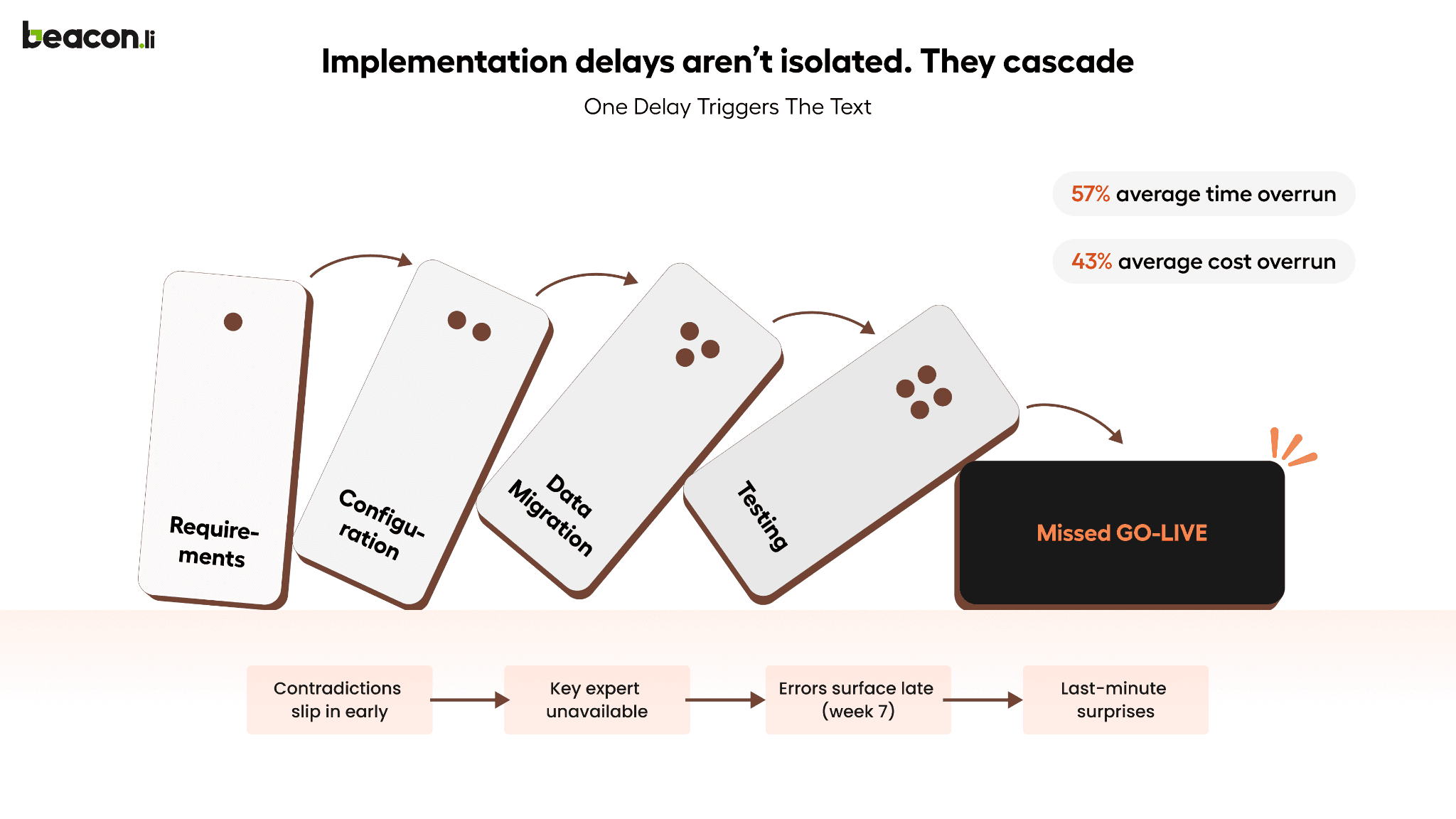
Enterprise SaaS implementations take longer than expected because the execution process is fragmented across multiple phases that don’t connect seamlessly. Requirements, configuration, data migration, and testing are handled in silos, with manual handoffs between teams creating delays, rework, and misalignment. As complexity increases, these gaps compound, turning what should be a structured rollout into a prolonged, unpredictable timeline.
The Gap Between Signed Contract and Go-Live Is Where Revenue Waits
Pull up the ARR report of any mid-to-large SaaS company. You'll see logos, deal values, and contract start dates. What you won't see is how long those deals sat in implementation before the customer reached production.
That gap, the time between closed-won and go-live, is where enterprise SaaS quietly loses money, customer trust, and forecast accuracy all at once. It's the most expensive phase in the entire customer lifecycle and the least instrumented.
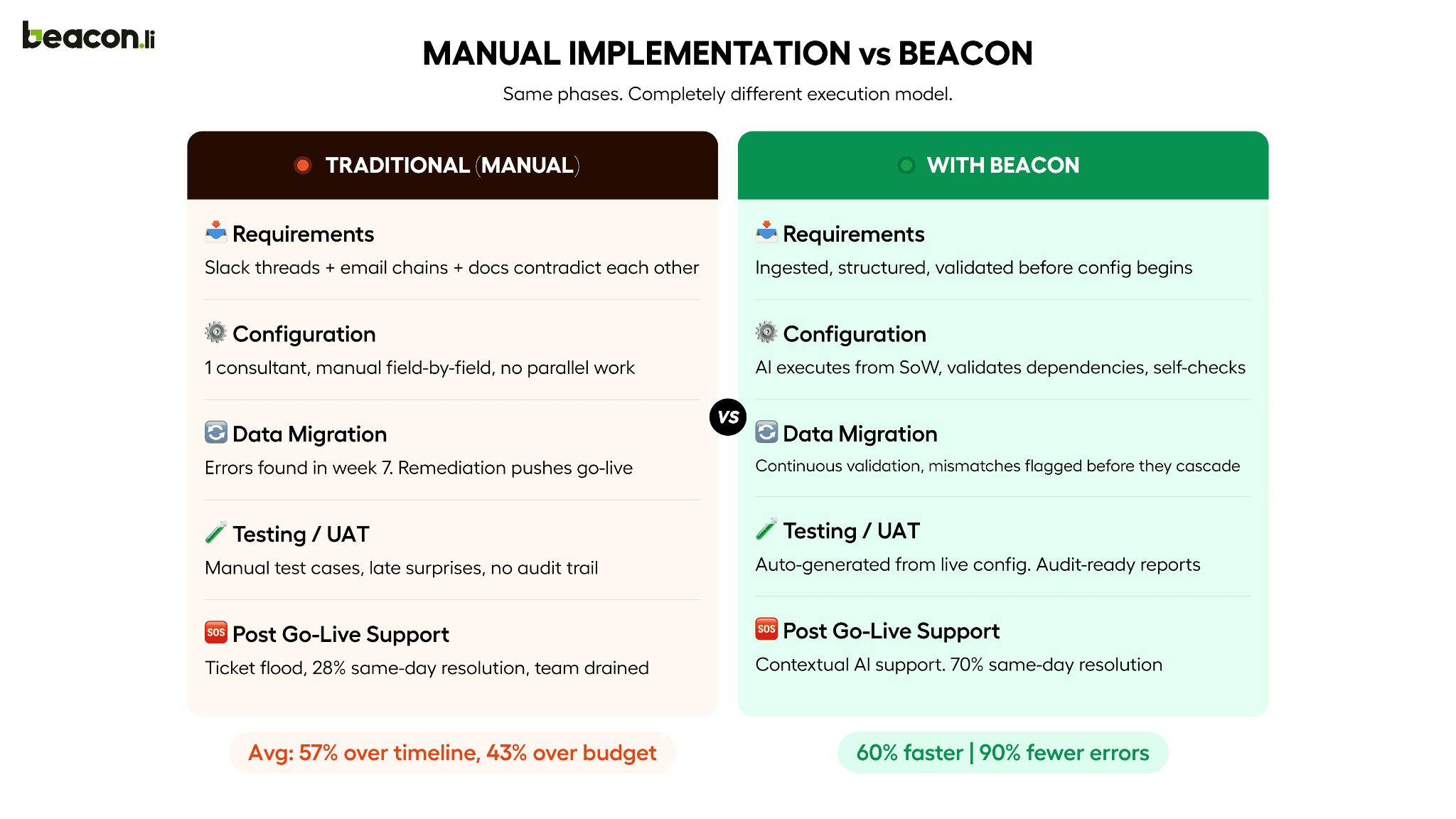
The numbers are striking. In 2024 IDC surveyed 240 enterprises that had implemented SaaS solutions since 2020 and found that 75% faced delays in implementation, with a time overrun of 57% and a cost overrun of 43% on average. These aren't outlier projects. They're the baseline.
For enterprise software specifically: only 49% of companies go live on schedule. 27% experience slight delays. 11% miss the go-live date entirely. The three leading causes are underestimating project staffing (38%), scope expansion (35%), and technical and data issues (34%).
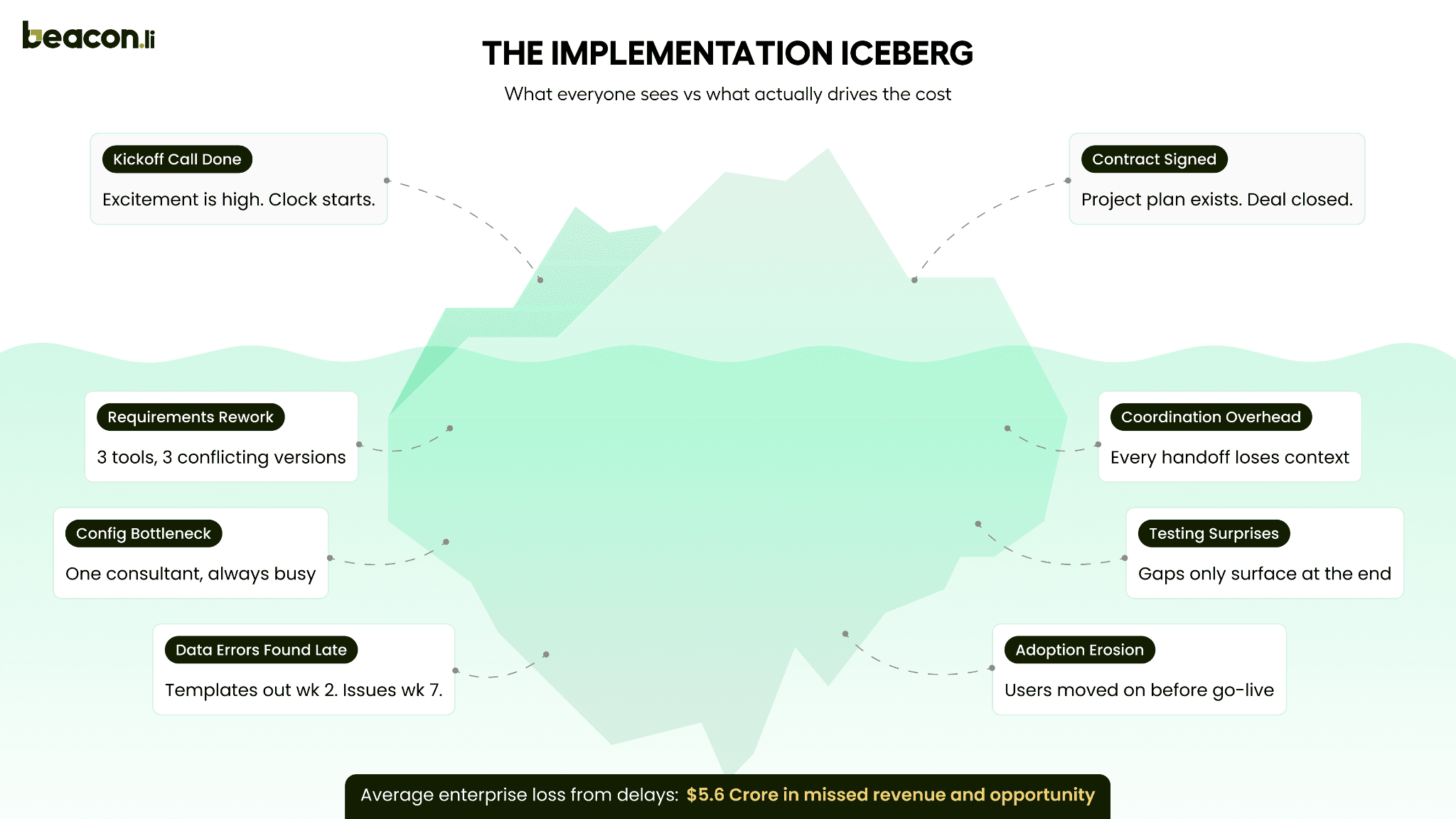
IDC estimated the average loss to an enterprise from SaaS implementation delays at 0.06 million dollars in missed revenue and business opportunities. Not the cost of implementation itself, but the cost of waiting to receive value from software already paid for.
Why SaaS Delivery Infrastructure Hasn't Kept Up With Market Growth
The global SaaS market is projected to grow from $317.55 billion in 2024 to $1.22 trillion by 2032. That growth was built on a services model that scales by headcount. More customers meant more implementation consultants. More consultants meant more variability. More variability meant more delays.
Enterprise SaaS implementation challenges didn't accumulate because teams weren't skilled. They accumulated because the execution model never changed. Every new customer brought a new instance of the same manual process: discovery workshops, requirements documents, configuration by a specialist, data migration scoped too late, testing cycles that surface surprises, and a go-live date that keeps moving to the right.
IT-to-employee ratios have climbed 31% year-over-year to 1 IT person for every 108 full-time employees, the sharpest single-year increase on record. Delivery teams are absorbing more complexity with shrinking bandwidth. The work volume grew. The structural approach to handling it didn't.
What Are the Root Causes of Slow SaaS Deployments?
Slow SaaS deployments are typically caused by a combination of fragmented requirements, dependency on individual expertise for configuration, late discovery of data and integration issues, and coordination overhead across teams. These problems don’t exist in isolation—they reinforce each other, leading to repeated rework, missed timelines, and inefficient execution across the implementation lifecycle.
Requirements Clarification Runs Long And Costs More Than It Should
The first phase of any enterprise SaaS implementation is requirements gathering. In theory: structured workshops, documented outcomes, scope signed off. In practice: Slack threads that contradict the workshop notes, email chains that contradict the Slack threads, and a requirements document that's already outdated by the time configuration begins.
The cause isn't incompetence. It's that requirements live in fragmented tools that don't enforce consistency or flag conflicts. A consultant reads the document, interprets it, and starts configuring. The interpretation gap between what the customer meant and what the consultant built only surfaces at testing, weeks later.
This is a structural enterprise SaaS implementation challenge: the system that holds requirements doesn't connect to the system doing configuration. Translation is manual. Manual means variable. Variable means rework.
Configuration Sits With One Person And That Person Is Always Busy
In most enterprise implementations, configuration knowledge belongs to a specific consultant. They know where the payroll rules live. They know which dependencies to activate first. They know the undocumented sequence that prevents a downstream error.
That knowledge isn't in the platform. It's in the person. Which means delivery capacity is constrained not by headcount in aggregate, but by the availability of the specific person who knows how this product is configured.
When that consultant moves to another project or leaves the company, the next implementation starts from scratch on the same configuration challenges. This is what makes enterprise SaaS implementation problems self-repeating. They don't compound toward faster outcomes. They reset.
Integration and Data Migration Challenges Surface at the Worst Possible Time
Data migration is the phase that most reliably extends SaaS deployment timelines beyond their original estimates. Not because the data is always dirty, though it often is, but because data issues are discovered during migration, not during scoping.
The sequence is predictable: data templates go to the customer in week two. The customer returns them in week six. The implementation team runs validation in week seven and finds structural mismatches, missing fields, and format inconsistencies that require another round of remediation. Go-live moves.
Integration and data migration challenges in SaaS implementations are consistently underestimated for the same reason: they're treated as a data handoff, not a validation problem. The gap between what the customer's source system exports and what the new platform accepts is almost always wider than the scoping conversation assumed.
Project Management Issues Compound Every Delay
Coordination overhead in enterprise software implementations is significant and underreported. Every handoff between implementation phases introduces lag: the configuration consultant hands to the data migration lead who hands to the testing team who waits on the customer's UAT team who escalates back through the vendor's project manager.
Each handoff is a context transfer. And context transfers that rely on status meetings, project management tools, and handoff documentation are slow and lossy. Information degrades. Decisions get re-made. Tasks get duplicated or missed.
Project management issues in enterprise software implementations aren't solved by better project management software. Smarter Gantt charts don't remove the structural gap between knowing what should happen and making it happen. The coordination layer and the execution layer remain separate, and work still flows between them manually.
Change Management and Adoption Problems Start Before Go-Live
Most conversations about change management and adoption in SaaS deployments focus on the post-go-live period, training programs, adoption campaigns, support resources. But the adoption problem starts earlier, during the implementation itself.
A customer that took six months to go live has a very different relationship with the product than one that took eight weeks. The long implementation erodes internal momentum. The champion who fought for the budget is now managing expectations upward. The end users who were excited in Q1 have moved on to other priorities by Q3. When go-live finally arrives, adoption doesn't start from neutral. It starts from exhausted.
What Is the Real Cost of SaaS Implementation Delays?
SaaS implementation delays create both visible and hidden costs for enterprises. While delayed revenue recognition is the most immediate impact, longer timelines also increase delivery costs, reduce customer satisfaction, and elevate churn risk. The longer it takes for a customer to reach value, the more strain it places on both financial performance and long-term retention.
Delayed Revenue Recognition Is the Visible Cost
The most direct financial consequence of SaaS deployment timeline issues is deferred revenue recognition. A contract closed in January that goes live in May represents four months of ARR booked but not realized. That gap shows up in forecast misses, cash flow pressure, and board conversations about whether growth metrics reflect what's actually happening in the business.
Revenue that exists on paper but hasn't reached the customer's production environment is not the same as revenue that's generating value. And value not generated is the precursor to churn.
Churn Risk Builds During Implementation — Before the Product Is Even Used
Enterprise customers with multi-year contracts rarely churn outright because switching costs are too high. But enterprise churn isn't always a cancellation. It's a downgrade. It's a renewal at reduced scope. It's a reference that never materializes. It's an expansion conversation that goes nowhere because the customer never became a confident user of the core product.
The SaaS implementation delays impact on retention is not linear. Customers who experience a long, friction-heavy implementation arrive at their first business review less adopted, less satisfied, and more skeptical of vendor claims. The customer success team then spends renewal cycles recovering lost ground instead of expanding.
Delivery Costs Accumulate While Timelines Extend
For SaaS vendors, implementation delays don't just defer revenue. They actively increase cost to serve. Professional services hours accumulate on stalled projects. Implementation consultants who should have moved to new accounts are still managing exceptions on an overdue deployment. The margin on implementation services, already thin, compresses further.
60% of IT teams report that excessive manual tasks prevent them from focusing on strategic initiatives. Delivery teams face the same constraint: implementation backlogs consume the capacity that should go toward improving implementation.
Why Haven't Existing Tools Solved Enterprise SaaS Implementation Challenges?
Existing tools haven’t solved SaaS implementation challenges because they focus on managing and tracking work rather than executing it. Project management platforms, integration tools, and automation solutions improve visibility and coordination, but they leave the core implementation tasks—configuration, validation, and testing—largely manual. As a result, the fundamental bottleneck remains unchanged: the gap between knowing what needs to be done and actually getting it done at scale.
Project and Integration Tools Track Work — They Don't Do It
The SaaS operations market responded to implementation complexity with more software: PSA tools for project management, integration platforms for system connectivity, digital adoption tools for user navigation, ticketing systems for exception handling.
Nearly 90% of IT professionals say automation is key to managing SaaS operations. 64% report that automation has significantly reduced manual work. But which manual work? Not implementation execution. Automation reduced the overhead of managing implementation. It didn't reduce the work of actually doing it.
The tools that exist are good at storing data, coordinating tasks, and reporting on status. None of them execute. Requirements still need a human to translate into configurations. Environments still need a consultant to set up. Data validation still requires someone to run through it manually. The system knows what should happen. The system does not do it.
RPA and API-Based Automation Break Under Real Conditions
Organizations have attempted to address technical complexity in enterprise SaaS implementation using robotic process automation, integration platforms, and digital adoption tools. Each approach has provided partial value. None has solved the problem end-to-end.
RPA replicates human actions at the interface level but is highly sensitive to change. In dynamic SaaS environments, even minor UI updates break RPA workflows, creating a continuous maintenance burden. Integration platforms depend on vendor APIs that rarely cover the full implementation lifecycle. Configuration, validation, and testing routinely fall outside API coverage, leaving the most time-intensive work still manual.
The automation gap isn't a technology gap. It's a scope gap. Existing automation was built to handle the predictable, repetitive steps at the edges of implementation. The complex, judgment-intensive middle, where most of the time actually goes, was left to humans.
How Is AI Changing Enterprise SaaS Implementation?
AI is beginning to shift SaaS implementation from a manual, consultant-driven process to a more automated and execution-driven model. While earlier tools focused on assisting teams with information and task management, newer approaches use AI to actively execute configuration, validation, and testing steps. This reduces dependency on human bandwidth and addresses the core bottleneck in implementation: execution speed.
Most AI Assists. The Shift Is Toward AI That Executes.
Most AI in enterprise software currently does one of two things: it surfaces information faster, or it generates drafts that a human still reviews and acts on. Both are useful. Neither removes the bottleneck.
The bottleneck in enterprise SaaS implementation is execution. Someone still needs to take the requirement, open the product, configure the field, validate the dependency, run the test, document the outcome, and move to the next item. AI that summarizes or suggests makes the consultant better informed before the work. The work still happens at human speed.
What's structurally changing is the emergence of orchestration layers that enable AI-driven execution, not just AI-assisted planning. The distinction matters: teams define outcomes, and the system determines how to achieve them and carries out the steps. That's a different class of capability than AI that produces a configuration recommendation for a human to then implement.
What Does an AI Orchestration Layer Actually Do?
An AI orchestration layer for enterprise SaaS implementation learns directly from a product's interface, not its APIs or backend, and executes configuration actions the way an experienced implementation consultant would, but with machine consistency and at machine speed.
This matters for SaaS implementation problems and solutions because the traditional approach to automation required deep technical integration before it could do anything. API-based automation needed the vendor to expose endpoints. RPA needed scripted pathways. Both failed when the environment changed.
An orchestration layer that learns from the UI directly can operate across dynamic environments. It works with what the implementation team works with. It doesn't require the product to expose a specific interface. It reads requirements, maps them to configuration actions, cross-checks dependencies, validates outputs, and flags exceptions, the same cognitive sequence a skilled consultant follows, executed without the consultant's bandwidth constraints.
How Does Beacon.li Solve Enterprise SaaS Implementation Problems?
Beacon.li addresses SaaS implementation delays by connecting every phase of the process into a single AI-driven execution layer. Instead of optimizing individual tasks, it automates the full lifecycle from requirements to go-live, ensuring consistency, reducing manual effort, and eliminating bottlenecks. This unified approach enables significantly faster and more predictable implementations.
Beacon.li Connects Every Phase of Implementation Into One Execution Layer
Beacon.li is an AI-powered implementation orchestration platform that automates enterprise SaaS deployments end-to-end, from initial configuration through post-launch hypercare. Where most implementation automation today focuses on speeding up individual tasks, Beacon connects requirements, configuration, testing, data migration, and hypercare into a single, intelligent execution layer.
That integration across phases is the architectural difference. A tool that accelerates configuration but leaves data migration manual has only moved the bottleneck. Beacon operates across the full implementation lifecycle so the constraint doesn't simply relocate. It reduces.
Beacon enables SaaS vendors to deliver implementations over 60% faster while ensuring consistent, audit-ready outcomes across complex, multi-tenant customer environments.
How Does Beacon.li Learn a Product Without API Access?
Beacon's AI learns directly from the product interface, not from APIs, backend access, or extensive documentation. It observes the UI the same way an implementation consultant would, builds a map of configuration logic and workflow dependencies, and executes actions within those learned pathways.
This is significant for enterprise SaaS vendors because it means deployment doesn't require a months-long integration project before Beacon can start doing anything. No backend access means no security review delays. No API dependency means no gaps in automation coverage where manual work re-enters.
Beacon works with any web-based application regardless of customization. The AI learns the specific workflows, custom fields, and processes of each product by observing the interface directly, with no configuration mapping required to get started.
What Results Are Beacon.li Customers Seeing?
The clearest concrete example is Darwinbox, a leading enterprise HCM platform. Leave module configuration required a consultant to manually read policy documents, map extracted rules to UI fields, cross-check dependencies, and validate before anything went live. Hundreds of configuration steps per customer.
With Beacon's orchestration layer, that entire sequence became a self-validating flow. The result was 85% faster implementations on the leave module, with the same approach extending to Attendance and Payroll.
Another customer noted that Beacon made their product meaningfully more self-serve, reducing the burden on implementation teams while giving customers a more guided, autonomous experience. A third is on a path to fully automating Enterprise HCM support through Beacon, with the team already halfway there.
How Does Beacon.li's AI Get Smarter Over Time?
Every implementation that runs through Beacon generates structured data: which configurations were applied, which dependencies were resolved in which order, which exceptions were handled and how. Beacon builds a living map of configuration logic and customer-specific patterns that improves with each deployment.
This compounding effect is what separates an orchestration platform from a task automation tool. A task automation tool does the same thing faster. An orchestration platform that learns means the fiftieth implementation of a product type is structurally faster and more reliable than the first, not because the team got better at following a playbook, but because the system carries the accumulated intelligence of every prior deployment.
This also addresses the knowledge drain that characterizes most enterprise SaaS implementation teams today. The decision that resolved a specific client's data migration conflict, the configuration sequence that prevented a downstream payroll error: these stop living in one consultant's head and start living in the system. When that consultant moves to another project, the knowledge doesn't move with them.
What Happens to Implementation Teams When Beacon.li Handles Execution?
This is the question delivery leaders ask most directly. The answer: their scope narrows to the work that actually requires judgment.
Beacon targets resolving 70–80% of implementation and support issues autonomously, handling configuration execution, FAQ-level questions, workflow errors in real time, and L2/L3 issue diagnosis using logs and product state, with escalation and full context when human judgment is required. Resolution time reduces by 60%.
What remains for the implementation consultant is genuine exception handling, stakeholder management, and decisions that require reading context the system can't capture. The repetitive, expertise-intensive-but-predictable work, configuring fields, validating migration outputs, running test sequences, runs through Beacon. The consultant's bandwidth focuses on what can't be systematized.
What's the Strategic Significance of Owning the Execution Layer?
Owning the execution layer represents a fundamental shift in enterprise software, moving from systems that store and organize data to systems that actually perform work. Historically, value has accrued to platforms that control data, but execution has remained human-driven and non-compounding. By turning execution into software, companies can capture, standardize, and improve how work gets done over time, creating a new source of competitive advantage that scales with every implementation.
Enterprise Software Built Trillion-Dollar Categories by Owning Data. Execution Is Next.
CRM owns customer relationship data. ERP owns financial and operational data. HCM owns workforce data. Each category compounded to hundreds of billions in value because data ownership creates lock-in, and the data gets more valuable as it accumulates.
The execution layer has not been owned by any category. Execution has always been human. It doesn't store, doesn't compound, and leaves the organization when the consultant does. For the first time, an AI orchestration platform can make execution software: something that captures how work is done, improves as it does more of it, and retains that intelligence in a system rather than in people.
By 2026, more than 80% of companies are expected to have deployed AI-enabled apps in their IT environments, up from just 5% in 2023. Almost all of those deployments require implementation. The question of who owns the execution layer is being answered right now, in every implementation backlog and every delayed go-live.
Why "More Tools" Won't Fix the Implementation Problem
53% of enterprises now believe that an integrated development platform and automation features will help reduce delays. That belief is correct. But the key word is "integrated." Adding another tool to an already fragmented implementation stack, one more tracker, one more integration, one more reporting dashboard, doesn't close the gap between knowing what should happen and making it happen.
What closes it is a platform that executes across the full implementation lifecycle, learns from every deployment, and surfaces that learning into each subsequent project. That's not a category that previously existed in enterprise SaaS. Beacon.li is building it.
What Does It Look Like When Implementation Stops Being a Bottleneck?
When implementation stops being a bottleneck, the entire SaaS lifecycle becomes faster, more predictable, and more value-driven. Go-live timelines shrink, revenue is recognized sooner, and customers reach meaningful outcomes earlier in their journey. This shift not only improves operational efficiency but also strengthens retention, expansion, and competitive positioning, turning implementation from a constraint into a strategic differentiator.
Faster Go-Lives, Cleaner Revenue Recognition, Stronger Retention
When enterprise SaaS implementation is orchestrated rather than manually executed, the outcomes change measurably. Go-live dates hold because the process that produces them is consistent, not variable. Revenue that was deferred now recognizes on schedule. The customer who reaches production in eight weeks instead of twenty arrives at their first business review with stronger adoption, higher satisfaction, and more internal credibility for the tool.
The downstream effects on retention are direct. Customers who are faster to value are more likely to expand. Customers who experienced a smooth implementation are more likely to serve as references. The customer success team spends renewal cycles on growth conversations instead of recovery conversations.
Implementation Becomes a Competitive Differentiator
For SaaS vendors, the implementation experience is a product decision. Two vendors with comparable feature sets will lose and win deals based on how long implementation takes and how painful it is. Time-to-value is a sales argument. Predictable delivery is a renewal argument.
Beacon.li enables SaaS vendors to make that argument credibly, because implementation timelines that reduce by 60% aren't a sales claim. They're a measured outcome across deployments. When implementation stops being a liability in the customer relationship and starts being a demonstration of operational competence, it becomes a competitive advantage.
The enterprise SaaS companies that treat the closed-won to go-live gap as a system problem, not a staffing problem, will realize revenue faster, retain customers more reliably, and build execution intelligence that compounds with every new deployment.
The ones that keep treating it as a services problem will keep hiring to manage structural drag. The drag will win.
Summary: Why Enterprise SaaS Implementations Take Too Long (And the Path Forward)
Enterprise SaaS implementations take too long because the execution layer, the actual work of translating requirements into configured, validated, live software, has always been manual. Every tool built around it made the manual work easier to track. None made it unnecessary.
The causes are structural: requirements that don't connect to configuration, configuration knowledge that lives in individuals, data migration challenges surfaced too late, testing cycles that have no automated validation, and change management problems that begin during implementation itself.
The financial consequences are direct: deferred revenue recognition, increased cost to serve, and churn risk that builds before the product is even in use.
Beacon.li addresses this as a system problem. Its AI orchestration platform learns from the product UI directly, executes implementation steps with machine consistency, connects every phase of the implementation lifecycle into a single intelligent layer, and compounds in intelligence with every deployment.
The result: implementations that complete 60%+ faster, go-lives that hold, revenue that recognizes on schedule, and delivery capacity that scales with software rather than headcount.
Interested in seeing what Beacon.li's orchestration layer can do on your product? Beacon sets up on a demo account in 7 days, no integration required, no backend access needed, no risk. Request a Demo Now.
Quick Answer:
To fix SaaS implementation delays, enterprise teams need to stop treating implementation as a series of disconnected steps and start executing it as one continuous process. Most delays come from gaps between requirements, configuration, data migration, and testing, where work is passed manually between teams and tools. Tools like project management platforms, integration tools, and RPA can help streamline specific tasks, but they do not solve the full execution problem and often break in dynamic environments. The fastest teams move implementation onto an AI orchestration platform like Beacon.li, which runs the full lifecycle from requirements to go-live and removes these bottlenecks, reducing timelines by 60% or more.
It is a Tuesday in Q2. A VP of Revenue is presenting the forecast. There are twelve logos on the slide. Six of them have been in implementation for more than four months.
No one raises a hand. No one asks why. The delays have been there long enough that the slide accounts for them. Someone calls it "a timing issue." Someone else calls it "the pipeline maturation cycle." Nobody calls it what it is: $2 million of signed revenue that is not generating value for anyone.
This is how enterprise SaaS loses money. In silences. In the normalized assumption that the gap between closed-won and go-live is just the cost of doing business.
It is not. It is a structural problem that the industry has learned to call acceptable. And it has a fix, but only if you stop treating it as a services problem.
This article breaks down exactly why enterprise SaaS implementations take too long, where the real friction lives, what existing tools consistently get wrong, and why platforms like Beacon.li represent a categorically different approach to the problem.
Why Do Enterprise SaaS Implementations Take So Long?
Enterprise SaaS implementations take longer than expected because the execution process is fragmented across multiple phases that don’t connect seamlessly. Requirements, configuration, data migration, and testing are handled in silos, with manual handoffs between teams creating delays, rework, and misalignment. As complexity increases, these gaps compound, turning what should be a structured rollout into a prolonged, unpredictable timeline.
The Gap Between Signed Contract and Go-Live Is Where Revenue Waits
Pull up the ARR report of any mid-to-large SaaS company. You'll see logos, deal values, and contract start dates. What you won't see is how long those deals sat in implementation before the customer reached production.
That gap, the time between closed-won and go-live, is where enterprise SaaS quietly loses money, customer trust, and forecast accuracy all at once. It's the most expensive phase in the entire customer lifecycle and the least instrumented.
The numbers are striking. In 2024 IDC surveyed 240 enterprises that had implemented SaaS solutions since 2020 and found that 75% faced delays in implementation, with a time overrun of 57% and a cost overrun of 43% on average. These aren't outlier projects. They're the baseline.
For enterprise software specifically: only 49% of companies go live on schedule. 27% experience slight delays. 11% miss the go-live date entirely. The three leading causes are underestimating project staffing (38%), scope expansion (35%), and technical and data issues (34%).
IDC estimated the average loss to an enterprise from SaaS implementation delays at 0.06 million dollars in missed revenue and business opportunities. Not the cost of implementation itself, but the cost of waiting to receive value from software already paid for.
Why SaaS Delivery Infrastructure Hasn't Kept Up With Market Growth
The global SaaS market is projected to grow from $317.55 billion in 2024 to $1.22 trillion by 2032. That growth was built on a services model that scales by headcount. More customers meant more implementation consultants. More consultants meant more variability. More variability meant more delays.
Enterprise SaaS implementation challenges didn't accumulate because teams weren't skilled. They accumulated because the execution model never changed. Every new customer brought a new instance of the same manual process: discovery workshops, requirements documents, configuration by a specialist, data migration scoped too late, testing cycles that surface surprises, and a go-live date that keeps moving to the right.
IT-to-employee ratios have climbed 31% year-over-year to 1 IT person for every 108 full-time employees, the sharpest single-year increase on record. Delivery teams are absorbing more complexity with shrinking bandwidth. The work volume grew. The structural approach to handling it didn't.
What Are the Root Causes of Slow SaaS Deployments?
Slow SaaS deployments are typically caused by a combination of fragmented requirements, dependency on individual expertise for configuration, late discovery of data and integration issues, and coordination overhead across teams. These problems don’t exist in isolation—they reinforce each other, leading to repeated rework, missed timelines, and inefficient execution across the implementation lifecycle.
Requirements Clarification Runs Long And Costs More Than It Should
The first phase of any enterprise SaaS implementation is requirements gathering. In theory: structured workshops, documented outcomes, scope signed off. In practice: Slack threads that contradict the workshop notes, email chains that contradict the Slack threads, and a requirements document that's already outdated by the time configuration begins.
The cause isn't incompetence. It's that requirements live in fragmented tools that don't enforce consistency or flag conflicts. A consultant reads the document, interprets it, and starts configuring. The interpretation gap between what the customer meant and what the consultant built only surfaces at testing, weeks later.
This is a structural enterprise SaaS implementation challenge: the system that holds requirements doesn't connect to the system doing configuration. Translation is manual. Manual means variable. Variable means rework.
Configuration Sits With One Person And That Person Is Always Busy
In most enterprise implementations, configuration knowledge belongs to a specific consultant. They know where the payroll rules live. They know which dependencies to activate first. They know the undocumented sequence that prevents a downstream error.
That knowledge isn't in the platform. It's in the person. Which means delivery capacity is constrained not by headcount in aggregate, but by the availability of the specific person who knows how this product is configured.
When that consultant moves to another project or leaves the company, the next implementation starts from scratch on the same configuration challenges. This is what makes enterprise SaaS implementation problems self-repeating. They don't compound toward faster outcomes. They reset.
Integration and Data Migration Challenges Surface at the Worst Possible Time
Data migration is the phase that most reliably extends SaaS deployment timelines beyond their original estimates. Not because the data is always dirty, though it often is, but because data issues are discovered during migration, not during scoping.
The sequence is predictable: data templates go to the customer in week two. The customer returns them in week six. The implementation team runs validation in week seven and finds structural mismatches, missing fields, and format inconsistencies that require another round of remediation. Go-live moves.
Integration and data migration challenges in SaaS implementations are consistently underestimated for the same reason: they're treated as a data handoff, not a validation problem. The gap between what the customer's source system exports and what the new platform accepts is almost always wider than the scoping conversation assumed.
Project Management Issues Compound Every Delay
Coordination overhead in enterprise software implementations is significant and underreported. Every handoff between implementation phases introduces lag: the configuration consultant hands to the data migration lead who hands to the testing team who waits on the customer's UAT team who escalates back through the vendor's project manager.
Each handoff is a context transfer. And context transfers that rely on status meetings, project management tools, and handoff documentation are slow and lossy. Information degrades. Decisions get re-made. Tasks get duplicated or missed.
Project management issues in enterprise software implementations aren't solved by better project management software. Smarter Gantt charts don't remove the structural gap between knowing what should happen and making it happen. The coordination layer and the execution layer remain separate, and work still flows between them manually.
Change Management and Adoption Problems Start Before Go-Live
Most conversations about change management and adoption in SaaS deployments focus on the post-go-live period, training programs, adoption campaigns, support resources. But the adoption problem starts earlier, during the implementation itself.
A customer that took six months to go live has a very different relationship with the product than one that took eight weeks. The long implementation erodes internal momentum. The champion who fought for the budget is now managing expectations upward. The end users who were excited in Q1 have moved on to other priorities by Q3. When go-live finally arrives, adoption doesn't start from neutral. It starts from exhausted.
What Is the Real Cost of SaaS Implementation Delays?
SaaS implementation delays create both visible and hidden costs for enterprises. While delayed revenue recognition is the most immediate impact, longer timelines also increase delivery costs, reduce customer satisfaction, and elevate churn risk. The longer it takes for a customer to reach value, the more strain it places on both financial performance and long-term retention.
Delayed Revenue Recognition Is the Visible Cost
The most direct financial consequence of SaaS deployment timeline issues is deferred revenue recognition. A contract closed in January that goes live in May represents four months of ARR booked but not realized. That gap shows up in forecast misses, cash flow pressure, and board conversations about whether growth metrics reflect what's actually happening in the business.
Revenue that exists on paper but hasn't reached the customer's production environment is not the same as revenue that's generating value. And value not generated is the precursor to churn.
Churn Risk Builds During Implementation — Before the Product Is Even Used
Enterprise customers with multi-year contracts rarely churn outright because switching costs are too high. But enterprise churn isn't always a cancellation. It's a downgrade. It's a renewal at reduced scope. It's a reference that never materializes. It's an expansion conversation that goes nowhere because the customer never became a confident user of the core product.
The SaaS implementation delays impact on retention is not linear. Customers who experience a long, friction-heavy implementation arrive at their first business review less adopted, less satisfied, and more skeptical of vendor claims. The customer success team then spends renewal cycles recovering lost ground instead of expanding.
Delivery Costs Accumulate While Timelines Extend
For SaaS vendors, implementation delays don't just defer revenue. They actively increase cost to serve. Professional services hours accumulate on stalled projects. Implementation consultants who should have moved to new accounts are still managing exceptions on an overdue deployment. The margin on implementation services, already thin, compresses further.
60% of IT teams report that excessive manual tasks prevent them from focusing on strategic initiatives. Delivery teams face the same constraint: implementation backlogs consume the capacity that should go toward improving implementation.
Why Haven't Existing Tools Solved Enterprise SaaS Implementation Challenges?
Existing tools haven’t solved SaaS implementation challenges because they focus on managing and tracking work rather than executing it. Project management platforms, integration tools, and automation solutions improve visibility and coordination, but they leave the core implementation tasks—configuration, validation, and testing—largely manual. As a result, the fundamental bottleneck remains unchanged: the gap between knowing what needs to be done and actually getting it done at scale.
Project and Integration Tools Track Work — They Don't Do It
The SaaS operations market responded to implementation complexity with more software: PSA tools for project management, integration platforms for system connectivity, digital adoption tools for user navigation, ticketing systems for exception handling.
Nearly 90% of IT professionals say automation is key to managing SaaS operations. 64% report that automation has significantly reduced manual work. But which manual work? Not implementation execution. Automation reduced the overhead of managing implementation. It didn't reduce the work of actually doing it.
The tools that exist are good at storing data, coordinating tasks, and reporting on status. None of them execute. Requirements still need a human to translate into configurations. Environments still need a consultant to set up. Data validation still requires someone to run through it manually. The system knows what should happen. The system does not do it.
RPA and API-Based Automation Break Under Real Conditions
Organizations have attempted to address technical complexity in enterprise SaaS implementation using robotic process automation, integration platforms, and digital adoption tools. Each approach has provided partial value. None has solved the problem end-to-end.
RPA replicates human actions at the interface level but is highly sensitive to change. In dynamic SaaS environments, even minor UI updates break RPA workflows, creating a continuous maintenance burden. Integration platforms depend on vendor APIs that rarely cover the full implementation lifecycle. Configuration, validation, and testing routinely fall outside API coverage, leaving the most time-intensive work still manual.
The automation gap isn't a technology gap. It's a scope gap. Existing automation was built to handle the predictable, repetitive steps at the edges of implementation. The complex, judgment-intensive middle, where most of the time actually goes, was left to humans.
How Is AI Changing Enterprise SaaS Implementation?
AI is beginning to shift SaaS implementation from a manual, consultant-driven process to a more automated and execution-driven model. While earlier tools focused on assisting teams with information and task management, newer approaches use AI to actively execute configuration, validation, and testing steps. This reduces dependency on human bandwidth and addresses the core bottleneck in implementation: execution speed.
Most AI Assists. The Shift Is Toward AI That Executes.
Most AI in enterprise software currently does one of two things: it surfaces information faster, or it generates drafts that a human still reviews and acts on. Both are useful. Neither removes the bottleneck.
The bottleneck in enterprise SaaS implementation is execution. Someone still needs to take the requirement, open the product, configure the field, validate the dependency, run the test, document the outcome, and move to the next item. AI that summarizes or suggests makes the consultant better informed before the work. The work still happens at human speed.
What's structurally changing is the emergence of orchestration layers that enable AI-driven execution, not just AI-assisted planning. The distinction matters: teams define outcomes, and the system determines how to achieve them and carries out the steps. That's a different class of capability than AI that produces a configuration recommendation for a human to then implement.
What Does an AI Orchestration Layer Actually Do?
An AI orchestration layer for enterprise SaaS implementation learns directly from a product's interface, not its APIs or backend, and executes configuration actions the way an experienced implementation consultant would, but with machine consistency and at machine speed.
This matters for SaaS implementation problems and solutions because the traditional approach to automation required deep technical integration before it could do anything. API-based automation needed the vendor to expose endpoints. RPA needed scripted pathways. Both failed when the environment changed.
An orchestration layer that learns from the UI directly can operate across dynamic environments. It works with what the implementation team works with. It doesn't require the product to expose a specific interface. It reads requirements, maps them to configuration actions, cross-checks dependencies, validates outputs, and flags exceptions, the same cognitive sequence a skilled consultant follows, executed without the consultant's bandwidth constraints.
How Does Beacon.li Solve Enterprise SaaS Implementation Problems?
Beacon.li addresses SaaS implementation delays by connecting every phase of the process into a single AI-driven execution layer. Instead of optimizing individual tasks, it automates the full lifecycle from requirements to go-live, ensuring consistency, reducing manual effort, and eliminating bottlenecks. This unified approach enables significantly faster and more predictable implementations.
Beacon.li Connects Every Phase of Implementation Into One Execution Layer
Beacon.li is an AI-powered implementation orchestration platform that automates enterprise SaaS deployments end-to-end, from initial configuration through post-launch hypercare. Where most implementation automation today focuses on speeding up individual tasks, Beacon connects requirements, configuration, testing, data migration, and hypercare into a single, intelligent execution layer.
That integration across phases is the architectural difference. A tool that accelerates configuration but leaves data migration manual has only moved the bottleneck. Beacon operates across the full implementation lifecycle so the constraint doesn't simply relocate. It reduces.
Beacon enables SaaS vendors to deliver implementations over 60% faster while ensuring consistent, audit-ready outcomes across complex, multi-tenant customer environments.
How Does Beacon.li Learn a Product Without API Access?
Beacon's AI learns directly from the product interface, not from APIs, backend access, or extensive documentation. It observes the UI the same way an implementation consultant would, builds a map of configuration logic and workflow dependencies, and executes actions within those learned pathways.
This is significant for enterprise SaaS vendors because it means deployment doesn't require a months-long integration project before Beacon can start doing anything. No backend access means no security review delays. No API dependency means no gaps in automation coverage where manual work re-enters.
Beacon works with any web-based application regardless of customization. The AI learns the specific workflows, custom fields, and processes of each product by observing the interface directly, with no configuration mapping required to get started.
What Results Are Beacon.li Customers Seeing?
The clearest concrete example is Darwinbox, a leading enterprise HCM platform. Leave module configuration required a consultant to manually read policy documents, map extracted rules to UI fields, cross-check dependencies, and validate before anything went live. Hundreds of configuration steps per customer.
With Beacon's orchestration layer, that entire sequence became a self-validating flow. The result was 85% faster implementations on the leave module, with the same approach extending to Attendance and Payroll.
Another customer noted that Beacon made their product meaningfully more self-serve, reducing the burden on implementation teams while giving customers a more guided, autonomous experience. A third is on a path to fully automating Enterprise HCM support through Beacon, with the team already halfway there.
How Does Beacon.li's AI Get Smarter Over Time?
Every implementation that runs through Beacon generates structured data: which configurations were applied, which dependencies were resolved in which order, which exceptions were handled and how. Beacon builds a living map of configuration logic and customer-specific patterns that improves with each deployment.
This compounding effect is what separates an orchestration platform from a task automation tool. A task automation tool does the same thing faster. An orchestration platform that learns means the fiftieth implementation of a product type is structurally faster and more reliable than the first, not because the team got better at following a playbook, but because the system carries the accumulated intelligence of every prior deployment.
This also addresses the knowledge drain that characterizes most enterprise SaaS implementation teams today. The decision that resolved a specific client's data migration conflict, the configuration sequence that prevented a downstream payroll error: these stop living in one consultant's head and start living in the system. When that consultant moves to another project, the knowledge doesn't move with them.
What Happens to Implementation Teams When Beacon.li Handles Execution?
This is the question delivery leaders ask most directly. The answer: their scope narrows to the work that actually requires judgment.
Beacon targets resolving 70–80% of implementation and support issues autonomously, handling configuration execution, FAQ-level questions, workflow errors in real time, and L2/L3 issue diagnosis using logs and product state, with escalation and full context when human judgment is required. Resolution time reduces by 60%.
What remains for the implementation consultant is genuine exception handling, stakeholder management, and decisions that require reading context the system can't capture. The repetitive, expertise-intensive-but-predictable work, configuring fields, validating migration outputs, running test sequences, runs through Beacon. The consultant's bandwidth focuses on what can't be systematized.
What's the Strategic Significance of Owning the Execution Layer?
Owning the execution layer represents a fundamental shift in enterprise software, moving from systems that store and organize data to systems that actually perform work. Historically, value has accrued to platforms that control data, but execution has remained human-driven and non-compounding. By turning execution into software, companies can capture, standardize, and improve how work gets done over time, creating a new source of competitive advantage that scales with every implementation.
Enterprise Software Built Trillion-Dollar Categories by Owning Data. Execution Is Next.
CRM owns customer relationship data. ERP owns financial and operational data. HCM owns workforce data. Each category compounded to hundreds of billions in value because data ownership creates lock-in, and the data gets more valuable as it accumulates.
The execution layer has not been owned by any category. Execution has always been human. It doesn't store, doesn't compound, and leaves the organization when the consultant does. For the first time, an AI orchestration platform can make execution software: something that captures how work is done, improves as it does more of it, and retains that intelligence in a system rather than in people.
By 2026, more than 80% of companies are expected to have deployed AI-enabled apps in their IT environments, up from just 5% in 2023. Almost all of those deployments require implementation. The question of who owns the execution layer is being answered right now, in every implementation backlog and every delayed go-live.
Why "More Tools" Won't Fix the Implementation Problem
53% of enterprises now believe that an integrated development platform and automation features will help reduce delays. That belief is correct. But the key word is "integrated." Adding another tool to an already fragmented implementation stack, one more tracker, one more integration, one more reporting dashboard, doesn't close the gap between knowing what should happen and making it happen.
What closes it is a platform that executes across the full implementation lifecycle, learns from every deployment, and surfaces that learning into each subsequent project. That's not a category that previously existed in enterprise SaaS. Beacon.li is building it.
What Does It Look Like When Implementation Stops Being a Bottleneck?
When implementation stops being a bottleneck, the entire SaaS lifecycle becomes faster, more predictable, and more value-driven. Go-live timelines shrink, revenue is recognized sooner, and customers reach meaningful outcomes earlier in their journey. This shift not only improves operational efficiency but also strengthens retention, expansion, and competitive positioning, turning implementation from a constraint into a strategic differentiator.
Faster Go-Lives, Cleaner Revenue Recognition, Stronger Retention
When enterprise SaaS implementation is orchestrated rather than manually executed, the outcomes change measurably. Go-live dates hold because the process that produces them is consistent, not variable. Revenue that was deferred now recognizes on schedule. The customer who reaches production in eight weeks instead of twenty arrives at their first business review with stronger adoption, higher satisfaction, and more internal credibility for the tool.
The downstream effects on retention are direct. Customers who are faster to value are more likely to expand. Customers who experienced a smooth implementation are more likely to serve as references. The customer success team spends renewal cycles on growth conversations instead of recovery conversations.
Implementation Becomes a Competitive Differentiator
For SaaS vendors, the implementation experience is a product decision. Two vendors with comparable feature sets will lose and win deals based on how long implementation takes and how painful it is. Time-to-value is a sales argument. Predictable delivery is a renewal argument.
Beacon.li enables SaaS vendors to make that argument credibly, because implementation timelines that reduce by 60% aren't a sales claim. They're a measured outcome across deployments. When implementation stops being a liability in the customer relationship and starts being a demonstration of operational competence, it becomes a competitive advantage.
The enterprise SaaS companies that treat the closed-won to go-live gap as a system problem, not a staffing problem, will realize revenue faster, retain customers more reliably, and build execution intelligence that compounds with every new deployment.
The ones that keep treating it as a services problem will keep hiring to manage structural drag. The drag will win.
Summary: Why Enterprise SaaS Implementations Take Too Long (And the Path Forward)
Enterprise SaaS implementations take too long because the execution layer, the actual work of translating requirements into configured, validated, live software, has always been manual. Every tool built around it made the manual work easier to track. None made it unnecessary.
The causes are structural: requirements that don't connect to configuration, configuration knowledge that lives in individuals, data migration challenges surfaced too late, testing cycles that have no automated validation, and change management problems that begin during implementation itself.
The financial consequences are direct: deferred revenue recognition, increased cost to serve, and churn risk that builds before the product is even in use.
Beacon.li addresses this as a system problem. Its AI orchestration platform learns from the product UI directly, executes implementation steps with machine consistency, connects every phase of the implementation lifecycle into a single intelligent layer, and compounds in intelligence with every deployment.
The result: implementations that complete 60%+ faster, go-lives that hold, revenue that recognizes on schedule, and delivery capacity that scales with software rather than headcount.
Interested in seeing what Beacon.li's orchestration layer can do on your product? Beacon sets up on a demo account in 7 days, no integration required, no backend access needed, no risk. Request a Demo Now.







Copyright © 2026 Beacon.li. All rights reserved.
Copyright © 2026 Beacon.li. All rights reserved.
