Meet us at booth #515

Meet us at booth #515
Meet us at booth #515
Meet us at booth #515
Meet us at booth #515
Meet us at booth #515

AI Orchestration
What Is Enterprise AI Orchestration? The Strategic Layer Enterprises Can't Scale Without


Over the past three years, enterprise AI has moved from experimentation to expectation.
What was once considered performative innovation is now a board-level mandate.
What was once a pilot is now expected to be production-grade.
What was once an isolated chatbot is now part of enterprise infrastructure.
In 2026, the conversation inside executive rooms has changed.
The question is no longer:
“Should we adopt AI?”
But rather:
“Why isn’t AI delivering consistent, scalable enterprise value yet?”
The answer is increasingly clear.
The gap is not model capability.
It is Enterprise Orchestration.
The structured coordination of AI systems with enterprise applications, data environments, workflow logic, access controls, governance policies, and human oversight that enables AI to operate safely and predictably at scale.
Why Enterprise AI Strategies Fail at Execution
Most large organizations now have a defined Enterprise AI Strategy. Yet despite strong planning, enterprise AI implementation challenges continue to slow execution and limit production-scale impact.
They typically include:
Portfolio-level AI prioritization
Governance frameworks
Risk and compliance controls
Responsible AI principles
Data modernization initiatives
Cloud and infrastructure alignment
ROI modeling and business case justification
On paper, the strategy is strong.
However, across industries, CIOs and transformation leaders report a consistent pattern: AI initiatives frequently struggle to transition from pilot programs to full-scale production. Implementation timelines extend beyond projections, data dependencies complicate deployment, governance reviews introduce additional checkpoints, and security considerations emerge later than anticipated.
At the same time, accountability between business and IT functions can become diffused, slowing coordinated execution. In many cases, the underlying models perform as expected, yet operational integration lags.
This is where Enterprise AI orchestration becomes decisive in translating strategic intent into scalable, production-ready execution.
Why Does Agentic AI Require Enterprise AI Orchestration?
The acceleration of agentic AI has intensified this challenge.
Enterprises are no longer deploying AI that merely generates text or summarizes documents.
Increasingly, AI systems are embedded directly into enterprise operations, executing workflows, triggering transactions, updating systems, interacting with customers, and shaping operational decisions.
AI is no longer just assisting; it is acting within core business processes, fundamentally changing the requirements for oversight and control.
This shift fundamentally changes enterprise risk posture and introduces new requirements for agentic AI governance across workflows, permissions, and decision accountability.
When AI systems begin to act, the enterprise must answer new questions:
What permissions does AI have?
Who defines its behavioral boundaries?
How are decisions logged and auditable?
How do we monitor drift not just in models, but in operational behavior?
How do we coordinate multiple AI agents across systems?
Now, this is, at its core, an orchestration problem.
Production-scale AI challenges for enterprises in 2026
Recent executive surveys and analyst commentary from sources such as Gartner, S&P, and more converge on a consistent pattern: The real question leaders are asking is no longer whether to adopt AI, but how to scale enterprise AI safely, consistently, and without increasing operational risk.
1. Fragmented AI Development
AI initiatives are often spread across departments such as marketing, finance, operations, and product, with each team experimenting independently. While this can accelerate innovation in pockets, it also leads to duplicated efforts, inconsistent governance standards, and architectures that do not integrate well with one another.
Without coordinated oversight and a shared operating model, enterprises begin to accumulate AI technical debt quickly, making future scaling more complex and costly.
2. Data Governance at Scale
C-suite leaders consistently identify data readiness and governance as primary barriers to scaling AI.
Not because data doesn’t exist, but because:
It lives across fragmented systems
It lacks standardized quality checks
It carries compliance obligations
It cannot be dynamically accessed with proper context controls
Connecting AI systems safely to enterprise data is significantly more complex than model integration alone.
3. Security Surface Expansion
AI systems introduce new entry points for risk.
Shadow AI usage, unsanctioned tools, and agent-based automation create expanded attack surfaces.
Security leaders increasingly recognize that AI governance and compliance in the enterprise must be proactive, embedded, and systemized instead of REACTIVE.
4. Pilot-to-Production Failure
The industry is clearly moving from experimentation to scale, yet that scaling remains uneven.
Pilot deployments often succeed in controlled environments, but production settings introduce far greater complexity. Integration friction emerges across legacy systems, workflows reveal inconsistencies, compliance gaps become visible, performance bottlenecks surface under real usage conditions, and cross-functional alignment is tested.
What works in isolation does not always translate seamlessly into enterprise-wide execution.
As agentic AI becomes embedded inside enterprise AI architectures, enterprise AI orchestration becomes the governing layer that ensures safe autonomy.
Understanding AI Orchestration for Enterprises
This is why AI Orchestration for Large Enterprises is becoming a strategic priority.
Enterprise AI orchestration is not simply chaining models together or routing API calls.
It involves the structured coordination of AI systems with enterprise applications, data environments, workflow logic, access controls, governance policies, monitoring mechanisms, and human oversight.
In effect, it functions as a control plane across the AI lifecycle, ensuring that intelligence operates in alignment with enterprise standards, processes, and risk frameworks.

As AI systems become more autonomous, orchestration becomes less optional and more infrastructural.
In many ways, Enterprise AI orchestration resembles earlier enterprise evolutions:
Cloud requires orchestration to manage infrastructure sprawl.
Identity management required centralized governance.
Observability became mandatory for reliability.
AI now requires its own orchestration discipline.
How Enterprise AI Orchestration Moves From Automation to Systemic Intelligence
The first wave of enterprise AI focused on augmentation: copilots, assistants, productivity gains.
The next wave focuses on coordinated execution.
This shift introduces new architectural priorities:
Policy-as-code enforcement for AI behavior
Centralized logging and traceability
Cross-system workflow mapping
Model-agnostic routing
Performance optimization across cost and latency
Structured human-in-the-loop intervention
Enterprise-grade resilience controls
Orchestration ensures AI operates within enterprise-defined boundaries, not just technological possibility.
Without orchestration, AI remains as fragmented automation.
With orchestration, AI becomes systemic intelligence.
The Economic Case for Enterprise AI Orchestration
For executives, this is not simply an architectural consideration within enterprise AI strategy; it is an economic one.
When orchestration is weak, implementation cycles extend, go-live dates slip, consulting dependency increases, institutional knowledge becomes a bottleneck, compliance reviews multiply, operational risk rises, and revenue recognition is delayed.
In many cases, the cost of execution ultimately exceeds the cost of model access itself. Conversely, when Enterprise AI orchestration matures, implementation effort declines, deployment cycles compress, governance reviews move more efficiently, audit readiness becomes continuous rather than reactive, operational variability decreases, and customer outcomes become more consistent.
In practical terms, orchestration functions as leverage, enabling enterprises to scale AI capabilities without proportionally scaling complexity and risk.
The C-Suite Shift: From Innovation to Infrastructure
In 2024, AI was viewed as an innovation.
In 2025, it will become a transformation.
In 2026, it is increasingly treated as infrastructure.

CIOs are being assigned explicit accountability for AI governance.
Boards are demanding measurable AI returns.
Regulators are formalizing AI compliance expectations.
Security leaders are integrating AI risk into enterprise threat models.
This shift elevates Enterprise AI orchestration from operational concern to strategic necessity.
AI must now meet the same standards as financial systems, ERP platforms, and core infrastructure.
It must be reliable, auditable, secure, scalable, and predictable.
These characteristics do not arise automatically from model capability alone; they are achieved through deliberate orchestration that embeds governance, controls, and operational discipline into how AI systems function within the enterprise.
The New Competitive Advantage
As AI capabilities commoditize and model access becomes widespread, differentiation shifts.
Enterprises will not compete on who has access to the most advanced model.
They will compete on:
Who operationalizes AI fastest
Who governs AI most effectively
Who integrates AI deepest into workflows
Who scales AI without increasing risk
Who converts AI strategy into measurable enterprise performance
This is where Enterprise AI orchestration becomes a strategic moat.
It transforms AI from isolated intelligence into coordinated enterprise capability.
From Vision to Scalable Execution
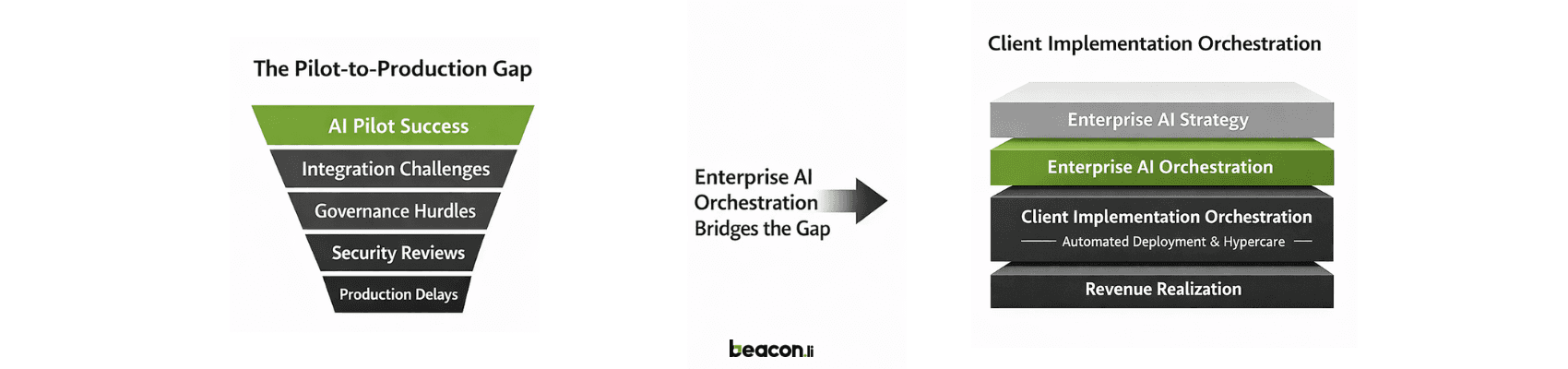
Enterprise AI strategy defines direction, but enterprise AI orchestration ensures that strategy holds up in the real world. It turns intent into systems that operate safely, predictably, and at scale across workflows, data, and governance boundaries.
Yet the real stress test often begins during client implementation. As organizations grow, configuring environments, aligning workflows, validating data, and managing go-live across accounts becomes resource-intensive and difficult to standardize. The product may be enterprise-ready, but the implementation model often isn’t built to scale, slowing revenue and creating delivery variability.
That’s still an orchestration problem.
Beacon addresses this execution layer as an Enterprise AI Implementation Orchestration platform, automating setup, validation, workflow alignment, and hypercare by learning product UI and system logic. The result is faster deployments, reduced delivery effort, and predictable, audit-ready outcomes at scale.
Because in enterprise AI, advantage belongs to those who can implement intelligence with precision — not just build it.
If your deployments are taking longer than expected, Beacon automates the actual work of enterprise AI orchestration for implementations – cutting rollouts from months to weeks, without code or backend integration.
See how Beacon works: https://www.beacon.li/request-a-demo
Over the past three years, enterprise AI has moved from experimentation to expectation.
What was once considered performative innovation is now a board-level mandate.
What was once a pilot is now expected to be production-grade.
What was once an isolated chatbot is now part of enterprise infrastructure.
In 2026, the conversation inside executive rooms has changed.
The question is no longer:
“Should we adopt AI?”
But rather:
“Why isn’t AI delivering consistent, scalable enterprise value yet?”
The answer is increasingly clear.
The gap is not model capability.
It is Enterprise Orchestration.
The structured coordination of AI systems with enterprise applications, data environments, workflow logic, access controls, governance policies, and human oversight that enables AI to operate safely and predictably at scale.
Why Enterprise AI Strategies Fail at Execution
Most large organizations now have a defined Enterprise AI Strategy. Yet despite strong planning, enterprise AI implementation challenges continue to slow execution and limit production-scale impact.
They typically include:
Portfolio-level AI prioritization
Governance frameworks
Risk and compliance controls
Responsible AI principles
Data modernization initiatives
Cloud and infrastructure alignment
ROI modeling and business case justification
On paper, the strategy is strong.
However, across industries, CIOs and transformation leaders report a consistent pattern: AI initiatives frequently struggle to transition from pilot programs to full-scale production. Implementation timelines extend beyond projections, data dependencies complicate deployment, governance reviews introduce additional checkpoints, and security considerations emerge later than anticipated.
At the same time, accountability between business and IT functions can become diffused, slowing coordinated execution. In many cases, the underlying models perform as expected, yet operational integration lags.
This is where Enterprise AI orchestration becomes decisive in translating strategic intent into scalable, production-ready execution.
Why Does Agentic AI Require Enterprise AI Orchestration?
The acceleration of agentic AI has intensified this challenge.
Enterprises are no longer deploying AI that merely generates text or summarizes documents.
Increasingly, AI systems are embedded directly into enterprise operations, executing workflows, triggering transactions, updating systems, interacting with customers, and shaping operational decisions.
AI is no longer just assisting; it is acting within core business processes, fundamentally changing the requirements for oversight and control.
This shift fundamentally changes enterprise risk posture and introduces new requirements for agentic AI governance across workflows, permissions, and decision accountability.
When AI systems begin to act, the enterprise must answer new questions:
What permissions does AI have?
Who defines its behavioral boundaries?
How are decisions logged and auditable?
How do we monitor drift not just in models, but in operational behavior?
How do we coordinate multiple AI agents across systems?
Now, this is, at its core, an orchestration problem.
Production-scale AI challenges for enterprises in 2026
Recent executive surveys and analyst commentary from sources such as Gartner, S&P, and more converge on a consistent pattern: The real question leaders are asking is no longer whether to adopt AI, but how to scale enterprise AI safely, consistently, and without increasing operational risk.
1. Fragmented AI Development
AI initiatives are often spread across departments such as marketing, finance, operations, and product, with each team experimenting independently. While this can accelerate innovation in pockets, it also leads to duplicated efforts, inconsistent governance standards, and architectures that do not integrate well with one another.
Without coordinated oversight and a shared operating model, enterprises begin to accumulate AI technical debt quickly, making future scaling more complex and costly.
2. Data Governance at Scale
C-suite leaders consistently identify data readiness and governance as primary barriers to scaling AI.
Not because data doesn’t exist, but because:
It lives across fragmented systems
It lacks standardized quality checks
It carries compliance obligations
It cannot be dynamically accessed with proper context controls
Connecting AI systems safely to enterprise data is significantly more complex than model integration alone.
3. Security Surface Expansion
AI systems introduce new entry points for risk.
Shadow AI usage, unsanctioned tools, and agent-based automation create expanded attack surfaces.
Security leaders increasingly recognize that AI governance and compliance in the enterprise must be proactive, embedded, and systemized instead of REACTIVE.
4. Pilot-to-Production Failure
The industry is clearly moving from experimentation to scale, yet that scaling remains uneven.
Pilot deployments often succeed in controlled environments, but production settings introduce far greater complexity. Integration friction emerges across legacy systems, workflows reveal inconsistencies, compliance gaps become visible, performance bottlenecks surface under real usage conditions, and cross-functional alignment is tested.
What works in isolation does not always translate seamlessly into enterprise-wide execution.
As agentic AI becomes embedded inside enterprise AI architectures, enterprise AI orchestration becomes the governing layer that ensures safe autonomy.
Understanding AI Orchestration for Enterprises
This is why AI Orchestration for Large Enterprises is becoming a strategic priority.
Enterprise AI orchestration is not simply chaining models together or routing API calls.
It involves the structured coordination of AI systems with enterprise applications, data environments, workflow logic, access controls, governance policies, monitoring mechanisms, and human oversight.
In effect, it functions as a control plane across the AI lifecycle, ensuring that intelligence operates in alignment with enterprise standards, processes, and risk frameworks.
As AI systems become more autonomous, orchestration becomes less optional and more infrastructural.
In many ways, Enterprise AI orchestration resembles earlier enterprise evolutions:
Cloud requires orchestration to manage infrastructure sprawl.
Identity management required centralized governance.
Observability became mandatory for reliability.
AI now requires its own orchestration discipline.
How Enterprise AI Orchestration Moves From Automation to Systemic Intelligence
The first wave of enterprise AI focused on augmentation: copilots, assistants, productivity gains.
The next wave focuses on coordinated execution.
This shift introduces new architectural priorities:
Policy-as-code enforcement for AI behavior
Centralized logging and traceability
Cross-system workflow mapping
Model-agnostic routing
Performance optimization across cost and latency
Structured human-in-the-loop intervention
Enterprise-grade resilience controls
Orchestration ensures AI operates within enterprise-defined boundaries, not just technological possibility.
Without orchestration, AI remains as fragmented automation.
With orchestration, AI becomes systemic intelligence.
The Economic Case for Enterprise AI Orchestration
For executives, this is not simply an architectural consideration within enterprise AI strategy; it is an economic one.
When orchestration is weak, implementation cycles extend, go-live dates slip, consulting dependency increases, institutional knowledge becomes a bottleneck, compliance reviews multiply, operational risk rises, and revenue recognition is delayed.
In many cases, the cost of execution ultimately exceeds the cost of model access itself. Conversely, when Enterprise AI orchestration matures, implementation effort declines, deployment cycles compress, governance reviews move more efficiently, audit readiness becomes continuous rather than reactive, operational variability decreases, and customer outcomes become more consistent.
In practical terms, orchestration functions as leverage, enabling enterprises to scale AI capabilities without proportionally scaling complexity and risk.
The C-Suite Shift: From Innovation to Infrastructure
In 2024, AI was viewed as an innovation.
In 2025, it will become a transformation.
In 2026, it is increasingly treated as infrastructure.
CIOs are being assigned explicit accountability for AI governance.
Boards are demanding measurable AI returns.
Regulators are formalizing AI compliance expectations.
Security leaders are integrating AI risk into enterprise threat models.
This shift elevates Enterprise AI orchestration from operational concern to strategic necessity.
AI must now meet the same standards as financial systems, ERP platforms, and core infrastructure.
It must be reliable, auditable, secure, scalable, and predictable.
These characteristics do not arise automatically from model capability alone; they are achieved through deliberate orchestration that embeds governance, controls, and operational discipline into how AI systems function within the enterprise.
The New Competitive Advantage
As AI capabilities commoditize and model access becomes widespread, differentiation shifts.
Enterprises will not compete on who has access to the most advanced model.
They will compete on:
Who operationalizes AI fastest
Who governs AI most effectively
Who integrates AI deepest into workflows
Who scales AI without increasing risk
Who converts AI strategy into measurable enterprise performance
This is where Enterprise AI orchestration becomes a strategic moat.
It transforms AI from isolated intelligence into coordinated enterprise capability.
From Vision to Scalable Execution
Enterprise AI strategy defines direction, but enterprise AI orchestration ensures that strategy holds up in the real world. It turns intent into systems that operate safely, predictably, and at scale across workflows, data, and governance boundaries.
Yet the real stress test often begins during client implementation. As organizations grow, configuring environments, aligning workflows, validating data, and managing go-live across accounts becomes resource-intensive and difficult to standardize. The product may be enterprise-ready, but the implementation model often isn’t built to scale, slowing revenue and creating delivery variability.
That’s still an orchestration problem.
Beacon addresses this execution layer as an Enterprise AI Implementation Orchestration platform, automating setup, validation, workflow alignment, and hypercare by learning product UI and system logic. The result is faster deployments, reduced delivery effort, and predictable, audit-ready outcomes at scale.
Because in enterprise AI, advantage belongs to those who can implement intelligence with precision — not just build it.
If your deployments are taking longer than expected, Beacon automates the actual work of enterprise AI orchestration for implementations – cutting rollouts from months to weeks, without code or backend integration.
See how Beacon works: https://www.beacon.li/request-a-demo








Copyright © 2026 Beacon.li. All rights reserved.
Copyright © 2026 Beacon.li. All rights reserved.
