Meet us at booth #515

Meet us at booth #515
Meet us at booth #515
Meet us at booth #515
Meet us at booth #515
Meet us at booth #515

Client Implementation
AI Orchestration
How to Accelerate SaaS Customer Onboarding: Best Tools and Strategies for Enterprise Teams


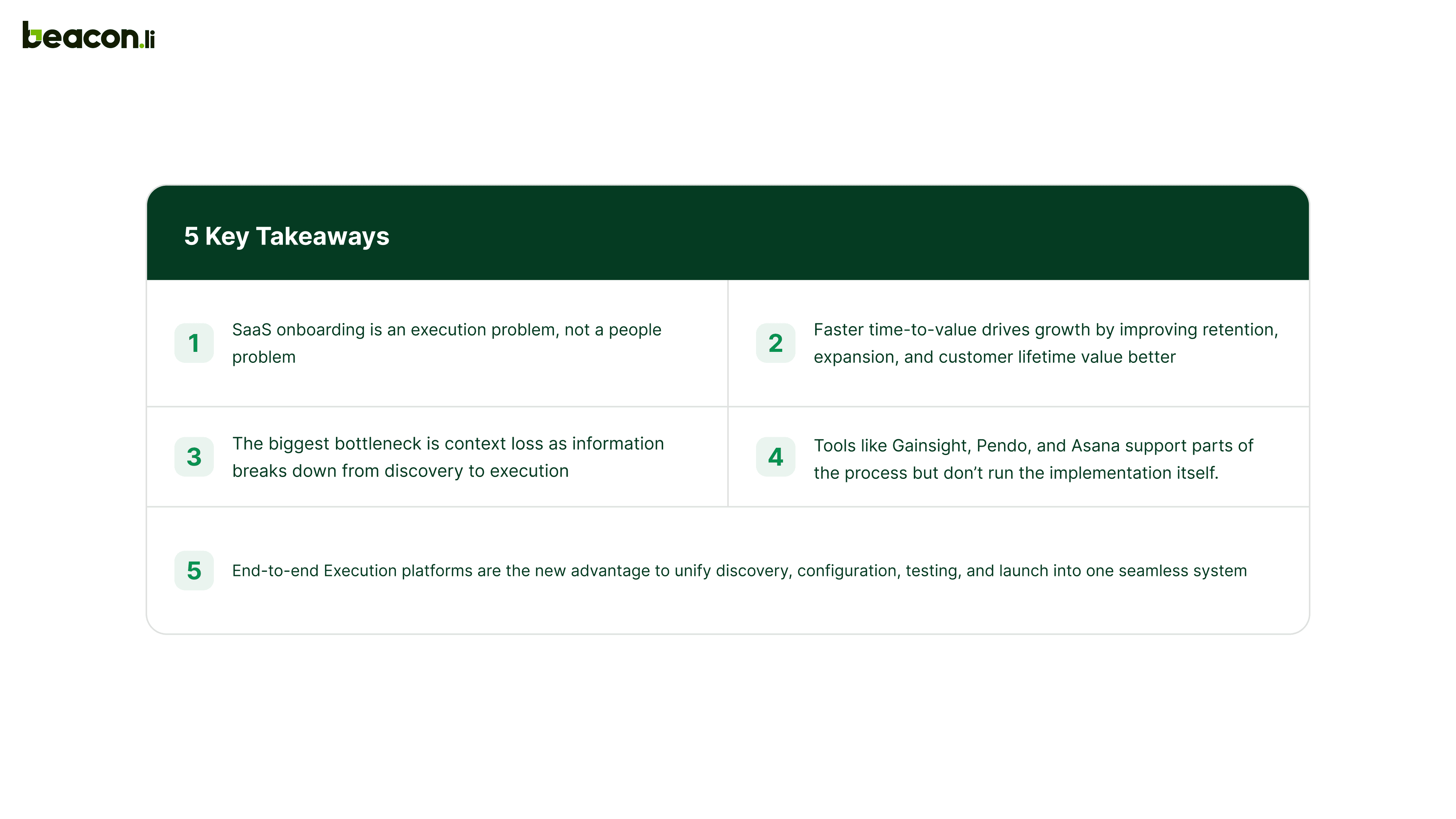
Quick Answer: To accelerate SaaS customer onboarding, enterprise teams need to close the gap between discovery, configuration, and testing, and stop relying on fragmented tool stacks to do it. Supporting tools like customer success platforms (Gainsight, ChurnZero), digital adoption tools (Pendo, WalkMe), and task management (Asana, Jira) each serve a specific function. But the teams moving fastest have shifted their implementation itself onto an end-to-end execution platform, Beacon, that runs the full lifecycle from structured discovery through configuration, testing, cutover, and hypercare, natively, without stitching tools together.
Onboarding a new enterprise customer sounds manageable until you're actually inside it.
The kickoff call goes well. Discovery feels productive. Everyone leaves aligned. And then, somewhere between that first session and go-live, things quietly start to slip. Timelines stretch. Context gets lost between handoffs. The onboarding team finds itself asking questions the sales team already answered three weeks ago, starting the customer relationship on the wrong foot before the real work has even begun.
This isn't a people problem. It's a structural one, and for enterprise SaaS teams, it compounds fast.
US companies lose an average of $136.8 billion per year due to avoidable customer churn, much of which traces directly back to poor onboarding experiences in the first 90 days. The good news is that the problem is solvable. But solving it requires understanding what's actually breaking down and choosing tools and strategies that fix the real bottleneck, not just the visible symptoms.
What Is SaaS Customer Onboarding?
SaaS customer onboarding is the structured process of guiding a new customer from signed contract to first real value. It covers requirements gathering, product configuration, integration setup, team training, testing, and user adoption. In enterprise SaaS, this process typically spans weeks to months and involves multiple stakeholders across departments, each with different needs, different levels of technical involvement, and different definitions of success.
The goal isn't just getting the product live. It's ensuring that what goes live actually matches what the customer needed when they signed, and that their team uses it consistently enough to generate return on their investment.
Why Enterprise SaaS Onboarding Is a Different Problem Than It Looks
Enterprise SaaS onboarding is unique because you're typically selling to someone who will never use the product themselves. The decision-maker is often a VP or C-level executive, while the actual end users are employees two or three levels down. That means you need customized engagement at every level: strategic alignment with the buyer, practical enablement with the users, often running simultaneously.
This creates complexity that smaller implementations simply don't face:
More stakeholders, each with different success metrics
Longer timelines where requirements drift if not tracked carefully
More integrations that surface unexpected constraints mid-project
A much higher cost if something gets misinterpreted between discovery and go-live
An onboarding that takes four weeks with a small business can take over a year with an enterprise. And across that timeline, the thing that determines success isn't the quality of the kickoff deck or the depth of the playbook. It's whether the context captured in week one is still intact and actionable in week eight.
Most of the time, it isn't.
The Three Layers Where Context Dies in Enterprise Onboarding
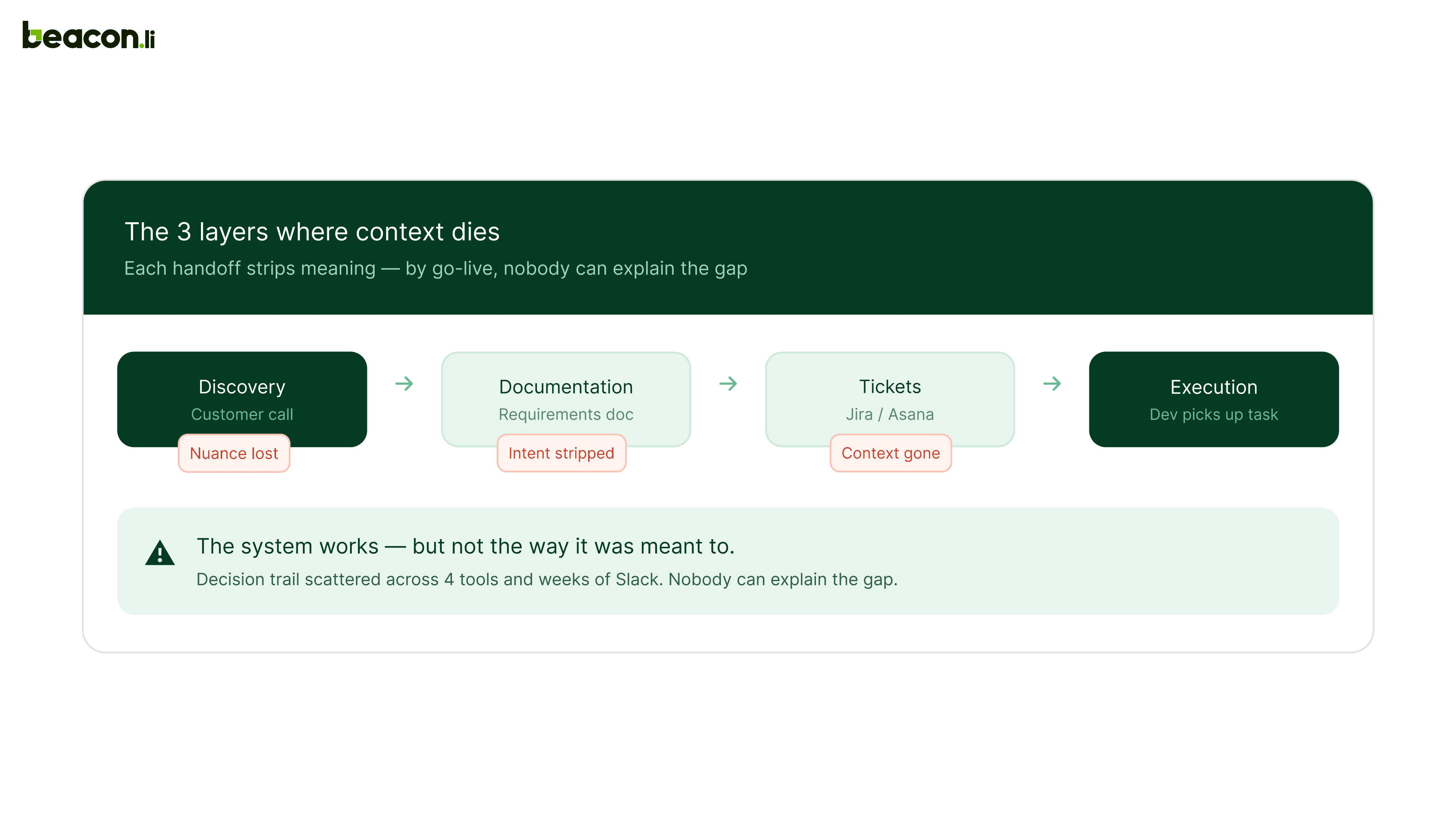
Understanding the enterprise onboarding process failure points is the first step to fixing them. Context doesn't disappear all at once. It erodes at three consistent handoff points:
Discovery to Documentation. A nuance captured on a customer call doesn't survive the translation into a requirements document. The texture of what the customer meant gets flattened into what could be written down.
Documentation to Tickets. A requirement that made sense in a Notion doc gets translated into a Jira task by someone who wasn't on the call. The intent behind the requirement gets reduced to its surface description.
Tickets to Execution. A developer picks up a ticket without reading the doc it came from. The configuration gets built against the task description, not the original requirement.
By go-live, the system works but not always the way it was meant to. Nobody can fully explain the gap because the decision trail is scattered across four different tools and six weeks of messages. Inefficient communication adds significant time and cost from the customer's perspective, lowering satisfaction before the implementation is even complete.
The Real Cost of a Slow SaaS Onboarding Process
Before looking at solutions, it's worth anchoring on why onboarding speed directly affects your bottom line and not just the implementation timeline.
A shocking 90% of customers believe the companies they buy from could do better at onboarding new users. That's not a niche complaint. It's a near-universal signal across enterprise software buyers.
Cutting time-to-value by just 20% lifted ARR growth by 18% for mid-market SaaS companies in a 2024 Amplitude study.
Users who complete onboarding are 80% more likely to become long-term customers and typically show three times higher lifetime value than those who don't.
The probability of selling to an existing customer is 60–70%, compared to 5–20% for new prospects, which makes properly onboarded customers a direct growth lever, not just an implementation concern.
The math is straightforward. Better onboarding means faster revenue recognition, lower churn, and higher expansion potential from accounts already in your portfolio.
What Good Enterprise SaaS Onboarding Actually Requires
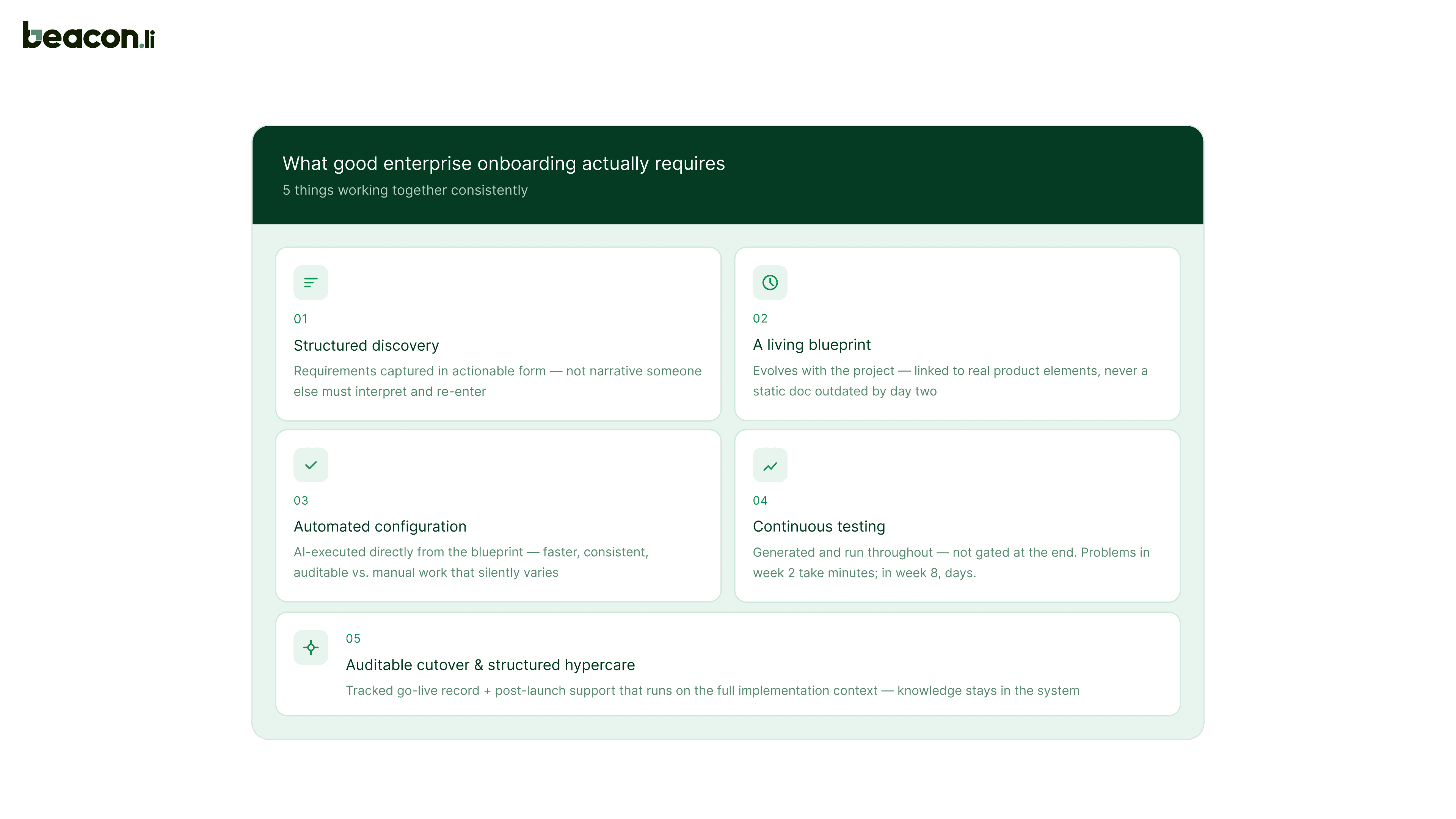
Effective enterprise SaaS onboarding isn't just a better checklist. It requires five things working together consistently:
1. Structured Discovery
Requirements need to be captured in a form that can be acted on directly, not just noted in a document that someone else has to interpret and translate into a project plan. When discovery produces a narrative that someone else has to parse into tasks, you've already introduced a gap between intent and execution.
2. A Living Blueprint
Static requirements documents are accurate the day they're written and increasingly inaccurate every day after that. Enterprise implementations shift as scope changes, priorities move, and integrations reveal unexpected constraints. The document describing what needs to be built has to evolve with the project, not sit still while the project moves past it.
3. Automated Configuration
Manual configuration is where enterprise onboarding most visibly fails the time-to-value test. It's slow, inconsistent across team members, and almost impossible to audit after the fact. Automating onboarding can save time, improve consistency, and allow for personalization at scale, all of which are essentials for a high-quality customer experience.
4. Continuous Testing
Treating testing as a gate at the end of the implementation rather than as a continuous signal throughout it means problems surface late and at high cost. Issues that would take minutes to fix in week two take days to untangle in week eight.
5. Auditable Cutover and Structured Hypercare
Go-live is where the most coordination is required and the least structure typically exists. Without a clear, tracked record of what happened and when, cutover becomes a war room: stressful, opaque, and impossible to learn from. Post-launch support that relies on whoever was in the room during implementation is equally fragile. When that person moves to the next project, institutional knowledge moves with them.
The SaaS Onboarding Tools Enterprise Teams Are Using and Where Each One Stops
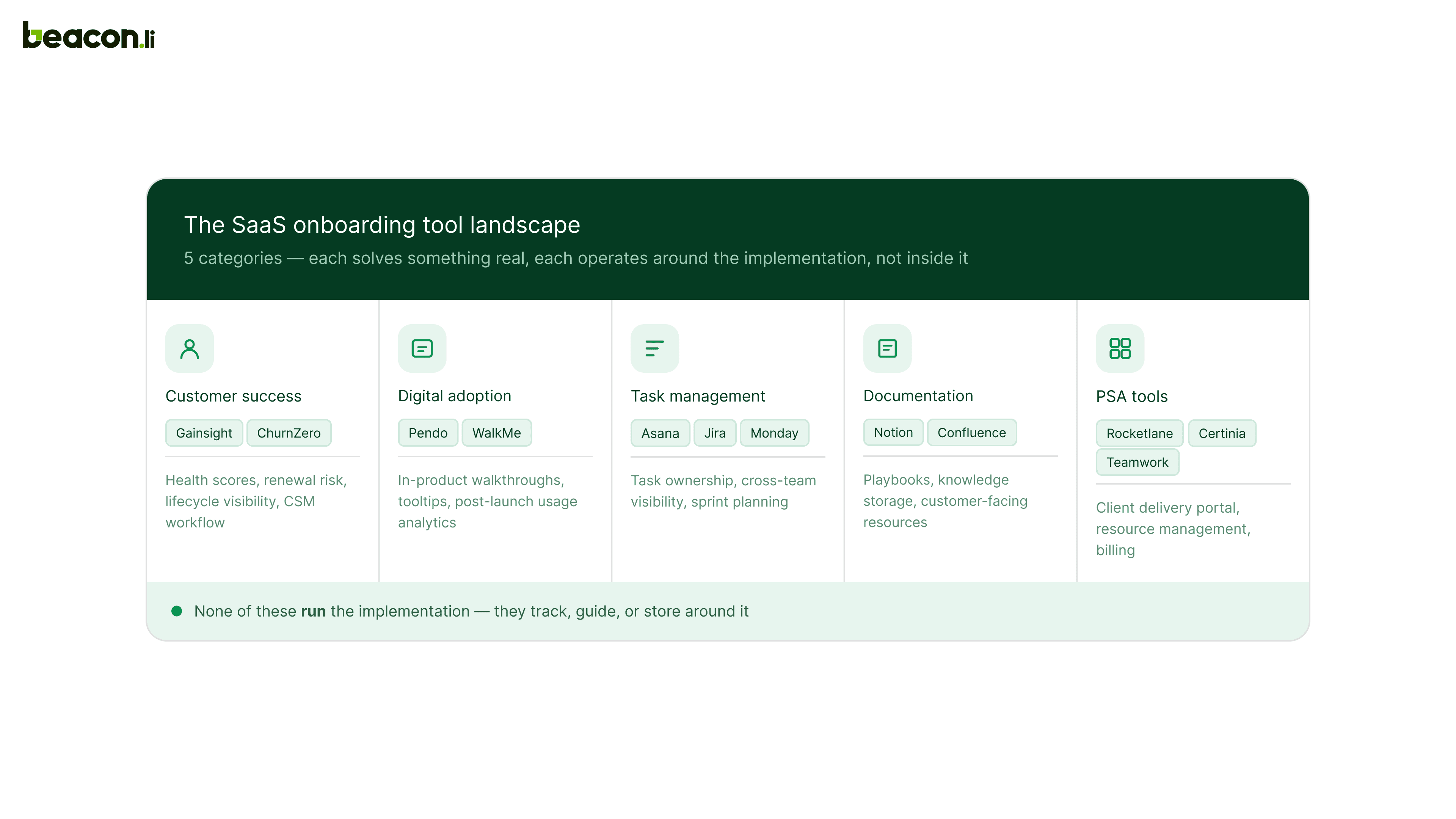
Most enterprise onboarding stacks are assembled from tools across five categories. Each solves something real. The pattern that emerges when you look at them together is that they all operate around the implementation, not inside it.
Customer Success Platforms
Best options: Gainsight, ChurnZero
Customer success platforms are built for lifecycle visibility: health scores, renewal risk, milestone tracking, automated check-ins. They're genuinely useful for surfacing risk signals early and giving CSMs a structured view of the broader relationship across their entire book of business.
What they don't do is execute the implementation. They're observational tools. They tell you what's happening. The work of making it happen still lives somewhere else.
Best for: Early risk detection, renewal forecasting, CSM workflow management
Stops at: Actually running the implementation
Digital Adoption Platforms
Best options: WalkMe, Pendo
These tools sit inside your product and guide users through it with walkthroughs, tooltips, in-app prompts, and contextual guidance. Pendo adds product analytics on top, so you can see where users are getting stuck and adjust your onboarding flows accordingly.
For customer onboarding in SaaS, digital adoption platforms are most valuable in the adoption phase, after the implementation is live and the work becomes getting users to actually use what was built. They're less useful in the earlier stages where the implementation itself is still being configured and validated.
Best for: Post-go-live user adoption, support reduction, usage analytics
Stops at: Implementation execution, which precedes adoption entirely
Project and Task Management
Best options: Asana, Monday.com
These are where most enterprise onboarding teams track the work. Asana works well for customer-facing onboarding plans where visibility across both sides of the project matters. Jira is more natural for technical implementations where engineers are involved and the work gets broken into issues and sprints.
Both tools are good at organizing what needs to happen and who owns it. The limitation is that they track tasks, not decisions. When a requirement changes or an edge case surfaces, the context behind that change lives in a comment thread or a Slack message, not in the ticket itself. Over time, across multiple implementations, that lost context adds up into systemic slowness.
Best for: Task ownership, cross-team coordination, sprint planning
Stops at: Decision traceability and context retention across the project
Collaborative Documentation
Best options: Notion, Confluence
These are where most teams try to solve the documentation problem. Onboarding playbooks live here. Meeting notes get captured here. Implementation guides, configuration decisions, and lessons from previous customers all end up here in theory.
In practice, these tools become graveyards for documents nobody reads after the project closes. The information exists but it isn't connected to anything active. The next team running a similar implementation has to find the document, read through it, figure out what's still relevant, and manually apply whatever they can salvage, which most people don't have time to do when the next kickoff is already on the calendar.
Best for: Knowledge storage, playbook creation, customer-facing documentation
Stops at: Keeping documentation connected to live execution
Professional Services Automation (PSA) Tools
Best options: Rocketlane, Certinia, Teamwork, Scoro
PSA tools are the category most specifically built for client-facing implementation work, and for that reason they're worth treating separately from general project management platforms. Rocketlane in particular has been designed around the SaaS onboarding and implementation use case, with shared project workspaces, customer-facing portals, embedded status tracking, and onboarding-specific templates that general tools like Asana or Jira don't offer out of the box. Certinia (formerly FinancialForce) is more common in larger enterprise services organizations where resource management, revenue recognition, and project delivery need to run inside a single system. Teamwork and Scoro sit in the mid-market space and offer strong project delivery and billing capabilities for services teams running multiple concurrent implementations.
What makes PSA tools valuable is also what defines their ceiling. They manage the delivery of the work with more client-facing structure than a generic task manager, but they still operate as tracking and coordination platforms. The implementation gets logged, scheduled, and reported inside a PSA tool. It doesn't get executed there. Requirements still have to be interpreted and entered manually. Configuration still happens outside the tool. Testing still needs to be coordinated separately. The context that builds up across an enterprise onboarding still has to be manually stitched together rather than captured automatically as the work happens.
For teams running high volumes of implementations with dedicated services operations, a PSA tool is often a meaningful upgrade over spreadsheets and Jira. But it solves the visibility and coordination problem, not the execution problem.
Best for: Client-facing project delivery, services resource management, customer portal visibility, implementation billing
Stops at: Executing the implementation itself, which still requires manual coordination across discovery, configuration, and testing
Where All SaaS Onboarding Tools Fall Short: The Case for End-to-End Execution
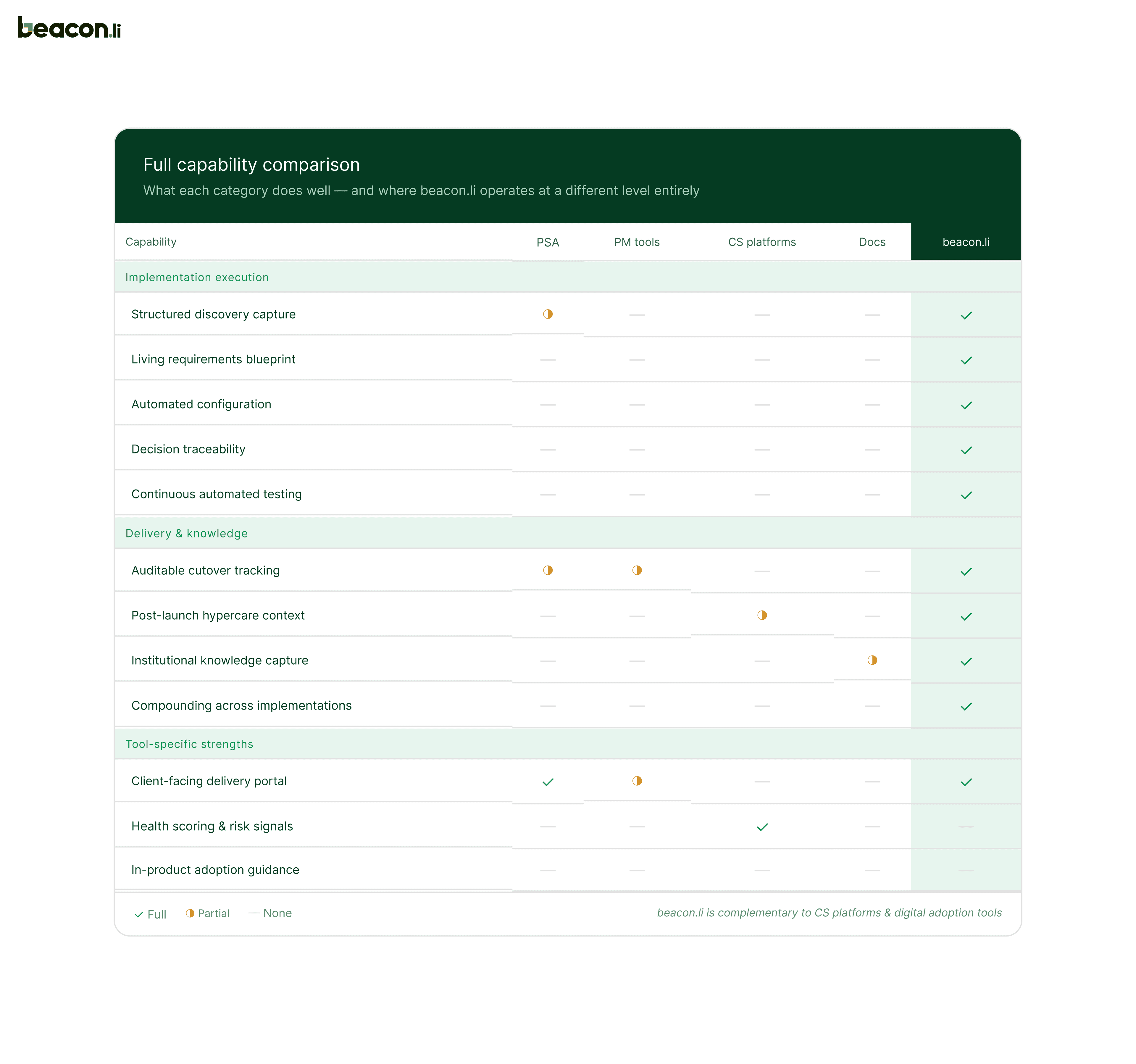
Each of the tools above is genuinely useful within its category. The problem isn't any individual tool. The problem is that the SaaS onboarding process itself, the actual execution of the implementation, doesn't live inside any of them.
A requirement gets captured in a discovery call. Someone puts it in a Notion doc. Someone else translates it into an Asana task. A developer picks up the task without reading the doc. The configuration gets built against the task description, not the original requirement. Three weeks later something doesn't work the way the customer expected, and nobody can immediately explain why, because the decision trail is fragmented across four different tools and two weeks of Slack messages.
This is the structural problem that makes enterprise SaaS onboarding slower and more expensive than it needs to be. Adding another reporting or tracking tool to the stack doesn't fix it, because the problem isn't a missing dashboard. It's that the implementation itself has no home. Discovery, configuration, testing, cutover, and hypercare are happening across disconnected surfaces, and every handoff between them costs context.
The teams accelerating fastest have stopped trying to stitch the fragmented model together and started running the implementation natively, inside a single platform built to execute it from end to end.
The Shift to End-to-End Onboarding Execution
The most significant change in how leading enterprise teams approach SaaS customer onboarding right now isn't a new reporting tool or a better playbook template. It's a recognition that tracking the work is not the same as running it, and that the implementations delivering faster, more consistent results are the ones where execution itself has a dedicated home.
This is where Beacon.li represents a fundamentally different category. It isn't a tool that sits alongside your existing stack and connects the dots between them. It's an end-to-end AI execution platform that runs the full implementation lifecycle natively, from the first discovery session through to post-launch hypercare, without requiring a fragmented collection of tools to function.
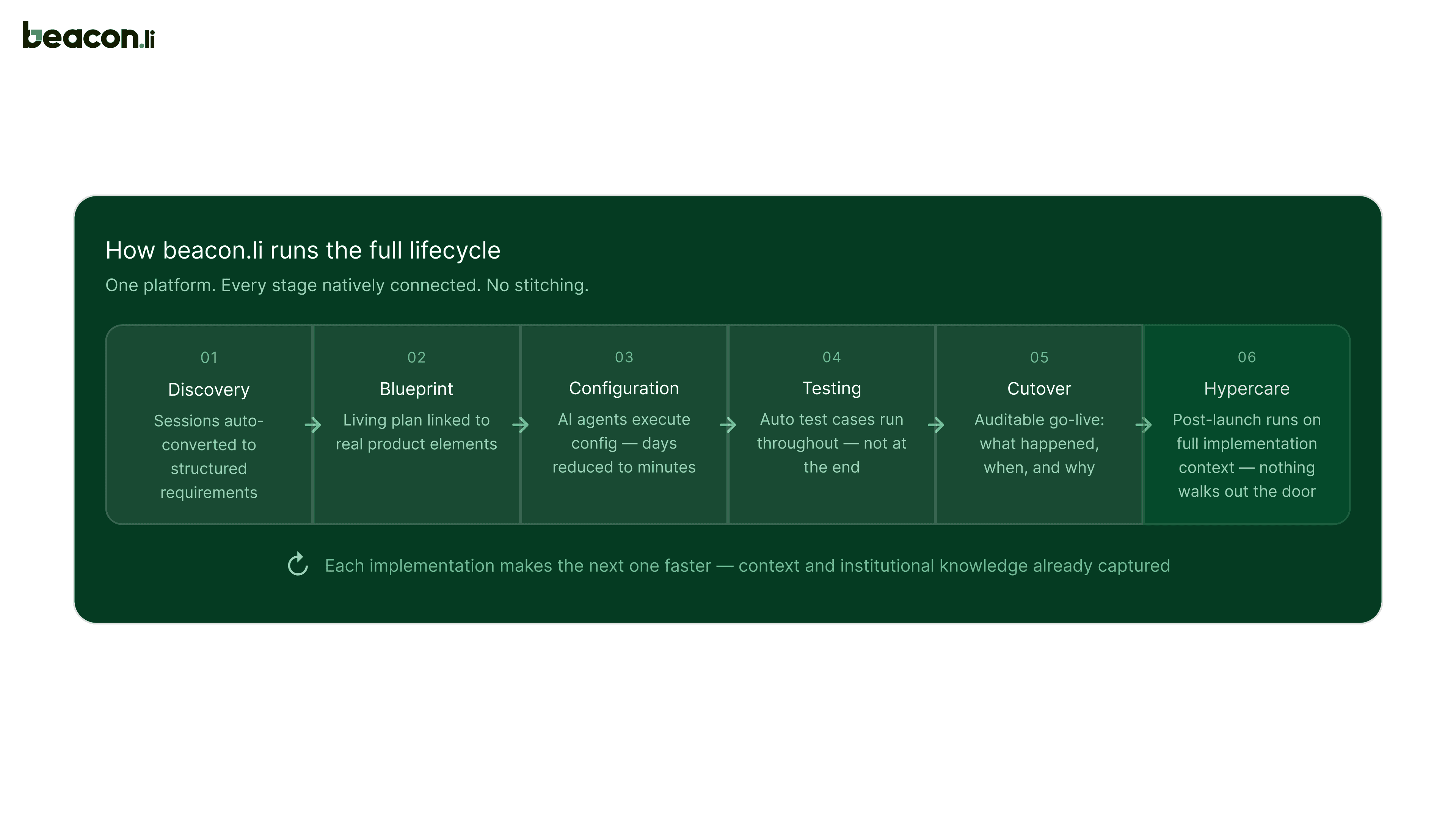
Here's what that looks like across each stage:
Discovery: Sessions are automatically converted into structured, actionable requirements. Nothing gets lost in translation from call to document.
Blueprint: A living implementation blueprint is created and continuously updated, linked directly to real product elements. It evolves as the project evolves, rather than becoming outdated the moment scope shifts.
Configuration: AI agents execute configuration work directly from the blueprint, reducing work that used to take days to minutes, with full traceability back to the requirements that drove each decision.
Testing: Test cases are automatically generated and run throughout the implementation, not as a gate at the end. Failures surface in plain language, early, when they're cheap to fix.
Cutover: Go-live is tracked and auditable, with a clear record of what happened, when, and why, rather than a stressful undocumented war room.
Hypercare: Post-launch support runs on the full context of everything that happened during the implementation. Knowledge stays in the system rather than walking out the door when the project team moves on.
For teams that want to keep using Asana, Jira, or other project management tools for task visibility, Beacon.li can sit above them and feed structured outputs downstream without disrupting existing workflows. But it doesn't depend on them. The execution happens inside Beacon.li, not across a patchwork of integrations.
For enterprise teams running multiple implementations simultaneously, the compounding effect of this model matters as much as any individual efficiency gain. Each implementation makes the next one faster, not because the work gets simpler, but because the context, decisions, and institutional knowledge are already captured and ready to build on.
How to Optimize the SaaS Onboarding Process: 8 Best Practices That Hold at Scale
Whether you're evaluating new tools or building on your existing stack, these SaaS onboarding best practices consistently produce better outcomes for enterprise teams.
1. Invest Heavily in the Sales-to-Implementation Handoff
Getting customer success involved before the deal closes isn't just about building rapport. It ensures the implementation team understands what was actually promised before they're responsible for delivering it. The gap between what sales commits and what implementation inherits is one of the most common and most avoidable sources of early friction. Teams using Beacon.li close this gap structurally: the requirements captured during discovery flow directly into the implementation blueprint, so nothing gets reinterpreted at handoff.
2. Measure Time-to-Value, Not Just Completion Rate
Time-to-value (TTV) tracks the time from when a new customer starts onboarding to when they begin seeing genuine, measurable benefit from the product. The sooner customers realize value, the stronger the retention signal, and the clearer the signal that you're optimizing the right thing. Automated configuration and continuous testing, both core to how Beacon.li runs implementations, are the two highest-leverage drivers of faster TTV in enterprise onboarding.
3. Build for Repeatability from the Start
Creating a scalable, repeatable SaaS onboarding process is the foundation for exceeding expectations consistently. Bespoke implementations rebuilt from scratch every time are expensive to run and almost impossible to improve systematically. You can't optimize what you can't measure, and you can't measure what never repeats. Every implementation run through Beacon.li leaves behind a full record of decisions, configurations, and outcomes that the next team can build on directly.
4. Keep Requirements Connected to What's Being Built
If discovery produces a document that nobody reads before writing tickets, and tickets are filled by engineers who haven't spoken to the customer, requirements will drift. The best enterprise onboarding processes keep a direct, traceable link from what the customer said they needed to what got configured, so when something is questioned, there's a clear trail. This traceability is built into how Beacon.li runs the execution: every configuration decision links back to the requirement that drove it.
5. Test Continuously, Not Just at Go-Live
End-of-project testing gates exist because testing was expensive when it required full team coordination. Modern implementations don't have that constraint. Continuous testing against the requirements that drove the configuration surfaces problems when they're cheap to fix, not when they're expensive to untangle. Beacon.li generates and runs test cases automatically throughout the implementation, making continuous testing a default rather than a deliberate effort.
6. Treat Hypercare as Part of the Implementation, Not an Afterthought
Post-launch is where retention is either secured or lost. Teams that carry the same level of structure and context from the implementation phase into hypercare consistently outperform those that treat go-live as the finish line. The implementation didn't end. It just shifted into a different mode. Because Beacon.li preserves the full implementation context, post-launch support teams have immediate visibility into what was built, why, and what edge cases were already handled.
7. Capture What Actually Happens, Not Just What Was Planned
The most useful thing a completed implementation can leave behind is an accurate record of real decisions, real edge cases, and real lessons, not a polished retrospective describing how the project should have gone. That's what compounds into faster, better onboarding over time.
8. Make Your Onboarding Playbooks Live Documents
Onboarding playbooks in SaaS fail when they describe an ideal implementation written once and never updated. Real enterprise onboarding is messier. Playbooks that don't evolve to capture actual decisions and lessons from live implementations stop reflecting reality quickly, and teams that rely on them scale a version of onboarding that no longer matches what actually happens.
The Ideal Enterprise SaaS Onboarding Tech Stack
Understanding where each tool fits and what it genuinely doesn't do is how enterprise teams build a stack that actually scales.
Each of these does its job well within its lane. Gainsight and ChurnZero surface risk signals before they become churn conversations. Pendo and WalkMe reduce the support burden once the product is live. Asana and Jira keep task ownership clear across large teams. Notion and Confluence store the knowledge that needs to be shared widely. PSA tools like Rocketlane add a client-facing delivery layer with more structure than a generic project manager, which is genuinely useful for services teams running multiple concurrent implementations.
“What none of them do is run the implementation!”
That's a separate problem, and it requires a separate kind of platform.
Beacon.li operates at a different level entirely. It's an end-to-end AI execution platform for SaaS implementation and onboarding. Rather than tracking tasks or storing documents, it runs the full implementation lifecycle natively: structured discovery, living blueprint, automated configuration, continuous testing, auditable cutover, and context-rich hypercare, all inside a single platform.
If your team uses Asana or Jira for task visibility, Beacon.li can sit above those tools and feed outputs to them. But the execution, the part that actually determines whether your implementation finishes on time, matches requirements, and leaves institutional knowledge behind, happens inside Beacon.li, not across a collection of tools hoping the context survives each handoff.
FAQs: SaaS Customer Onboarding Tools and Strategy
1. What does SaaS customer onboarding include?
SaaS customer onboarding is the process of guiding a new customer from signed contract to first real value. It covers requirements gathering, product configuration, integration setup, team training, testing, and user adoption. In enterprise SaaS, this typically spans weeks to months, involves multiple stakeholders across departments, and requires coordinating both technical and change management work in parallel.
2. How is enterprise SaaS onboarding different from onboarding a small business?
Enterprise SaaS onboarding involves far more stakeholders, longer implementation timelines, more complex integrations, and a much higher cost when requirements are misinterpreted. A mismatch that would be a minor fix in a small implementation can become a significant remediation project at the enterprise level, which is why execution infrastructure and context retention matter so much more at scale.
3. What metrics should you track to improve your SaaS onboarding process?
The most important metrics for SaaS onboarding process improvement are time-to-value (how quickly customers see genuine benefit), activation rate (the percentage completing key setup milestones), feature adoption rate (whether users are engaging with the core product), and context retention across handoffs (how consistently outcomes match original requirements). Completion rates alone don't tell you whether the implementation actually delivered what the customer needed.
4. What should customer onboarding software actually do for enterprise teams?
Customer onboarding software broadly refers to any tool that supports the process of getting a new customer from signed contract to active, successful use of a product. The category includes customer success platforms for health tracking, digital adoption tools for in-product guidance, project management tools for task coordination, PSA tools like Rocketlane or Certinia for client-facing delivery management, and documentation platforms for knowledge storage. But the most important and most often missing piece is an execution platform that actually runs the implementation itself. The right question to ask of any tool in this category isn't just what it tracks, but what it executes.
5. What is the difference between onboarding orchestration and project management?
End-to-end onboarding orchestration means the entire SaaS implementation and onboarding lifecycle, covering discovery, blueprint, configuration, testing, cutover, and hypercare, runs inside a single execution platform rather than across a fragmented collection of tools. Project management tools like Asana or Jira track what needs to happen and who owns it. An end-to-end execution platform like Beacon.li actually runs the implementation: converting discovery into structured requirements, executing configuration from a living blueprint, generating and running tests, and preserving full institutional knowledge when the project closes. The distinction isn't about integration. It's about where the work itself lives.
6. Why do SaaS onboarding playbooks break down at scale?
Static onboarding playbooks in SaaS describe what should happen in an ideal implementation. When your organization doesn't have a streamlined process, the story told by sales or implementation teams reflects best-case scenarios rather than realistic ones. Playbooks that don't evolve to capture real decisions, edge cases, and lessons from live implementations stop reflecting reality quickly. The teams that scale well treat their playbooks as living systems fed by real execution data, not documents written once and maintained by optimism.
7. How do you speed up SaaS customer onboarding without losing quality?
Speed in enterprise onboarding process optimization comes from reducing the cost of context transfer, not from cutting steps. When discovery connects directly to configuration, when decisions are traceable back to the requirements that drove them, and when each implementation feeds institutional knowledge into the next one, the work gets faster because the foundation is already there. The teams accelerating onboarding fastest aren't running harder. They're running in a system that compounds.
8. What does effective hypercare look like after a SaaS implementation?
Good hypercare is a continuation of the implementation, not a departure from it. It means post-launch support teams have full visibility into what was built, why specific decisions were made, and what edge cases were handled during the implementation. When that context lives in a system rather than in the memory of whoever ran the project, hypercare becomes genuinely proactive rather than reactive, and the transition to steady-state support happens without knowledge loss.
9. How do you know if your enterprise onboarding process is actually working?
Beyond completion rates and go-live dates, effective measurement of enterprise SaaS onboarding includes how consistently outcomes match original requirements (requirement-to-delivery fidelity), how much time is spent re-answering questions already covered in earlier stages (context loss indicator), how quickly each successive implementation closes compared to the previous one (compounding efficiency), and how many post-launch issues trace back to misinterpreted requirements (upstream quality signal).
10. What is the most common reason enterprise SaaS onboarding fails?
The most common and costly failure mode in customer onboarding in SaaS at the enterprise level is treating implementation as something that happens across tools rather than inside a platform built to run it. Discovery in one place, configuration in another, testing in a third, institutional knowledge in a fourth, and nothing that actually executes the work end to end. Every handoff in that model costs context. Over time, that context loss is what makes enterprise onboarding slower, more inconsistent, and harder to scale than it needs to be. The fix isn't tighter integrations between those tools. It's running the implementation itself inside a platform that owns the full lifecycle.
Ready to see what end-to-end onboarding execution looks like in practice? Explore how Beacon.li runs the full SaaS implementation lifecycle, from discovery to hypercare, natively, without the fragmentation.
Quick Answer: To accelerate SaaS customer onboarding, enterprise teams need to close the gap between discovery, configuration, and testing, and stop relying on fragmented tool stacks to do it. Supporting tools like customer success platforms (Gainsight, ChurnZero), digital adoption tools (Pendo, WalkMe), and task management (Asana, Jira) each serve a specific function. But the teams moving fastest have shifted their implementation itself onto an end-to-end execution platform, Beacon, that runs the full lifecycle from structured discovery through configuration, testing, cutover, and hypercare, natively, without stitching tools together.
Onboarding a new enterprise customer sounds manageable until you're actually inside it.
The kickoff call goes well. Discovery feels productive. Everyone leaves aligned. And then, somewhere between that first session and go-live, things quietly start to slip. Timelines stretch. Context gets lost between handoffs. The onboarding team finds itself asking questions the sales team already answered three weeks ago, starting the customer relationship on the wrong foot before the real work has even begun.
This isn't a people problem. It's a structural one, and for enterprise SaaS teams, it compounds fast.
US companies lose an average of $136.8 billion per year due to avoidable customer churn, much of which traces directly back to poor onboarding experiences in the first 90 days. The good news is that the problem is solvable. But solving it requires understanding what's actually breaking down and choosing tools and strategies that fix the real bottleneck, not just the visible symptoms.
What Is SaaS Customer Onboarding?
SaaS customer onboarding is the structured process of guiding a new customer from signed contract to first real value. It covers requirements gathering, product configuration, integration setup, team training, testing, and user adoption. In enterprise SaaS, this process typically spans weeks to months and involves multiple stakeholders across departments, each with different needs, different levels of technical involvement, and different definitions of success.
The goal isn't just getting the product live. It's ensuring that what goes live actually matches what the customer needed when they signed, and that their team uses it consistently enough to generate return on their investment.
Why Enterprise SaaS Onboarding Is a Different Problem Than It Looks
Enterprise SaaS onboarding is unique because you're typically selling to someone who will never use the product themselves. The decision-maker is often a VP or C-level executive, while the actual end users are employees two or three levels down. That means you need customized engagement at every level: strategic alignment with the buyer, practical enablement with the users, often running simultaneously.
This creates complexity that smaller implementations simply don't face:
More stakeholders, each with different success metrics
Longer timelines where requirements drift if not tracked carefully
More integrations that surface unexpected constraints mid-project
A much higher cost if something gets misinterpreted between discovery and go-live
An onboarding that takes four weeks with a small business can take over a year with an enterprise. And across that timeline, the thing that determines success isn't the quality of the kickoff deck or the depth of the playbook. It's whether the context captured in week one is still intact and actionable in week eight.
Most of the time, it isn't.
The Three Layers Where Context Dies in Enterprise Onboarding
Understanding the enterprise onboarding process failure points is the first step to fixing them. Context doesn't disappear all at once. It erodes at three consistent handoff points:
Discovery to Documentation. A nuance captured on a customer call doesn't survive the translation into a requirements document. The texture of what the customer meant gets flattened into what could be written down.
Documentation to Tickets. A requirement that made sense in a Notion doc gets translated into a Jira task by someone who wasn't on the call. The intent behind the requirement gets reduced to its surface description.
Tickets to Execution. A developer picks up a ticket without reading the doc it came from. The configuration gets built against the task description, not the original requirement.
By go-live, the system works but not always the way it was meant to. Nobody can fully explain the gap because the decision trail is scattered across four different tools and six weeks of messages. Inefficient communication adds significant time and cost from the customer's perspective, lowering satisfaction before the implementation is even complete.
The Real Cost of a Slow SaaS Onboarding Process
Before looking at solutions, it's worth anchoring on why onboarding speed directly affects your bottom line and not just the implementation timeline.
A shocking 90% of customers believe the companies they buy from could do better at onboarding new users. That's not a niche complaint. It's a near-universal signal across enterprise software buyers.
Cutting time-to-value by just 20% lifted ARR growth by 18% for mid-market SaaS companies in a 2024 Amplitude study.
Users who complete onboarding are 80% more likely to become long-term customers and typically show three times higher lifetime value than those who don't.
The probability of selling to an existing customer is 60–70%, compared to 5–20% for new prospects, which makes properly onboarded customers a direct growth lever, not just an implementation concern.
The math is straightforward. Better onboarding means faster revenue recognition, lower churn, and higher expansion potential from accounts already in your portfolio.
What Good Enterprise SaaS Onboarding Actually Requires
Effective enterprise SaaS onboarding isn't just a better checklist. It requires five things working together consistently:
1. Structured Discovery
Requirements need to be captured in a form that can be acted on directly, not just noted in a document that someone else has to interpret and translate into a project plan. When discovery produces a narrative that someone else has to parse into tasks, you've already introduced a gap between intent and execution.
2. A Living Blueprint
Static requirements documents are accurate the day they're written and increasingly inaccurate every day after that. Enterprise implementations shift as scope changes, priorities move, and integrations reveal unexpected constraints. The document describing what needs to be built has to evolve with the project, not sit still while the project moves past it.
3. Automated Configuration
Manual configuration is where enterprise onboarding most visibly fails the time-to-value test. It's slow, inconsistent across team members, and almost impossible to audit after the fact. Automating onboarding can save time, improve consistency, and allow for personalization at scale, all of which are essentials for a high-quality customer experience.
4. Continuous Testing
Treating testing as a gate at the end of the implementation rather than as a continuous signal throughout it means problems surface late and at high cost. Issues that would take minutes to fix in week two take days to untangle in week eight.
5. Auditable Cutover and Structured Hypercare
Go-live is where the most coordination is required and the least structure typically exists. Without a clear, tracked record of what happened and when, cutover becomes a war room: stressful, opaque, and impossible to learn from. Post-launch support that relies on whoever was in the room during implementation is equally fragile. When that person moves to the next project, institutional knowledge moves with them.
The SaaS Onboarding Tools Enterprise Teams Are Using and Where Each One Stops
Most enterprise onboarding stacks are assembled from tools across five categories. Each solves something real. The pattern that emerges when you look at them together is that they all operate around the implementation, not inside it.
Customer Success Platforms
Best options: Gainsight, ChurnZero
Customer success platforms are built for lifecycle visibility: health scores, renewal risk, milestone tracking, automated check-ins. They're genuinely useful for surfacing risk signals early and giving CSMs a structured view of the broader relationship across their entire book of business.
What they don't do is execute the implementation. They're observational tools. They tell you what's happening. The work of making it happen still lives somewhere else.
Best for: Early risk detection, renewal forecasting, CSM workflow management
Stops at: Actually running the implementation
Digital Adoption Platforms
Best options: WalkMe, Pendo
These tools sit inside your product and guide users through it with walkthroughs, tooltips, in-app prompts, and contextual guidance. Pendo adds product analytics on top, so you can see where users are getting stuck and adjust your onboarding flows accordingly.
For customer onboarding in SaaS, digital adoption platforms are most valuable in the adoption phase, after the implementation is live and the work becomes getting users to actually use what was built. They're less useful in the earlier stages where the implementation itself is still being configured and validated.
Best for: Post-go-live user adoption, support reduction, usage analytics
Stops at: Implementation execution, which precedes adoption entirely
Project and Task Management
Best options: Asana, Monday.com
These are where most enterprise onboarding teams track the work. Asana works well for customer-facing onboarding plans where visibility across both sides of the project matters. Jira is more natural for technical implementations where engineers are involved and the work gets broken into issues and sprints.
Both tools are good at organizing what needs to happen and who owns it. The limitation is that they track tasks, not decisions. When a requirement changes or an edge case surfaces, the context behind that change lives in a comment thread or a Slack message, not in the ticket itself. Over time, across multiple implementations, that lost context adds up into systemic slowness.
Best for: Task ownership, cross-team coordination, sprint planning
Stops at: Decision traceability and context retention across the project
Collaborative Documentation
Best options: Notion, Confluence
These are where most teams try to solve the documentation problem. Onboarding playbooks live here. Meeting notes get captured here. Implementation guides, configuration decisions, and lessons from previous customers all end up here in theory.
In practice, these tools become graveyards for documents nobody reads after the project closes. The information exists but it isn't connected to anything active. The next team running a similar implementation has to find the document, read through it, figure out what's still relevant, and manually apply whatever they can salvage, which most people don't have time to do when the next kickoff is already on the calendar.
Best for: Knowledge storage, playbook creation, customer-facing documentation
Stops at: Keeping documentation connected to live execution
Professional Services Automation (PSA) Tools
Best options: Rocketlane, Certinia, Teamwork, Scoro
PSA tools are the category most specifically built for client-facing implementation work, and for that reason they're worth treating separately from general project management platforms. Rocketlane in particular has been designed around the SaaS onboarding and implementation use case, with shared project workspaces, customer-facing portals, embedded status tracking, and onboarding-specific templates that general tools like Asana or Jira don't offer out of the box. Certinia (formerly FinancialForce) is more common in larger enterprise services organizations where resource management, revenue recognition, and project delivery need to run inside a single system. Teamwork and Scoro sit in the mid-market space and offer strong project delivery and billing capabilities for services teams running multiple concurrent implementations.
What makes PSA tools valuable is also what defines their ceiling. They manage the delivery of the work with more client-facing structure than a generic task manager, but they still operate as tracking and coordination platforms. The implementation gets logged, scheduled, and reported inside a PSA tool. It doesn't get executed there. Requirements still have to be interpreted and entered manually. Configuration still happens outside the tool. Testing still needs to be coordinated separately. The context that builds up across an enterprise onboarding still has to be manually stitched together rather than captured automatically as the work happens.
For teams running high volumes of implementations with dedicated services operations, a PSA tool is often a meaningful upgrade over spreadsheets and Jira. But it solves the visibility and coordination problem, not the execution problem.
Best for: Client-facing project delivery, services resource management, customer portal visibility, implementation billing
Stops at: Executing the implementation itself, which still requires manual coordination across discovery, configuration, and testing
Where All SaaS Onboarding Tools Fall Short: The Case for End-to-End Execution
Each of the tools above is genuinely useful within its category. The problem isn't any individual tool. The problem is that the SaaS onboarding process itself, the actual execution of the implementation, doesn't live inside any of them.
A requirement gets captured in a discovery call. Someone puts it in a Notion doc. Someone else translates it into an Asana task. A developer picks up the task without reading the doc. The configuration gets built against the task description, not the original requirement. Three weeks later something doesn't work the way the customer expected, and nobody can immediately explain why, because the decision trail is fragmented across four different tools and two weeks of Slack messages.
This is the structural problem that makes enterprise SaaS onboarding slower and more expensive than it needs to be. Adding another reporting or tracking tool to the stack doesn't fix it, because the problem isn't a missing dashboard. It's that the implementation itself has no home. Discovery, configuration, testing, cutover, and hypercare are happening across disconnected surfaces, and every handoff between them costs context.
The teams accelerating fastest have stopped trying to stitch the fragmented model together and started running the implementation natively, inside a single platform built to execute it from end to end.
The Shift to End-to-End Onboarding Execution
The most significant change in how leading enterprise teams approach SaaS customer onboarding right now isn't a new reporting tool or a better playbook template. It's a recognition that tracking the work is not the same as running it, and that the implementations delivering faster, more consistent results are the ones where execution itself has a dedicated home.
This is where Beacon.li represents a fundamentally different category. It isn't a tool that sits alongside your existing stack and connects the dots between them. It's an end-to-end AI execution platform that runs the full implementation lifecycle natively, from the first discovery session through to post-launch hypercare, without requiring a fragmented collection of tools to function.
Here's what that looks like across each stage:
Discovery: Sessions are automatically converted into structured, actionable requirements. Nothing gets lost in translation from call to document.
Blueprint: A living implementation blueprint is created and continuously updated, linked directly to real product elements. It evolves as the project evolves, rather than becoming outdated the moment scope shifts.
Configuration: AI agents execute configuration work directly from the blueprint, reducing work that used to take days to minutes, with full traceability back to the requirements that drove each decision.
Testing: Test cases are automatically generated and run throughout the implementation, not as a gate at the end. Failures surface in plain language, early, when they're cheap to fix.
Cutover: Go-live is tracked and auditable, with a clear record of what happened, when, and why, rather than a stressful undocumented war room.
Hypercare: Post-launch support runs on the full context of everything that happened during the implementation. Knowledge stays in the system rather than walking out the door when the project team moves on.
For teams that want to keep using Asana, Jira, or other project management tools for task visibility, Beacon.li can sit above them and feed structured outputs downstream without disrupting existing workflows. But it doesn't depend on them. The execution happens inside Beacon.li, not across a patchwork of integrations.
For enterprise teams running multiple implementations simultaneously, the compounding effect of this model matters as much as any individual efficiency gain. Each implementation makes the next one faster, not because the work gets simpler, but because the context, decisions, and institutional knowledge are already captured and ready to build on.
How to Optimize the SaaS Onboarding Process: 8 Best Practices That Hold at Scale
Whether you're evaluating new tools or building on your existing stack, these SaaS onboarding best practices consistently produce better outcomes for enterprise teams.
1. Invest Heavily in the Sales-to-Implementation Handoff
Getting customer success involved before the deal closes isn't just about building rapport. It ensures the implementation team understands what was actually promised before they're responsible for delivering it. The gap between what sales commits and what implementation inherits is one of the most common and most avoidable sources of early friction. Teams using Beacon.li close this gap structurally: the requirements captured during discovery flow directly into the implementation blueprint, so nothing gets reinterpreted at handoff.
2. Measure Time-to-Value, Not Just Completion Rate
Time-to-value (TTV) tracks the time from when a new customer starts onboarding to when they begin seeing genuine, measurable benefit from the product. The sooner customers realize value, the stronger the retention signal, and the clearer the signal that you're optimizing the right thing. Automated configuration and continuous testing, both core to how Beacon.li runs implementations, are the two highest-leverage drivers of faster TTV in enterprise onboarding.
3. Build for Repeatability from the Start
Creating a scalable, repeatable SaaS onboarding process is the foundation for exceeding expectations consistently. Bespoke implementations rebuilt from scratch every time are expensive to run and almost impossible to improve systematically. You can't optimize what you can't measure, and you can't measure what never repeats. Every implementation run through Beacon.li leaves behind a full record of decisions, configurations, and outcomes that the next team can build on directly.
4. Keep Requirements Connected to What's Being Built
If discovery produces a document that nobody reads before writing tickets, and tickets are filled by engineers who haven't spoken to the customer, requirements will drift. The best enterprise onboarding processes keep a direct, traceable link from what the customer said they needed to what got configured, so when something is questioned, there's a clear trail. This traceability is built into how Beacon.li runs the execution: every configuration decision links back to the requirement that drove it.
5. Test Continuously, Not Just at Go-Live
End-of-project testing gates exist because testing was expensive when it required full team coordination. Modern implementations don't have that constraint. Continuous testing against the requirements that drove the configuration surfaces problems when they're cheap to fix, not when they're expensive to untangle. Beacon.li generates and runs test cases automatically throughout the implementation, making continuous testing a default rather than a deliberate effort.
6. Treat Hypercare as Part of the Implementation, Not an Afterthought
Post-launch is where retention is either secured or lost. Teams that carry the same level of structure and context from the implementation phase into hypercare consistently outperform those that treat go-live as the finish line. The implementation didn't end. It just shifted into a different mode. Because Beacon.li preserves the full implementation context, post-launch support teams have immediate visibility into what was built, why, and what edge cases were already handled.
7. Capture What Actually Happens, Not Just What Was Planned
The most useful thing a completed implementation can leave behind is an accurate record of real decisions, real edge cases, and real lessons, not a polished retrospective describing how the project should have gone. That's what compounds into faster, better onboarding over time.
8. Make Your Onboarding Playbooks Live Documents
Onboarding playbooks in SaaS fail when they describe an ideal implementation written once and never updated. Real enterprise onboarding is messier. Playbooks that don't evolve to capture actual decisions and lessons from live implementations stop reflecting reality quickly, and teams that rely on them scale a version of onboarding that no longer matches what actually happens.
The Ideal Enterprise SaaS Onboarding Tech Stack
Understanding where each tool fits and what it genuinely doesn't do is how enterprise teams build a stack that actually scales.
Each of these does its job well within its lane. Gainsight and ChurnZero surface risk signals before they become churn conversations. Pendo and WalkMe reduce the support burden once the product is live. Asana and Jira keep task ownership clear across large teams. Notion and Confluence store the knowledge that needs to be shared widely. PSA tools like Rocketlane add a client-facing delivery layer with more structure than a generic project manager, which is genuinely useful for services teams running multiple concurrent implementations.
“What none of them do is run the implementation!”
That's a separate problem, and it requires a separate kind of platform.
Beacon.li operates at a different level entirely. It's an end-to-end AI execution platform for SaaS implementation and onboarding. Rather than tracking tasks or storing documents, it runs the full implementation lifecycle natively: structured discovery, living blueprint, automated configuration, continuous testing, auditable cutover, and context-rich hypercare, all inside a single platform.
If your team uses Asana or Jira for task visibility, Beacon.li can sit above those tools and feed outputs to them. But the execution, the part that actually determines whether your implementation finishes on time, matches requirements, and leaves institutional knowledge behind, happens inside Beacon.li, not across a collection of tools hoping the context survives each handoff.
FAQs: SaaS Customer Onboarding Tools and Strategy
1. What does SaaS customer onboarding include?
SaaS customer onboarding is the process of guiding a new customer from signed contract to first real value. It covers requirements gathering, product configuration, integration setup, team training, testing, and user adoption. In enterprise SaaS, this typically spans weeks to months, involves multiple stakeholders across departments, and requires coordinating both technical and change management work in parallel.
2. How is enterprise SaaS onboarding different from onboarding a small business?
Enterprise SaaS onboarding involves far more stakeholders, longer implementation timelines, more complex integrations, and a much higher cost when requirements are misinterpreted. A mismatch that would be a minor fix in a small implementation can become a significant remediation project at the enterprise level, which is why execution infrastructure and context retention matter so much more at scale.
3. What metrics should you track to improve your SaaS onboarding process?
The most important metrics for SaaS onboarding process improvement are time-to-value (how quickly customers see genuine benefit), activation rate (the percentage completing key setup milestones), feature adoption rate (whether users are engaging with the core product), and context retention across handoffs (how consistently outcomes match original requirements). Completion rates alone don't tell you whether the implementation actually delivered what the customer needed.
4. What should customer onboarding software actually do for enterprise teams?
Customer onboarding software broadly refers to any tool that supports the process of getting a new customer from signed contract to active, successful use of a product. The category includes customer success platforms for health tracking, digital adoption tools for in-product guidance, project management tools for task coordination, PSA tools like Rocketlane or Certinia for client-facing delivery management, and documentation platforms for knowledge storage. But the most important and most often missing piece is an execution platform that actually runs the implementation itself. The right question to ask of any tool in this category isn't just what it tracks, but what it executes.
5. What is the difference between onboarding orchestration and project management?
End-to-end onboarding orchestration means the entire SaaS implementation and onboarding lifecycle, covering discovery, blueprint, configuration, testing, cutover, and hypercare, runs inside a single execution platform rather than across a fragmented collection of tools. Project management tools like Asana or Jira track what needs to happen and who owns it. An end-to-end execution platform like Beacon.li actually runs the implementation: converting discovery into structured requirements, executing configuration from a living blueprint, generating and running tests, and preserving full institutional knowledge when the project closes. The distinction isn't about integration. It's about where the work itself lives.
6. Why do SaaS onboarding playbooks break down at scale?
Static onboarding playbooks in SaaS describe what should happen in an ideal implementation. When your organization doesn't have a streamlined process, the story told by sales or implementation teams reflects best-case scenarios rather than realistic ones. Playbooks that don't evolve to capture real decisions, edge cases, and lessons from live implementations stop reflecting reality quickly. The teams that scale well treat their playbooks as living systems fed by real execution data, not documents written once and maintained by optimism.
7. How do you speed up SaaS customer onboarding without losing quality?
Speed in enterprise onboarding process optimization comes from reducing the cost of context transfer, not from cutting steps. When discovery connects directly to configuration, when decisions are traceable back to the requirements that drove them, and when each implementation feeds institutional knowledge into the next one, the work gets faster because the foundation is already there. The teams accelerating onboarding fastest aren't running harder. They're running in a system that compounds.
8. What does effective hypercare look like after a SaaS implementation?
Good hypercare is a continuation of the implementation, not a departure from it. It means post-launch support teams have full visibility into what was built, why specific decisions were made, and what edge cases were handled during the implementation. When that context lives in a system rather than in the memory of whoever ran the project, hypercare becomes genuinely proactive rather than reactive, and the transition to steady-state support happens without knowledge loss.
9. How do you know if your enterprise onboarding process is actually working?
Beyond completion rates and go-live dates, effective measurement of enterprise SaaS onboarding includes how consistently outcomes match original requirements (requirement-to-delivery fidelity), how much time is spent re-answering questions already covered in earlier stages (context loss indicator), how quickly each successive implementation closes compared to the previous one (compounding efficiency), and how many post-launch issues trace back to misinterpreted requirements (upstream quality signal).
10. What is the most common reason enterprise SaaS onboarding fails?
The most common and costly failure mode in customer onboarding in SaaS at the enterprise level is treating implementation as something that happens across tools rather than inside a platform built to run it. Discovery in one place, configuration in another, testing in a third, institutional knowledge in a fourth, and nothing that actually executes the work end to end. Every handoff in that model costs context. Over time, that context loss is what makes enterprise onboarding slower, more inconsistent, and harder to scale than it needs to be. The fix isn't tighter integrations between those tools. It's running the implementation itself inside a platform that owns the full lifecycle.
Ready to see what end-to-end onboarding execution looks like in practice? Explore how Beacon.li runs the full SaaS implementation lifecycle, from discovery to hypercare, natively, without the fragmentation.







Copyright © 2026 Beacon.li. All rights reserved.
Copyright © 2026 Beacon.li. All rights reserved.
