
How to Scale Professional Services Teams in Enterprise SaaS Without Proportional Hiring


A practical guide for PS leaders in enterprise SaaS who are ready to break the headcount trap.
Enterprise SaaS professional services teams don’t fail to scale because of a lack of hiring—they fail because the delivery model doesn’t evolve with growth. As customer volume increases, expert bottlenecks, inconsistent delivery, and rising operational complexity begin to limit throughput.
This guide breaks down how leading SaaS companies scale professional services without proportional headcount growth. By productizing delivery, automating repeatable work, building tiered team structures, and shifting expert focus to high-value tasks, organizations can increase capacity, improve margins, and deliver more consistent outcomes.
Why Enterprise SaaS Professional Services Teams Struggle to Scale
Scaling professional services in enterprise SaaS without proportional hiring comes down to four structural changes: productizing delivery, automating repeatable implementation work, building a tiered delivery model, and redirecting expert time to only the work that requires it. This piece breaks down each lever, with benchmarks.
In a market where acquisition costs have risen and board attention has shifted from logo count to net revenue retention, the pressure to grow efficiently has never been higher.
And most leadership teams are looking for the lever in the wrong place.
They’re refining the sales motion. Optimizing pricing. Building expansion playbooks. But underneath all of it, quietly compressing margins and stretching timelines is an enterprise SaaS professional services model that wasn’t built for this volume.
High Alpha’s 2025 Benchmarks Report shows that at $50M+ ARR, roughly 60% of new ARR already comes from existing customers. Companies with strong NRR grow 2.5x faster than their low-NRR counterparts. The retention and expansion engine is now the growth engine.
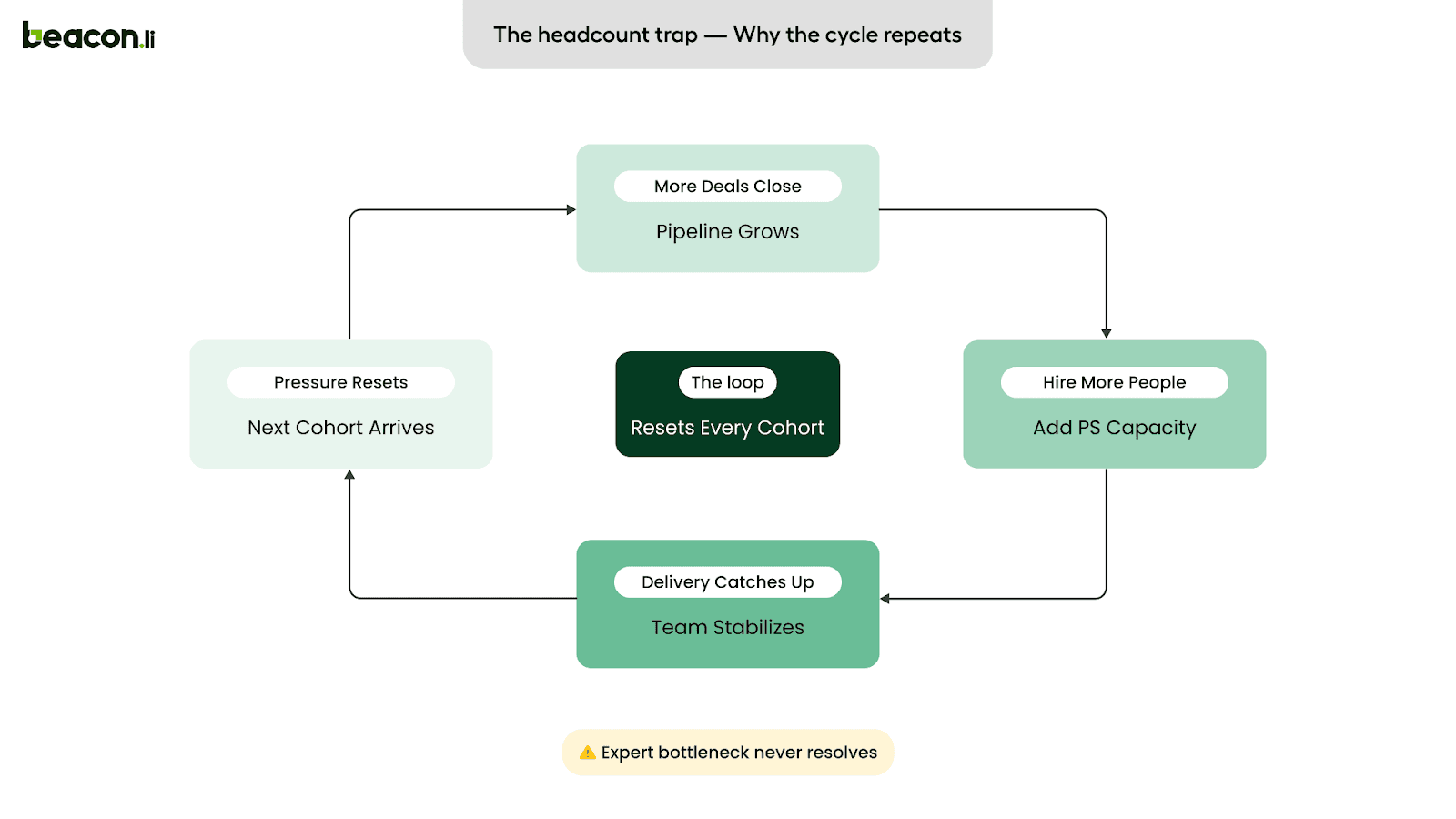
More deals close. More implementations begin. And the instinct is always the same! Hire more capacity, absorb the load, keep things moving. For a while, it works. Then the next cohort arrives, and the ask goes back to finance.
The team grows. The pressure resets.
But here’s what the headcount number doesn’t show.
Most of the new capacity handles the predictable parts: the standard configurations, the familiar project sequences, the work that follows a pattern. That’s fine, until it isn’t. Because the moment something deviates from an edge case, an unusual integration, a more complex customer environment… It routes straight back to the same two or three senior people it always has.
The experts are still the experts. And they’re still the bottleneck.
Their knowledge stays with them. It doesn’t transfer. It doesn’t get systematized. Every complex situation gets solved in the moment, by the same people, and the next time a similar situation arises… It starts from scratch again.
This is what eventually shows up in the numbers. Not as a single line item. But as delayed implementations, compressed professional services productivity, senior talent pulled away from high-value work, and a delivery cost that keeps climbing even as the team grows.
The problem isn’t that you’re hiring. It’s that hiring alone isn’t changing how the knowledge flows or how the work is structured around the people who carry it.
That’s what this piece is about.
Why Hiring Alone Doesn’t Scale Professional Services in Enterprise SaaS
There’s a fundamental mismatch at the center of most SaaS delivery scaling conversations: leaders treat delivery pressure as a capacity problem when it’s actually a structural one.
Every new hire comes with a hidden invoice, 60–90 days of ramp time before they reach full productivity. In practice, it can take up to six months to meaningfully close a delivery gap. And during that time, the underlying inefficiencies remain unchanged.
Meanwhile, a large share of professional services work is inherently repeatable: standard configurations, familiar onboarding paths, predictable project milestones. Yet it continues to be treated as bespoke and manually executed, rebuilt from scratch for every customer.
This is where margins erode.
SaaS professional services teams are expected to operate at 30–40% gross margins. But when repeatable work is delivered manually, services revenue exceeding 15–20% of total revenue begins to drag overall company gross margin below the 77% benchmark. - OpenView Partners / Benchmarkit 2025
The result: more hiring, lower efficiency, and a delivery model that becomes harder to scale with every new customer.
Professional services scalability doesn’t come from adding more people to a broken model. It comes from changing the model itself.
How Beacon Scale Professional Services in Enterprise SaaS:
Beacon’s AI trains on your product UI, captures expert knowledge in structured playbooks, and replaces manual configuration with intelligent, repeatable execution. So, your senior consultants stop being the bottleneck and start being the multiplier.
The Hidden Cost of Poor Professional Services Scalability
The financial pressure is measurable. The non-financial cost is often worse — and harder to reverse.
Senior Talent Burnout
When your most experienced implementation leads are perpetually on-call for escalations, edge cases, and complex configurations, they’re not doing the work that justifies their seniority. Over time, this creates a quiet attrition problem – your best people leave, and with them goes the institutional knowledge that was never systematized.
Inconsistent Customer Outcomes
When delivery depends on individual expertise rather than a structured system, quality varies. One customer gets an exceptional implementation. Another gets a stretched project manager carrying too many accounts. 2025 B2B SaaS retention benchmarks show that structured onboarding programs boost first-year retention by 25%, and customers who adopt 70%+ of core features are twice as likely to stay. Inconsistent enterprise SaaS professional services delivery directly undermines both.
Expansion Revenue Stalls
Expansion is downstream of adoption. Adoption is downstream of implementation. When customers reach activation without truly understanding what they’ve built, the upsell conversation never gains traction. The customer isn’t ready for more. They’re still digesting what they already have.
Sales and PS Misalignment
Sales closes a complex enterprise deal. PS inherits scope they weren’t involved in defining. Timelines that looked reasonable in the proposal become impossible in delivery. The customer relationship starts under strain before a single configuration is complete.
How Beacon Tackles the Hidden Operational Costs of PS Services:
Beacon’s audit-ready delivery framework standardizes outcomes across every implementation and reduces variability, enabling consistent go-lives, and giving PS leaders real visibility into professional services productivity at scale.
How to Scale a Professional Services Team Without Proportional Hiring
The path forward isn’t to hire less, it’s to build a delivery model where every hire contributes more. Professional services scalability in enterprise SaaS comes from changing the structure of the work, not just the size of the team. Here’s the framework.
How to Improve Professional Services Productivity With Repeatable IP
Most PS teams fail to scale professional services teams because every project is treated as custom. The fix is converting your best delivery patterns into reusable assets that the industry calls productized services.
Break implementations into fixed packages: ‘90-day onboarding’, ‘enterprise rollout kit’
Define standard timelines, scopes, and predefined deliverables per use case
Build playbooks and templates that any team member can execute — not just your senior leads
Think: services as SKUs, not services as projects. According to TSIA, productized services typically achieve 10–15% higher professional services productivity margins than custom engagements and they onboard new hires dramatically faster.
How Beacon Breaks the Link Between Growth and Hiring in PS Teams: Beacon automates the productized delivery layer and turns your implementation playbooks into executable workflows that run consistently across every customer, without manual coordination.
How Pre-Sales Alignment Reduces SaaS Implementation Team Workload
According to Wudpecker's 2025 B2B retention data, structured onboarding programs increase first year retention by 25%. Every hour of implementation your customer can self-serve before your PS team touches it is an hour your team can spend on higher-complexity work.
Reduce PS workload by solving problems before services are needed. Strengthen pre-sales scoping so customers arrive with realistic expectations.
Provide self-serve onboarding guides, interactive product tours, and knowledge bases so customers can complete 30–50% of onboarding themselves before your SaaS implementation team touches it.
The goal isn’t to remove your team from onboarding. It’s to make sure the hours they spend are on the 20% of work that actually requires their expertise.
SaaS Implementation Automation: How to Do More With the Same Team
Professional services automation starts with identifying the repetitive tasks inside every implementation and removing the human dependency from them. This includes automated data migrations, configuration scripts, one-click integrations, and AI-assisted setup recommendations.
The result: one consultant handling 2–3x more accounts without degrading quality. High Alpha’s 2025 benchmarks confirm that ARR per employee continues to climb as teams use AI for professional services teams to compress non-differentiated work – the same principle applies directly to PS delivery.
SaaS implementation automation isn’t about replacing people. It’s about giving them the infrastructure to operate at a level that wasn’t possible before.
Beacon: Beacon replaces manual setup, data validation, and fragmented workflows with intelligent, scalable execution and reduces implementation effort and timeline by over 60%. One consultant. Far more accounts. Same delivery quality.
How a Partner Ecosystem Scales Enterprise SaaS Delivery Teams
You don’t need to do all services yourself. System integrators, implementation partners, and certified consultants can absorb standardized delivery and frees your internal enterprise SaaS delivery team for strategic, high-value work.
Create certification programs with clear delivery standards
Provide partner playbooks built from your best internal IP
Keep complex, high-risk implementations in-house; outsource the repeatable tier
Treat your partner ecosystem as a capacity multiplier, not a fallback option.
How to Structure Scaling SaaS Delivery Teams by Work Tier
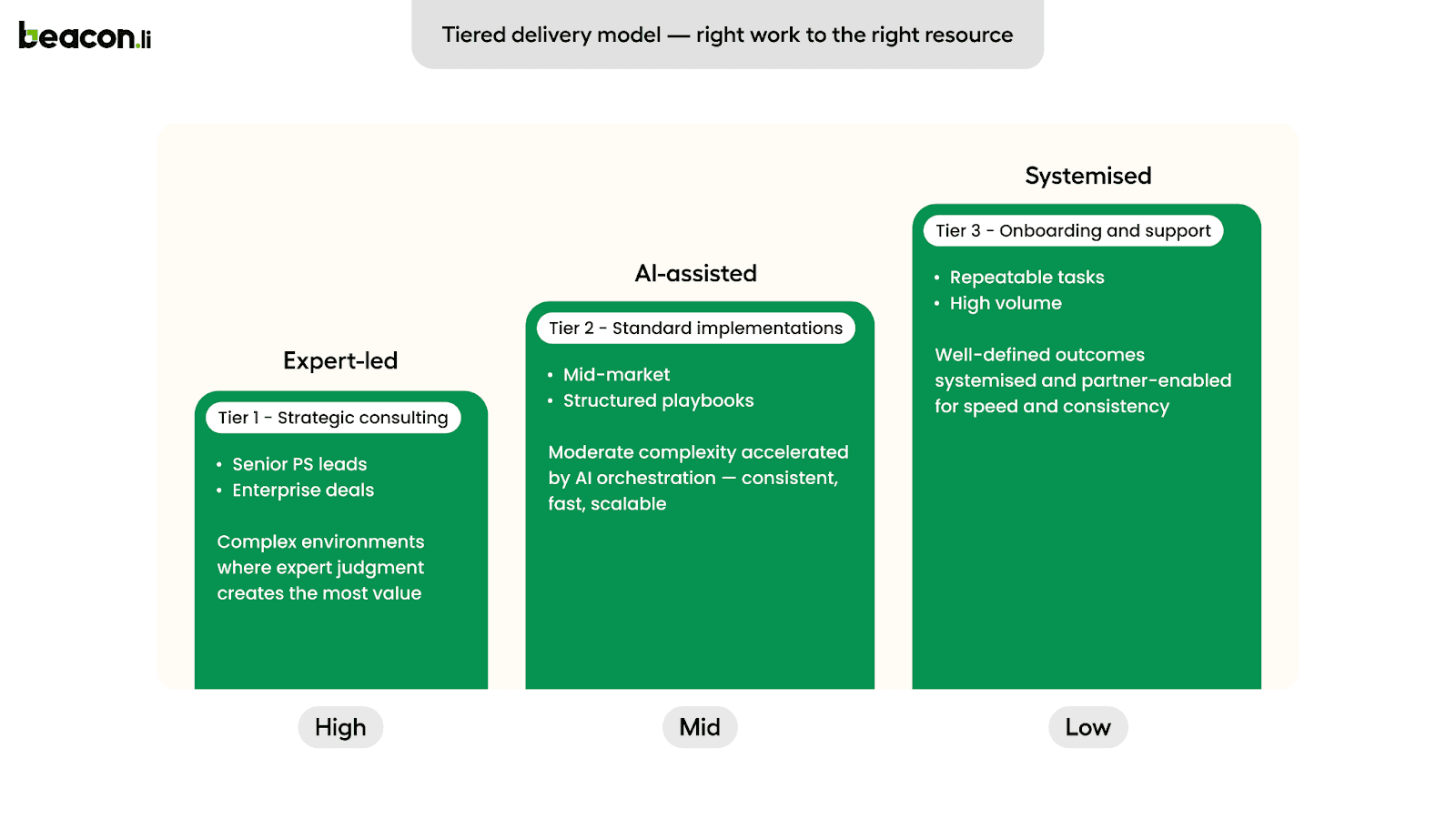
Not all services require top talent. Scaling SaaS delivery teams sustainably means building a tiered delivery model that matches work complexity to the right level of resource:
Tier 1: Strategic consulting: Enterprise deals, complex environments, executive relationships
Tier 2: Standard implementations: Mid-market, structured playbooks, moderate complexity
Tier 3: Support and onboarding assistance: Automation, partners, or junior resources
Push lower-tier work down the stack so your most experienced people spend their time where they create differentiated value.
Beacon: Beacon’s orchestration layer handles Tier 2 and Tier 3 work automatically. Environment setup, data readiness, SoP alignment, validation, cutover, and hypercare, so your senior consultants focus entirely on Tier 1.
Professional Services Productivity Metrics That Actually Predict Scale
Utilization alone leads to burnout and doesn’t capture whether professional services scalability is actually improving. Track these instead:
Revenue per consultant
Time-to-value (customer onboarding speed)
% of standardized vs. custom work
Gross margin of services
Attach rate (PS sold per deal)
Your north star: increase revenue per employee without degrading customer outcomes. This is the metric that separates scaling SaaS implementation teams that compound from those that cope.
The Most Powerful Lever for Professional Services Automation
The most powerful long-term form of professional services automation is eliminating services work entirely by converting repeat service tasks into product features. Configuration UIs replace manual setup. In-product guidance replaces onboarding sessions. Templates become self-serve.
The evolution: consultant sets up workflows → templates created → templates become product features → customers self-configure.
Every implementation task that moves into the product is a task that never burdens your PS team again.
Enterprise SaaS Delivery Automation: Building a Factory Model
Enterprise SaaS delivery automation starts with thinking like manufacturing, not consulting. Standardize every stage of the delivery lifecycle: intake, scoping, delivery, QA, and handoff. Use checklists, workflow tools, and capacity planning systems to create predictable, repeatable throughput.
The outcome isn’t uniformity – it’s confidence. When delivery follows a system, timelines become reliable, escalations decrease, and every new customer starts from the same strong foundation.
Beacon as Powerful Lever for Professional Services Automation: Beacon handles the core stages of the implementation lifecycle. Environment setup with configs, workflows and permissions, data readiness, SoP alignment, validation, cutover, and hypercare and creates a factory-model delivery system that runs without manual coordination.
Hybrid Models That Improve Professional Services Scalability
Instead of full-service engagements, consider co-delivery (customer + PS), guided implementations, and office hours or advisory models. These reduce effort per customer while maintaining strong success rates and they build customer capability in a way that reduces enterprise SaaS professional services dependency over time.
Cross-Team Alignment for Scalable SaaS Implementation Management
AI-powered implementation management only works when the go-to-market motion supports it. Sales shouldn’t oversell custom work. Product should reduce service dependency over time. Customer Success should own outcomes, not inherit them from PS at handoff.
The most common failure mode: Sales closes complex deals, PS absorbs the chaos. Fix it with deal qualification frameworks and early PS involvement in large enterprise opportunities.
What a Scalable Enterprise SaaS Professional Services Org Looks Like and How AI Gets You There
In a scalable enterprise SaaS professional services organization:
50–70% of work is standardized and templated
Partners handle a meaningful portion of repeatable delivery
Professional services automation replaces repetitive tasks across the implementation lifecycle
Product progressively reduces dependency on services
Revenue per consultant steadily increases quarter over quarter
The 4P Framework for Scaling Enterprise SaaS Professional Services
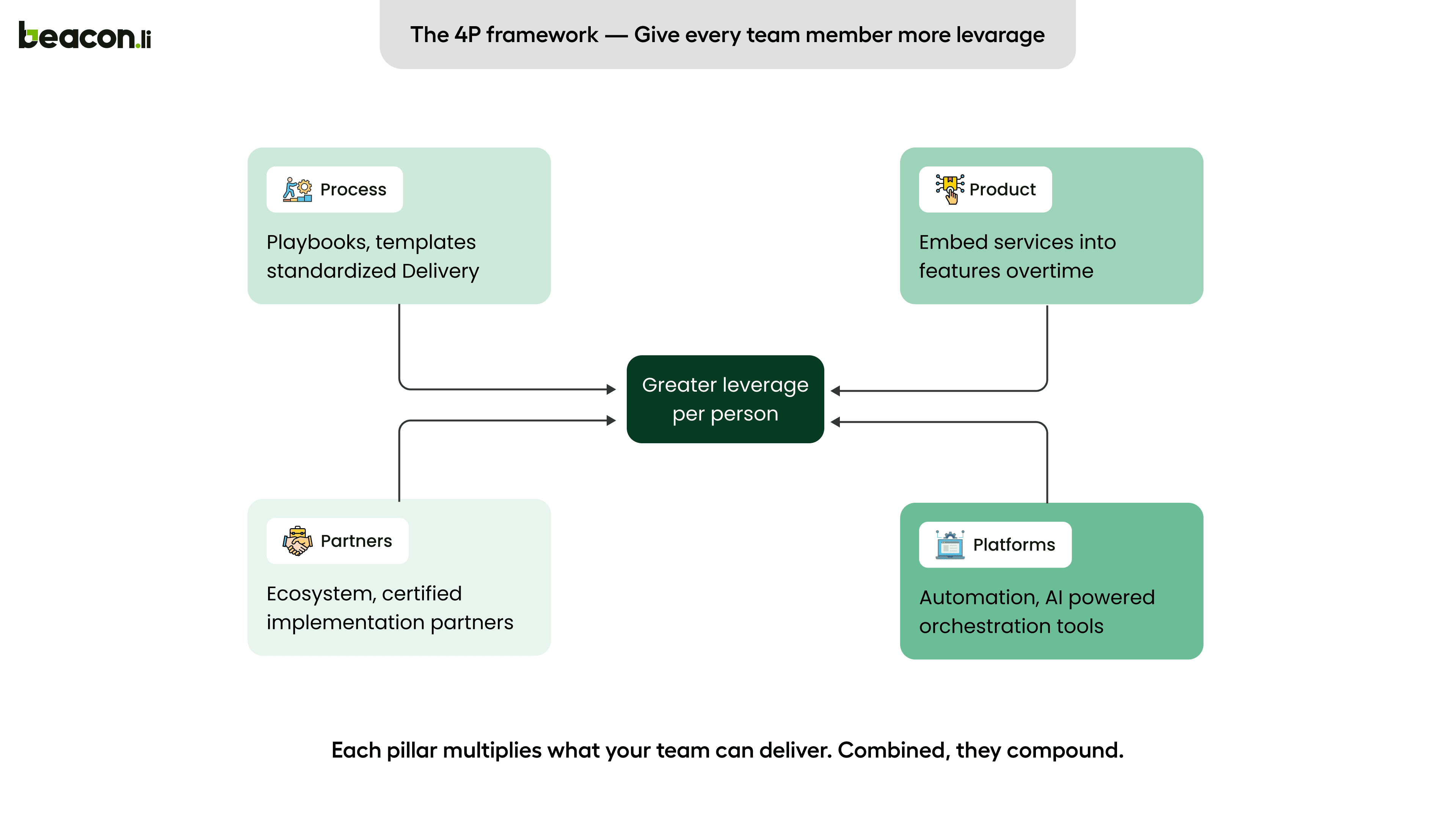
The simple mental model for scaling SaaS implementation teams without proportional hiring: replace people with Process (playbooks), Product (features), Partners (ecosystem), and Platforms (automation).
Process: Convert your best delivery patterns into productized packages, playbooks, and fixed-scope offerings. This is what makes tribal knowledge transferable.
Product: Progressively move repeatable service tasks into the product itself. Every feature that replaces a consultant-hour compounds.
Partners: Build a certified ecosystem to absorb standardized Tier 2 and Tier 3 delivery. Reserve internal capacity for Tier 1.
Platforms: Automate environment setup, data validation, configuration, and workflow orchestration. This is where implementation timelines compress.
Beacon is the AI-powered implementation management platform built to operationalize exactly this model. By automating enterprise implementation from configuration to hypercare, Beacon reduces delivery effort and timeline by over 60%.
Beacon’s AI for professional services teams trains on your product UI, maps every action possible in each page, and replaces manual setup, data validation, and fragmented workflows with intelligent, scalable execution. The result: faster revenue recognition, lower operational cost, and consistent customer success at enterprise scale.
The companies that win the next phase of enterprise SaaS growth won’t be the ones that hire the most. They’ll be the ones that give their teams the leverage to deliver more with the same people, in less time, with greater consistency.
Real scale doesn’t come from adding more hands. It comes from giving your team more leverage.
A practical guide for PS leaders in enterprise SaaS who are ready to break the headcount trap.
Enterprise SaaS professional services teams don’t fail to scale because of a lack of hiring—they fail because the delivery model doesn’t evolve with growth. As customer volume increases, expert bottlenecks, inconsistent delivery, and rising operational complexity begin to limit throughput.
This guide breaks down how leading SaaS companies scale professional services without proportional headcount growth. By productizing delivery, automating repeatable work, building tiered team structures, and shifting expert focus to high-value tasks, organizations can increase capacity, improve margins, and deliver more consistent outcomes.
Why Enterprise SaaS Professional Services Teams Struggle to Scale
Scaling professional services in enterprise SaaS without proportional hiring comes down to four structural changes: productizing delivery, automating repeatable implementation work, building a tiered delivery model, and redirecting expert time to only the work that requires it. This piece breaks down each lever, with benchmarks.
In a market where acquisition costs have risen and board attention has shifted from logo count to net revenue retention, the pressure to grow efficiently has never been higher.
And most leadership teams are looking for the lever in the wrong place.
They’re refining the sales motion. Optimizing pricing. Building expansion playbooks. But underneath all of it, quietly compressing margins and stretching timelines is an enterprise SaaS professional services model that wasn’t built for this volume.
High Alpha’s 2025 Benchmarks Report shows that at $50M+ ARR, roughly 60% of new ARR already comes from existing customers. Companies with strong NRR grow 2.5x faster than their low-NRR counterparts. The retention and expansion engine is now the growth engine.
More deals close. More implementations begin. And the instinct is always the same! Hire more capacity, absorb the load, keep things moving. For a while, it works. Then the next cohort arrives, and the ask goes back to finance.
The team grows. The pressure resets.
But here’s what the headcount number doesn’t show.
Most of the new capacity handles the predictable parts: the standard configurations, the familiar project sequences, the work that follows a pattern. That’s fine, until it isn’t. Because the moment something deviates from an edge case, an unusual integration, a more complex customer environment… It routes straight back to the same two or three senior people it always has.
The experts are still the experts. And they’re still the bottleneck.
Their knowledge stays with them. It doesn’t transfer. It doesn’t get systematized. Every complex situation gets solved in the moment, by the same people, and the next time a similar situation arises… It starts from scratch again.
This is what eventually shows up in the numbers. Not as a single line item. But as delayed implementations, compressed professional services productivity, senior talent pulled away from high-value work, and a delivery cost that keeps climbing even as the team grows.
The problem isn’t that you’re hiring. It’s that hiring alone isn’t changing how the knowledge flows or how the work is structured around the people who carry it.
That’s what this piece is about.
Why Hiring Alone Doesn’t Scale Professional Services in Enterprise SaaS
There’s a fundamental mismatch at the center of most SaaS delivery scaling conversations: leaders treat delivery pressure as a capacity problem when it’s actually a structural one.
Every new hire comes with a hidden invoice, 60–90 days of ramp time before they reach full productivity. In practice, it can take up to six months to meaningfully close a delivery gap. And during that time, the underlying inefficiencies remain unchanged.
Meanwhile, a large share of professional services work is inherently repeatable: standard configurations, familiar onboarding paths, predictable project milestones. Yet it continues to be treated as bespoke and manually executed, rebuilt from scratch for every customer.
This is where margins erode.
SaaS professional services teams are expected to operate at 30–40% gross margins. But when repeatable work is delivered manually, services revenue exceeding 15–20% of total revenue begins to drag overall company gross margin below the 77% benchmark. - OpenView Partners / Benchmarkit 2025
The result: more hiring, lower efficiency, and a delivery model that becomes harder to scale with every new customer.
Professional services scalability doesn’t come from adding more people to a broken model. It comes from changing the model itself.
How Beacon Scale Professional Services in Enterprise SaaS:
Beacon’s AI trains on your product UI, captures expert knowledge in structured playbooks, and replaces manual configuration with intelligent, repeatable execution. So, your senior consultants stop being the bottleneck and start being the multiplier.
The Hidden Cost of Poor Professional Services Scalability
The financial pressure is measurable. The non-financial cost is often worse — and harder to reverse.
Senior Talent Burnout
When your most experienced implementation leads are perpetually on-call for escalations, edge cases, and complex configurations, they’re not doing the work that justifies their seniority. Over time, this creates a quiet attrition problem – your best people leave, and with them goes the institutional knowledge that was never systematized.
Inconsistent Customer Outcomes
When delivery depends on individual expertise rather than a structured system, quality varies. One customer gets an exceptional implementation. Another gets a stretched project manager carrying too many accounts. 2025 B2B SaaS retention benchmarks show that structured onboarding programs boost first-year retention by 25%, and customers who adopt 70%+ of core features are twice as likely to stay. Inconsistent enterprise SaaS professional services delivery directly undermines both.
Expansion Revenue Stalls
Expansion is downstream of adoption. Adoption is downstream of implementation. When customers reach activation without truly understanding what they’ve built, the upsell conversation never gains traction. The customer isn’t ready for more. They’re still digesting what they already have.
Sales and PS Misalignment
Sales closes a complex enterprise deal. PS inherits scope they weren’t involved in defining. Timelines that looked reasonable in the proposal become impossible in delivery. The customer relationship starts under strain before a single configuration is complete.
How Beacon Tackles the Hidden Operational Costs of PS Services:
Beacon’s audit-ready delivery framework standardizes outcomes across every implementation and reduces variability, enabling consistent go-lives, and giving PS leaders real visibility into professional services productivity at scale.
How to Scale a Professional Services Team Without Proportional Hiring
The path forward isn’t to hire less, it’s to build a delivery model where every hire contributes more. Professional services scalability in enterprise SaaS comes from changing the structure of the work, not just the size of the team. Here’s the framework.
How to Improve Professional Services Productivity With Repeatable IP
Most PS teams fail to scale professional services teams because every project is treated as custom. The fix is converting your best delivery patterns into reusable assets that the industry calls productized services.
Break implementations into fixed packages: ‘90-day onboarding’, ‘enterprise rollout kit’
Define standard timelines, scopes, and predefined deliverables per use case
Build playbooks and templates that any team member can execute — not just your senior leads
Think: services as SKUs, not services as projects. According to TSIA, productized services typically achieve 10–15% higher professional services productivity margins than custom engagements and they onboard new hires dramatically faster.
How Beacon Breaks the Link Between Growth and Hiring in PS Teams: Beacon automates the productized delivery layer and turns your implementation playbooks into executable workflows that run consistently across every customer, without manual coordination.
How Pre-Sales Alignment Reduces SaaS Implementation Team Workload
According to Wudpecker's 2025 B2B retention data, structured onboarding programs increase first year retention by 25%. Every hour of implementation your customer can self-serve before your PS team touches it is an hour your team can spend on higher-complexity work.
Reduce PS workload by solving problems before services are needed. Strengthen pre-sales scoping so customers arrive with realistic expectations.
Provide self-serve onboarding guides, interactive product tours, and knowledge bases so customers can complete 30–50% of onboarding themselves before your SaaS implementation team touches it.
The goal isn’t to remove your team from onboarding. It’s to make sure the hours they spend are on the 20% of work that actually requires their expertise.
SaaS Implementation Automation: How to Do More With the Same Team
Professional services automation starts with identifying the repetitive tasks inside every implementation and removing the human dependency from them. This includes automated data migrations, configuration scripts, one-click integrations, and AI-assisted setup recommendations.
The result: one consultant handling 2–3x more accounts without degrading quality. High Alpha’s 2025 benchmarks confirm that ARR per employee continues to climb as teams use AI for professional services teams to compress non-differentiated work – the same principle applies directly to PS delivery.
SaaS implementation automation isn’t about replacing people. It’s about giving them the infrastructure to operate at a level that wasn’t possible before.
Beacon: Beacon replaces manual setup, data validation, and fragmented workflows with intelligent, scalable execution and reduces implementation effort and timeline by over 60%. One consultant. Far more accounts. Same delivery quality.
How a Partner Ecosystem Scales Enterprise SaaS Delivery Teams
You don’t need to do all services yourself. System integrators, implementation partners, and certified consultants can absorb standardized delivery and frees your internal enterprise SaaS delivery team for strategic, high-value work.
Create certification programs with clear delivery standards
Provide partner playbooks built from your best internal IP
Keep complex, high-risk implementations in-house; outsource the repeatable tier
Treat your partner ecosystem as a capacity multiplier, not a fallback option.
How to Structure Scaling SaaS Delivery Teams by Work Tier
Not all services require top talent. Scaling SaaS delivery teams sustainably means building a tiered delivery model that matches work complexity to the right level of resource:
Tier 1: Strategic consulting: Enterprise deals, complex environments, executive relationships
Tier 2: Standard implementations: Mid-market, structured playbooks, moderate complexity
Tier 3: Support and onboarding assistance: Automation, partners, or junior resources
Push lower-tier work down the stack so your most experienced people spend their time where they create differentiated value.
Beacon: Beacon’s orchestration layer handles Tier 2 and Tier 3 work automatically. Environment setup, data readiness, SoP alignment, validation, cutover, and hypercare, so your senior consultants focus entirely on Tier 1.
Professional Services Productivity Metrics That Actually Predict Scale
Utilization alone leads to burnout and doesn’t capture whether professional services scalability is actually improving. Track these instead:
Revenue per consultant
Time-to-value (customer onboarding speed)
% of standardized vs. custom work
Gross margin of services
Attach rate (PS sold per deal)
Your north star: increase revenue per employee without degrading customer outcomes. This is the metric that separates scaling SaaS implementation teams that compound from those that cope.
The Most Powerful Lever for Professional Services Automation
The most powerful long-term form of professional services automation is eliminating services work entirely by converting repeat service tasks into product features. Configuration UIs replace manual setup. In-product guidance replaces onboarding sessions. Templates become self-serve.
The evolution: consultant sets up workflows → templates created → templates become product features → customers self-configure.
Every implementation task that moves into the product is a task that never burdens your PS team again.
Enterprise SaaS Delivery Automation: Building a Factory Model
Enterprise SaaS delivery automation starts with thinking like manufacturing, not consulting. Standardize every stage of the delivery lifecycle: intake, scoping, delivery, QA, and handoff. Use checklists, workflow tools, and capacity planning systems to create predictable, repeatable throughput.
The outcome isn’t uniformity – it’s confidence. When delivery follows a system, timelines become reliable, escalations decrease, and every new customer starts from the same strong foundation.
Beacon as Powerful Lever for Professional Services Automation: Beacon handles the core stages of the implementation lifecycle. Environment setup with configs, workflows and permissions, data readiness, SoP alignment, validation, cutover, and hypercare and creates a factory-model delivery system that runs without manual coordination.
Hybrid Models That Improve Professional Services Scalability
Instead of full-service engagements, consider co-delivery (customer + PS), guided implementations, and office hours or advisory models. These reduce effort per customer while maintaining strong success rates and they build customer capability in a way that reduces enterprise SaaS professional services dependency over time.
Cross-Team Alignment for Scalable SaaS Implementation Management
AI-powered implementation management only works when the go-to-market motion supports it. Sales shouldn’t oversell custom work. Product should reduce service dependency over time. Customer Success should own outcomes, not inherit them from PS at handoff.
The most common failure mode: Sales closes complex deals, PS absorbs the chaos. Fix it with deal qualification frameworks and early PS involvement in large enterprise opportunities.
What a Scalable Enterprise SaaS Professional Services Org Looks Like and How AI Gets You There
In a scalable enterprise SaaS professional services organization:
50–70% of work is standardized and templated
Partners handle a meaningful portion of repeatable delivery
Professional services automation replaces repetitive tasks across the implementation lifecycle
Product progressively reduces dependency on services
Revenue per consultant steadily increases quarter over quarter
The 4P Framework for Scaling Enterprise SaaS Professional Services
The simple mental model for scaling SaaS implementation teams without proportional hiring: replace people with Process (playbooks), Product (features), Partners (ecosystem), and Platforms (automation).
Process: Convert your best delivery patterns into productized packages, playbooks, and fixed-scope offerings. This is what makes tribal knowledge transferable.
Product: Progressively move repeatable service tasks into the product itself. Every feature that replaces a consultant-hour compounds.
Partners: Build a certified ecosystem to absorb standardized Tier 2 and Tier 3 delivery. Reserve internal capacity for Tier 1.
Platforms: Automate environment setup, data validation, configuration, and workflow orchestration. This is where implementation timelines compress.
Beacon is the AI-powered implementation management platform built to operationalize exactly this model. By automating enterprise implementation from configuration to hypercare, Beacon reduces delivery effort and timeline by over 60%.
Beacon’s AI for professional services teams trains on your product UI, maps every action possible in each page, and replaces manual setup, data validation, and fragmented workflows with intelligent, scalable execution. The result: faster revenue recognition, lower operational cost, and consistent customer success at enterprise scale.
The companies that win the next phase of enterprise SaaS growth won’t be the ones that hire the most. They’ll be the ones that give their teams the leverage to deliver more with the same people, in less time, with greater consistency.
Real scale doesn’t come from adding more hands. It comes from giving your team more leverage.







Copyright © 2026 Beacon.li. All rights reserved.
Copyright © 2026 Beacon.li. All rights reserved.
