Is Automation Enough for Insurance Claims? Here’s How AI Orchestration Steps In
Imagine Sarah, a claims adjuster at a mid-sized insurer. Her day should be simple: review claims, approve eligible ones, and keep policyholders updated. But in reality, automation only takes her so far.
A policyholder submits a claim online. Automation flags the submission and routes it to Sarah. Sounds ideal. Until she discovers:
Some documents are incomplete, but the system can’t tell which ones.
Policy details are spread across three different platforms.
She has to verify coverage manually, check prior claims, and update each system individually.
By the time Sarah has confirmed everything, hours have passed, and the policyholder still hasn’t received a meaningful update. Despite having “automation” in place, the process is slow, fragmented, and frustrating for both the adjuster and the customer.
How Far Has Automation Taken Insurance?
Automation has certainly moved the needle in claims processing, primarily for repetitive and rule-based tasks. These efforts focus on speeding up standard workflows, reducing manual entry, and improving consistency. Key areas include:
Data Capture & Document Handling
Auto-extraction of policy and claim information from forms and uploaded documents.
Basic validation of data fields to reduce errors.
Claims Routing & Assignment
Automated assignment of claims to adjusters based on type, location, or severity.
Escalation rules for specific claim categories.
Status Updates & Notifications
Standardized notifications to policyholders about claim receipt or progress.
Automatic reminders for missing documents or signatures.
Fraud & Compliance Checks
Rule-based alerts flagging unusual claim patterns.
Pre-configured checks for regulatory compliance, so that every decision is traceable and NAIC-compliant with state-specific processing.
Yet even with these capabilities, automation hits a wall. Adjusters still juggle multiple tools, exceptions require human intervention, and policyholders experience delays. Operational inefficiencies persist, slowing cycle times and driving up costs.
Where Automation Hits a “Wall”
Automation in claims handles repetitive tasks well, but it has clear limits. Most systems operate in silos, focusing on one workflow at a time. That means:
Adjusters are still juggling tools: Multiple portals, spreadsheets, and systems slow down decision-making.
Manual intervention is unavoidable: Incomplete documents, complex claims, and exceptions require human follow-up.
Customer experience suffers: Delays in processing translate to long wait times and frustrated policyholders.
Operational inefficiencies persist: Time spent reconciling data, chasing approvals, and updating multiple systems reduces productivity and increases costs.
Next Step: From Automation to AI Orchestration
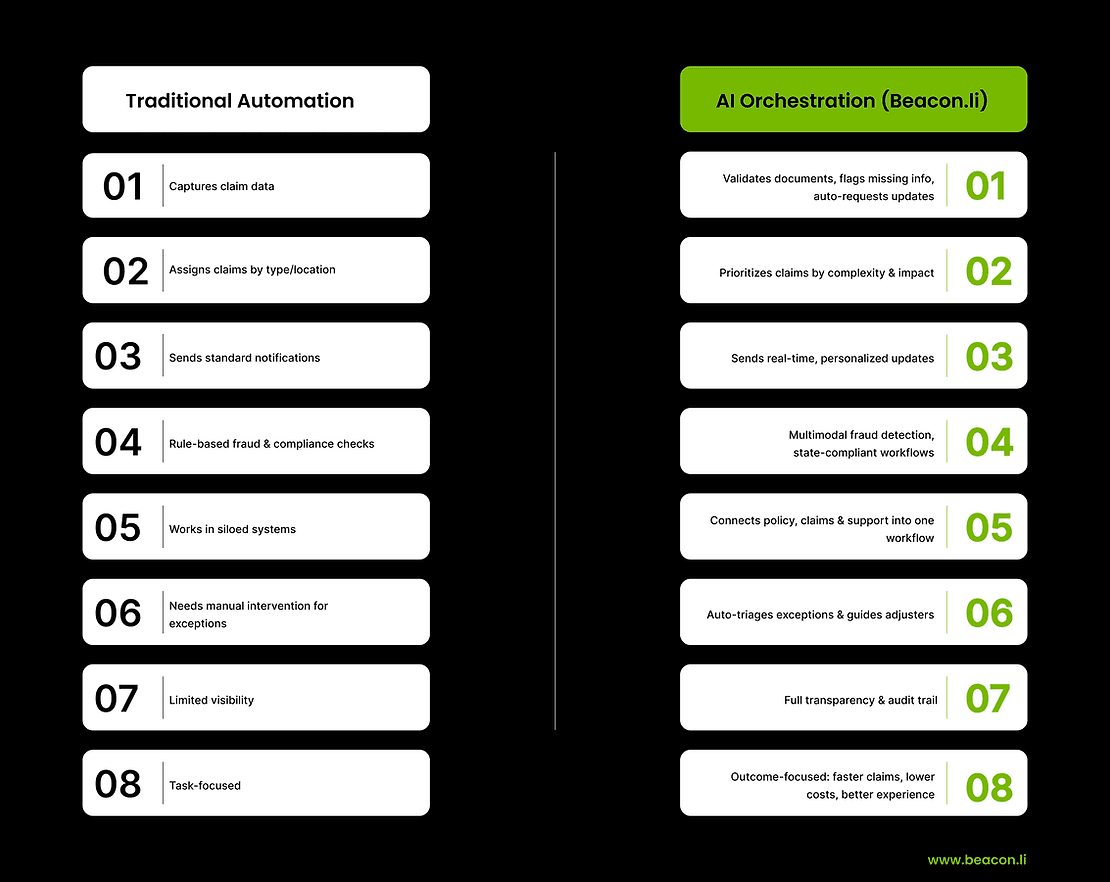
Current Automation:
Task-Level Focus: Captures claim data, routes claims, sends standard notifications, and performs rule-based checks.
Limitations: Works in silos. Adjusters manually verify missing documents, reconcile data, and follow up across multiple systems. Customers still experience delays.
AI Orchestration:
End-to-End Coordination: Connects policy, claims, and support systems into a single intelligent workflow.
Smart Decision-Making: Flags exceptions automatically, prioritizes high-impact claims, and routes them to the right adjuster.
Seamless Customer Updates: Generates timely, accurate communication without manual intervention.
Operational Efficiency: Workflows are transparent, measurable, and optimized for faster cycle times.
What is AI Orchestration?
AI orchestration is the intelligent coordination of multiple systems, workflows, and automated tasks to achieve end-to-end operational efficiency. Unlike traditional automation, which executes individual, rule-based tasks, AI orchestration connects disparate tools, processes, and decisions into a seamless, intelligent workflow. It acts as a central conductor, ensuring that every step in a process happens in the right order, at the right time, with minimal human intervention.
Key benefits of AI orchestration in general:
Reduces manual handoffs and bottlenecks
Optimizes workflows across systems
Provides real-time decision-making support
Increases transparency, traceability, and auditability
How AI Orchestration Works for Insurance Claims
In the context of insurance claims, AI orchestration transforms fragmented processes into a unified, intelligent workflow:
Automated Claim Intake & Validation
Claims submitted online are automatically checked for completeness. Missing documents and images are flagged, and policyholders are prompted for corrections without adjuster intervention.
Integrated Systems & Workflows
Policy, claims, and customer support systems communicate seamlessly. Adjusters no longer switch between multiple portals or reconcile data manually.
Prioritization & Routing
AI evaluates claim complexity, severity, and potential impact, assigning claims to the right adjuster at the right time.
Real-Time Customer Updates
Policyholders receive timely, accurate notifications at each step, reducing uncertainty and support inquiries.
Decision Support for Adjusters
Repetitive, rule-based tasks are handled automatically. Adjusters focus on exceptions, approvals, and complex decisions.
Transparency & Auditability
Every step is logged and measurable, providing visibility for management and regulators.
Beacon’s AI Agentic Orchestration Layer:
Traditional automation handles tasks in isolation, leaving gaps and inefficiencies across systems. Beacon.li takes a different approach. Its modular AI agent layer orchestrates multiple AI agents, human decision points, and enterprise systems into unified, intelligent workflows, without ever touching backend systems.
Beacon.li drives enterprise-wide AI velocity across claims automation:
Media Intake & Fraud Detection
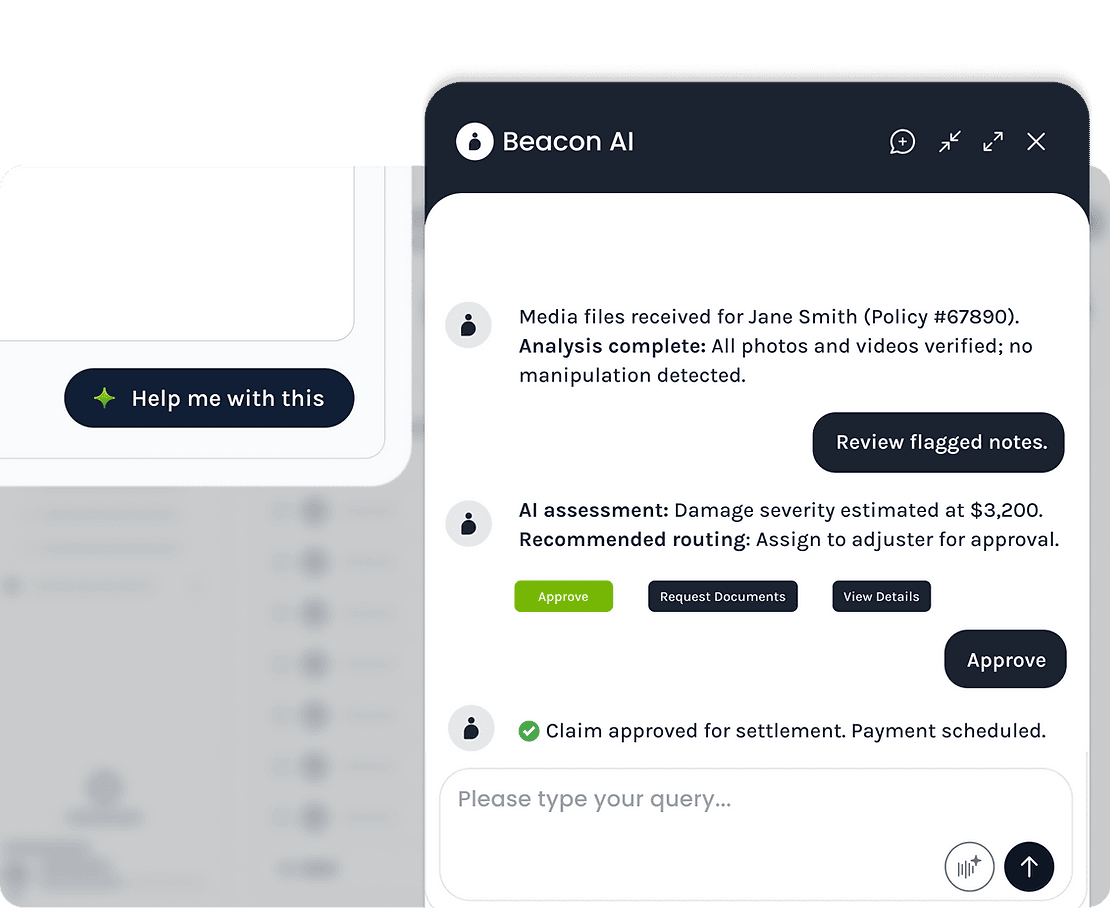
Multimodal AI ingests documents, images, and videos instantly
Flags manipulated or AI-generated media upfront, requiring no manual review
Contextual Validation
Automatically verifies submitted media against claim type and claimant identity
Eliminates ghost claims and mismatched invoices
State-Specific Processing & Compliance
Workflows adapt to varying state regulations and timeframes
Every decision is traceable and NAIC-compliant
Autonomous Decision Engine
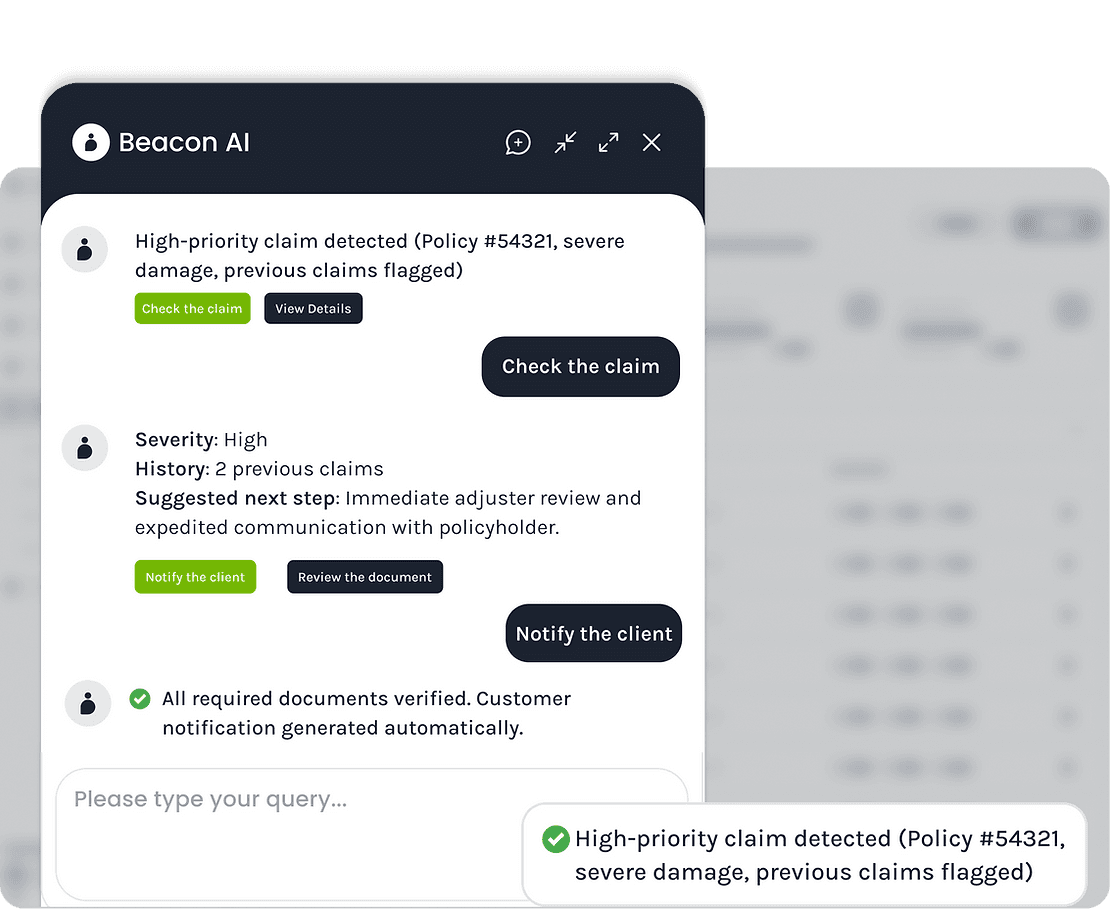
Intelligent Claim Routing: Triage based on severity, history, and business rules
Transparent Adjudication: Audit-ready documentation with explainable reasoning
Automated Workflows: Post-processing handles communication, document generation, and payment coordination without human intervention
With Beacon.li, adjusters like Sarah no longer juggle multiple systems or chase missing documents. Claims are validated, routed, and communicated automatically through agentic orchestration. She can focus on complex decisions and high-value work, while policyholders receive timely, accurate updates.
See it in action: Contact us for a live demo and experience how Beacon.li can orchestrate your insurance workflows, streamline claims, and elevate customer experience.
Imagine Sarah, a claims adjuster at a mid-sized insurer. Her day should be simple: review claims, approve eligible ones, and keep policyholders updated. But in reality, automation only takes her so far.
A policyholder submits a claim online. Automation flags the submission and routes it to Sarah. Sounds ideal. Until she discovers:
Some documents are incomplete, but the system can’t tell which ones.
Policy details are spread across three different platforms.
She has to verify coverage manually, check prior claims, and update each system individually.
By the time Sarah has confirmed everything, hours have passed, and the policyholder still hasn’t received a meaningful update. Despite having “automation” in place, the process is slow, fragmented, and frustrating for both the adjuster and the customer.
How Far Has Automation Taken Insurance?
Automation has certainly moved the needle in claims processing, primarily for repetitive and rule-based tasks. These efforts focus on speeding up standard workflows, reducing manual entry, and improving consistency. Key areas include:
Data Capture & Document Handling
Auto-extraction of policy and claim information from forms and uploaded documents.
Basic validation of data fields to reduce errors.
Claims Routing & Assignment
Automated assignment of claims to adjusters based on type, location, or severity.
Escalation rules for specific claim categories.
Status Updates & Notifications
Standardized notifications to policyholders about claim receipt or progress.
Automatic reminders for missing documents or signatures.
Fraud & Compliance Checks
Rule-based alerts flagging unusual claim patterns.
Pre-configured checks for regulatory compliance, so that every decision is traceable and NAIC-compliant with state-specific processing.
Yet even with these capabilities, automation hits a wall. Adjusters still juggle multiple tools, exceptions require human intervention, and policyholders experience delays. Operational inefficiencies persist, slowing cycle times and driving up costs.
Where Automation Hits a “Wall”
Automation in claims handles repetitive tasks well, but it has clear limits. Most systems operate in silos, focusing on one workflow at a time. That means:
Adjusters are still juggling tools: Multiple portals, spreadsheets, and systems slow down decision-making.
Manual intervention is unavoidable: Incomplete documents, complex claims, and exceptions require human follow-up.
Customer experience suffers: Delays in processing translate to long wait times and frustrated policyholders.
Operational inefficiencies persist: Time spent reconciling data, chasing approvals, and updating multiple systems reduces productivity and increases costs.
Next Step: From Automation to AI Orchestration
Current Automation:
Task-Level Focus: Captures claim data, routes claims, sends standard notifications, and performs rule-based checks.
Limitations: Works in silos. Adjusters manually verify missing documents, reconcile data, and follow up across multiple systems. Customers still experience delays.
AI Orchestration:
End-to-End Coordination: Connects policy, claims, and support systems into a single intelligent workflow.
Smart Decision-Making: Flags exceptions automatically, prioritizes high-impact claims, and routes them to the right adjuster.
Seamless Customer Updates: Generates timely, accurate communication without manual intervention.
Operational Efficiency: Workflows are transparent, measurable, and optimized for faster cycle times.
What is AI Orchestration?
AI orchestration is the intelligent coordination of multiple systems, workflows, and automated tasks to achieve end-to-end operational efficiency. Unlike traditional automation, which executes individual, rule-based tasks, AI orchestration connects disparate tools, processes, and decisions into a seamless, intelligent workflow. It acts as a central conductor, ensuring that every step in a process happens in the right order, at the right time, with minimal human intervention.
Key benefits of AI orchestration in general:
Reduces manual handoffs and bottlenecks
Optimizes workflows across systems
Provides real-time decision-making support
Increases transparency, traceability, and auditability
How AI Orchestration Works for Insurance Claims
In the context of insurance claims, AI orchestration transforms fragmented processes into a unified, intelligent workflow:
Automated Claim Intake & Validation
Claims submitted online are automatically checked for completeness. Missing documents and images are flagged, and policyholders are prompted for corrections without adjuster intervention.
Integrated Systems & Workflows
Policy, claims, and customer support systems communicate seamlessly. Adjusters no longer switch between multiple portals or reconcile data manually.
Prioritization & Routing
AI evaluates claim complexity, severity, and potential impact, assigning claims to the right adjuster at the right time.
Real-Time Customer Updates
Policyholders receive timely, accurate notifications at each step, reducing uncertainty and support inquiries.
Decision Support for Adjusters
Repetitive, rule-based tasks are handled automatically. Adjusters focus on exceptions, approvals, and complex decisions.
Transparency & Auditability
Every step is logged and measurable, providing visibility for management and regulators.
Beacon’s AI Agentic Orchestration Layer:
Traditional automation handles tasks in isolation, leaving gaps and inefficiencies across systems. Beacon.li takes a different approach. Its modular AI agent layer orchestrates multiple AI agents, human decision points, and enterprise systems into unified, intelligent workflows, without ever touching backend systems.
Beacon.li drives enterprise-wide AI velocity across claims automation:
Media Intake & Fraud Detection
Multimodal AI ingests documents, images, and videos instantly
Flags manipulated or AI-generated media upfront, requiring no manual review
Contextual Validation
Automatically verifies submitted media against claim type and claimant identity
Eliminates ghost claims and mismatched invoices
State-Specific Processing & Compliance
Workflows adapt to varying state regulations and timeframes
Every decision is traceable and NAIC-compliant
Autonomous Decision Engine
Intelligent Claim Routing: Triage based on severity, history, and business rules
Transparent Adjudication: Audit-ready documentation with explainable reasoning
Automated Workflows: Post-processing handles communication, document generation, and payment coordination without human intervention
With Beacon.li, adjusters like Sarah no longer juggle multiple systems or chase missing documents. Claims are validated, routed, and communicated automatically through agentic orchestration. She can focus on complex decisions and high-value work, while policyholders receive timely, accurate updates.
See it in action: Contact us for a live demo and experience how Beacon.li can orchestrate your insurance workflows, streamline claims, and elevate customer experience.