Client Implementation
The Fastest Client Implementations in 2026 Will Be AI-Orchestrated

By 2026, most implementation leaders will agree on the fundamentals.
AI will be embedded into delivery.
Speed will matter more than activity.
Customer experience will start at implementation, not after go-live.
But many will still underestimate what AI orchestration actually means. And, where the real gains come from.
Because the biggest shift isn’t better visibility, smarter governance, or cleaner reporting.
It’s this: AI is beginning to execute the work of implementation itself.
Why “Managing Better” Isn’t Enough Anymore
For years, the implementation function has tried to move faster by managing better:
More detailed plans
More precise timelines
More dashboards
More process
These tools improved coordination. They didn’t fundamentally change throughput.
Implementation leaders understand why. The slowest parts of delivery aren’t status updates. They're execution-heavy, detail-dense tasks that depend on deep product knowledge:
Configuring complex environments
Translating customer requirements into working systems
Validating data and workflows
Preparing realistic UAT
Supporting customers through the fragile post-go-live phase
None of this is solved by better tracking. It’s solved by changing how the work is done.
The Emerging Reality of AI Orchestration
Early conversations about AI in implementation focused on assistance:
Recommendations
Insights
Forecasts
Risk flags
These were useful, but incremental.
What’s changing now is that orchestration is moving into the execution path.
Instead of telling teams what should happen next, AI systems are increasingly:
Interpreting customer requirements
Performing configuration steps
Validating data and dependencies continuously
Generating test scenarios from real environments
Absorbing a large share of post-go-live support queries
This is orchestration as action, not oversight. And the reason why implementation velocity is starting to scale without proportional increases in headcount.
From Fragmented Phases to a Single Flow
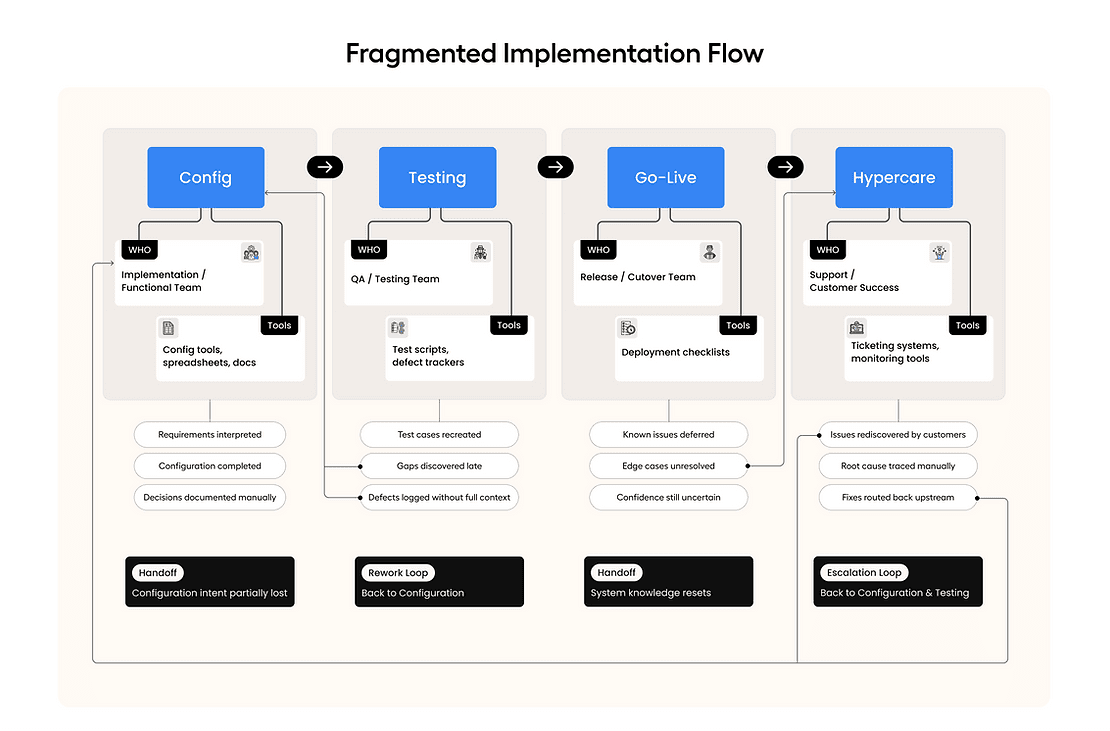
One of the least discussed sources of delay in implementation is fragmentation.
Configuration happens in one phase.
Testing happens later.
Hypercare happens after go-live — often with entirely different tools and teams.
Each transition introduces rework, context loss, and risk. AI-orchestrated implementations collapse these boundaries.
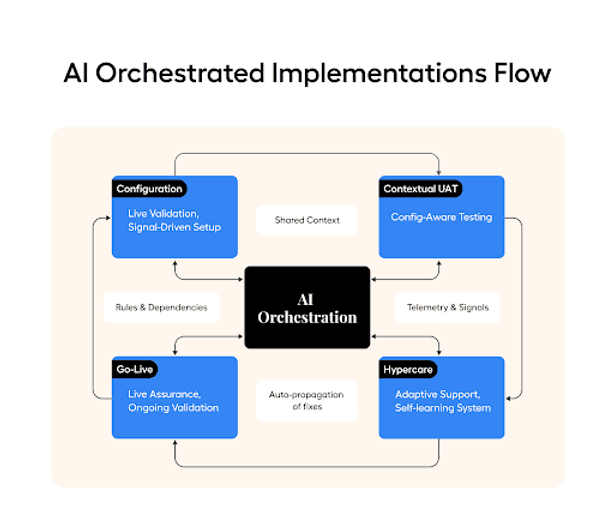
When configuration, validation, testing, and early support are stitched into a continuous flow, issues surface earlier, fixes propagate automatically, and customers experience momentum instead of handoffs.
From the leader’s perspective, this feels less like “automation” and more like implementation finally behaving as a system.
Why Learning the Product Matters More Than Integrating It
Another quiet shift is how orchestration systems understand products. Traditional automation depends on deep integrations, APIs, and custom logic. These are expensive to build and brittle to maintain.
The newer generation of orchestration platforms takes a different approach: learning how the product actually behaves by interacting with it the way humans do.
By observing configurations, dependencies, and workflows through the interface itself, these systems build an operational understanding that’s: Closer to reality, faster to deploy, more resilient to change
For implementation leaders, this removes a major barrier to scale: long integration projects just to automate delivery.
Why People Matter More Than Ever
A common misconception about AI orchestration is that it diminishes the role of humans. In practice, the opposite is happening.
As execution becomes more automated:
Human judgment becomes more valuable
Exception handling becomes more strategic
Customer conversations become more thoughtful
Implementation leaders in 2026 are investing just as heavily in human-centered leadership as they are in technology. Empathy, communication, and decision-making amplified by AI, not overridden by it.
The best orchestration systems are designed around this reality: humans in control, AI handling the heavy lifting.
The Compounding Effect Leaders Don’t Expect
What surprises many teams isn’t the first implementation, it’s the tenth.
When execution is orchestrated and captured systematically, every implementation leaves behind structured knowledge:
What configurations worked
Where data broke
Which workflows caused friction
What customers asked after go-live
Over time, this turns implementation from a series of one-off efforts into a compounding system, where expertise is reused automatically instead of rediscovered manually.
This is where delivery capacity expands without burning out teams.
Why This Matters for Revenue, Not Just Delivery
Ultimately, this shift isn’t about operational elegance. It’s about revenue reality.
Faster, more predictable implementations mean:
Earlier revenue recognition
Higher customer confidence
Lower churn risk
Faster expansion cycles
That’s why forward-looking organizations are beginning to treat implementation orchestration as strategic infrastructure instead as a delivery tool.
Platforms like Beacon reflect this evolution, operating not at the level of project management, but directly in the implementation trenches where configuration, testing, and post-go-live execution actually happen. This allows existing teams to deliver significantly more with their current capacity.
Looking Ahead
In 2026, AI orchestration will no longer be defined by dashboards or copilots.
It will be defined by whether the system can do the work, learn from it, repeat it reliably, and make the next implementation faster than the last.
The fastest client implementations won’t come from teams trying to manage complexity better.
They’ll come from teams that let AI orchestrate execution and apply human expertise where it matters the most.
That shift is already underway. And it’s bigger than most people expect.
By 2026, most implementation leaders will agree on the fundamentals.
AI will be embedded into delivery.
Speed will matter more than activity.
Customer experience will start at implementation, not after go-live.
But many will still underestimate what AI orchestration actually means. And, where the real gains come from.
Because the biggest shift isn’t better visibility, smarter governance, or cleaner reporting.
It’s this: AI is beginning to execute the work of implementation itself.
Why “Managing Better” Isn’t Enough Anymore
For years, the implementation function has tried to move faster by managing better:
More detailed plans
More precise timelines
More dashboards
More process
These tools improved coordination. They didn’t fundamentally change throughput.
Implementation leaders understand why. The slowest parts of delivery aren’t status updates. They're execution-heavy, detail-dense tasks that depend on deep product knowledge:
Configuring complex environments
Translating customer requirements into working systems
Validating data and workflows
Preparing realistic UAT
Supporting customers through the fragile post-go-live phase
None of this is solved by better tracking. It’s solved by changing how the work is done.
The Emerging Reality of AI Orchestration
Early conversations about AI in implementation focused on assistance:
Recommendations
Insights
Forecasts
Risk flags
These were useful, but incremental.
What’s changing now is that orchestration is moving into the execution path.
Instead of telling teams what should happen next, AI systems are increasingly:
Interpreting customer requirements
Performing configuration steps
Validating data and dependencies continuously
Generating test scenarios from real environments
Absorbing a large share of post-go-live support queries
This is orchestration as action, not oversight. And the reason why implementation velocity is starting to scale without proportional increases in headcount.
From Fragmented Phases to a Single Flow
One of the least discussed sources of delay in implementation is fragmentation.
Configuration happens in one phase.
Testing happens later.
Hypercare happens after go-live — often with entirely different tools and teams.
Each transition introduces rework, context loss, and risk. AI-orchestrated implementations collapse these boundaries.
When configuration, validation, testing, and early support are stitched into a continuous flow, issues surface earlier, fixes propagate automatically, and customers experience momentum instead of handoffs.
From the leader’s perspective, this feels less like “automation” and more like implementation finally behaving as a system.
Why Learning the Product Matters More Than Integrating It
Another quiet shift is how orchestration systems understand products. Traditional automation depends on deep integrations, APIs, and custom logic. These are expensive to build and brittle to maintain.
The newer generation of orchestration platforms takes a different approach: learning how the product actually behaves by interacting with it the way humans do.
By observing configurations, dependencies, and workflows through the interface itself, these systems build an operational understanding that’s: Closer to reality, faster to deploy, more resilient to change
For implementation leaders, this removes a major barrier to scale: long integration projects just to automate delivery.
Why People Matter More Than Ever
A common misconception about AI orchestration is that it diminishes the role of humans. In practice, the opposite is happening.
As execution becomes more automated:
Human judgment becomes more valuable
Exception handling becomes more strategic
Customer conversations become more thoughtful
Implementation leaders in 2026 are investing just as heavily in human-centered leadership as they are in technology. Empathy, communication, and decision-making amplified by AI, not overridden by it.
The best orchestration systems are designed around this reality: humans in control, AI handling the heavy lifting.
The Compounding Effect Leaders Don’t Expect
What surprises many teams isn’t the first implementation, it’s the tenth.
When execution is orchestrated and captured systematically, every implementation leaves behind structured knowledge:
What configurations worked
Where data broke
Which workflows caused friction
What customers asked after go-live
Over time, this turns implementation from a series of one-off efforts into a compounding system, where expertise is reused automatically instead of rediscovered manually.
This is where delivery capacity expands without burning out teams.
Why This Matters for Revenue, Not Just Delivery
Ultimately, this shift isn’t about operational elegance. It’s about revenue reality.
Faster, more predictable implementations mean:
Earlier revenue recognition
Higher customer confidence
Lower churn risk
Faster expansion cycles
That’s why forward-looking organizations are beginning to treat implementation orchestration as strategic infrastructure instead as a delivery tool.
Platforms like Beacon reflect this evolution, operating not at the level of project management, but directly in the implementation trenches where configuration, testing, and post-go-live execution actually happen. This allows existing teams to deliver significantly more with their current capacity.
Looking Ahead
In 2026, AI orchestration will no longer be defined by dashboards or copilots.
It will be defined by whether the system can do the work, learn from it, repeat it reliably, and make the next implementation faster than the last.
The fastest client implementations won’t come from teams trying to manage complexity better.
They’ll come from teams that let AI orchestrate execution and apply human expertise where it matters the most.
That shift is already underway. And it’s bigger than most people expect.