
When to Automate SaaS Implementation: A Guide for Enterprise SaaS Companies



There is a point in the life of almost every growing enterprise SaaS company when implementation stops feeling like a customer-success function and starts behaving like a capacity constraint.
Sales is doing its job. The pipeline is healthy. New contracts are being signed. The product is mature enough to support larger customers. Then the implementation team starts asking a different set of questions: How many customers can we actually onboard next quarter? How many implementation managers do we need to hire? Why are projects taking longer even though the team has more experience? Why are experienced consultants spending their days chasing approvals, updating project plans, copying requirements between systems, and answering questions that were already resolved three weeks ago?
This is usually the point at which the question changes from “How do we improve implementation?” to “When should we automate SaaS implementation?”
The answer is not determined by a magic number of implementations per month. A company does not suddenly become ready for automation at 50, 100, or 500 implementations. The decision depends on the relationship between implementation volume, complexity, repetition, human capacity, cost, and the economic consequences of delay.
A useful way to think about it is this: implementation automation becomes worth investigating when the amount of repeatable work inside your implementation process is growing faster than your organization's ability to absorb it efficiently.
That distinction matters. A highly bespoke enterprise implementation with dozens of stakeholders may require significant human judgment even if you automate every administrative task around it. Conversely, a relatively small implementation team can have a compelling automation case if its members spend a large proportion of their time repeating the same work across customers.
The goal, therefore, is not to automate implementation because automation is fashionable. The goal is to create implementation capacity without allowing implementation costs, timelines, and headcount to grow in direct proportion to customer volume.
What Is SaaS Implementation Automation?
SaaS implementation automation is the use of software, workflow automation, AI, and orchestration to execute repeatable parts of the journey from signed contract to successful customer deployment.
That journey can include requirements gathering, discovery, configuration, provisioning, data preparation, integration setup, testing, approvals, customer communication, go-live coordination, and post-launch support. In a mature enterprise SaaS organization, implementation is rarely one process owned by one team. It is a chain of interdependent activities involving sales, solutions engineering, implementation, professional services, product, engineering, IT, security, customer success, and the customer itself.
That is why implementation automation should not be confused with simply automating a few administrative tasks.
Sending an automated reminder is automation. Automatically converting a discovery conversation into structured requirements is automation. Creating a project plan from those requirements is automation. Applying standardized configuration based on approved requirements is automation. Generating test cases from the implementation blueprint and identifying exceptions before go-live is a much deeper form of automation.
The distinction becomes especially important in enterprise SaaS because implementation is where commercial promises become operational reality. A contract may say what the customer bought, but implementation determines what actually gets configured, integrated, tested, adopted, and ultimately used.
A useful implementation automation strategy therefore starts with the entire implementation lifecycle rather than a collection of disconnected tasks. Beacon's Enterprise SaaS Implementation Checklist maps the implementation journey across requirements, blueprinting, configuration, testing, go-live, and hypercare, treating those stages as connected parts of one delivery system rather than isolated activities.
That way of thinking is important because the biggest sources of implementation inefficiency often occur at the boundaries between phases rather than inside any individual task.
The same principle applies to SaaS onboarding. Automating SaaS onboarding is not simply about sending customers more emails or giving them a better checklist. It is about reducing the amount of manual coordination required to move a customer from one implementation state to the next. Beacon describes this distinction in its guide to accelerating enterprise SaaS customer onboarding: tracking implementation work is different from actually executing it.
The best automation therefore removes repetitive execution while preserving human judgment where it actually matters.
An implementation manager should not have to spend an hour every morning checking which customers have completed a form, copying information into another system, updating five project plans, and sending six nearly identical emails. That work is a poor use of implementation capacity. The manager's time is more valuable when a customer has an unusual requirement, a critical integration has failed, a stakeholder is disagreeing about scope, or a deployment needs a decision that cannot be derived from a rule.
That is the central idea behind implementation automation: automate the repeatable work so people can concentrate on the consequential work.
Why Implementation Becomes a Growth Bottleneck
Imagine a SaaS company that signs ten enterprise customers in a quarter. Its implementation team can handle them comfortably. Everyone knows the customers. Project plans are manageable. Consultants have enough time to understand each account. The occasional spreadsheet or manual handoff does not feel expensive.
Now imagine the same company signs forty customers in a quarter.
The company has not necessarily made its implementation process four times harder. But the number of handoffs, approvals, configuration activities, status updates, dependencies, and exceptions can increase rapidly as more projects run in parallel.
The first response is usually to hire.
One implementation manager becomes two. Two become four. A professional services leader adds another project manager. Customer success adds another onboarding specialist. Operations introduces a new dashboard. Someone creates a larger spreadsheet to track everything.
For a while, this works.
Then the company grows again.
This is how implementation becomes a growth bottleneck. The organization is not necessarily running out of people. It is running out of operational leverage.
Professional Services organizations have long treated utilization, resource allocation, profitability, and delivery efficiency as critical operating metrics. That distinction is particularly important in SaaS implementation because an implementation manager may appear fully utilized while a substantial portion of the day is spent on work that creates little incremental customer value: moving information between systems, preparing status reports, requesting missing information, coordinating meetings, updating documentation, and translating one team's output into another team's input.
From the outside, the person is busy.
From an operational perspective, the organization may be wasting scarce implementation capacity.
This is why SaaS implementation scalability should not be measured only by the number of customers that successfully go live. Two customers can go live on the same day while consuming dramatically different amounts of implementation effort.
Beacon's analysis of how to measure implementation efficiency beyond time to go-live makes this distinction explicit: time to go-live alone cannot reveal how much rework, human effort, or post-launch support an implementation consumed. Implementation efficiency is better understood through effort, cost, capacity, quality, and customer value.
That changes the question leaders should ask.
Instead of asking, “How quickly are we getting customers live?”, ask:
“How much implementation capacity does each successful go-live consume?”
That is where the automation opportunity begins.
7 Signs Your Enterprise SaaS Company Is Ready for Implementation Automation
1. Implementation volume is growing faster than implementation capacity
The most obvious signal is also the easiest to misinterpret.
More implementations do not automatically mean you need automation. What matters is whether implementation workload is growing faster than the team's practical capacity to deliver it.
Suppose an implementation team can comfortably manage 20 concurrent projects. The sales organization begins closing enough enterprise business to create 30, then 40, then 50 concurrent implementations. If the only solution is to keep adding implementation managers, the company has created a linear relationship between revenue growth and delivery headcount.
That may be perfectly rational for highly bespoke professional services. But if a significant proportion of those projects contain the same discovery questions, the same configuration patterns, the same customer communications, the same validation steps, and the same handoffs, the company may be paying people to repeatedly execute a process that could be partially standardized and automated.
The question to ask is not, “How many implementations do we have?”
It is, “How many implementation hours are we buying with every new customer?”
That is a much more revealing metric.
2. Implementation headcount is rising almost in lockstep with customer volume
Hiring is not a failure.
Sometimes hiring is exactly what a growing SaaS company should do. Enterprise customers have legitimate complexity, and complex implementations require people.
The warning sign appears when headcount becomes the default answer to every increase in demand.
If implementation volume rises by 50% and implementation headcount must rise by roughly 50% just to preserve service levels, the organization has limited operating leverage. The company is scaling people alongside customers rather than making the implementation system itself more productive.
This is where the phrase scale SaaS implementations without hiring needs to be interpreted carefully. The goal is not necessarily to avoid hiring forever. The goal is to avoid hiring people simply because the organization has not automated work that does not require human judgment.
Beacon's approach to scaling SaaS Professional Services without proportional hiring is built around this distinction: automate environment setup, data validation, configuration, and workflow execution so delivery teams can reserve human capacity for work that actually requires expertise.
A healthy automation strategy can make each implementation employee more capable without expecting that person to work more hours.
3. Your implementation team repeats the same work on almost every customer
This is perhaps the strongest signal of all.
Listen to implementation managers describe their week.
If you repeatedly hear phrases such as “I have to update this in three places,” “I need to send the same email again,” “I have to turn those notes into a project plan,” “we are waiting for the customer to complete the same form,” or “I need to check whether that configuration was completed,” you have discovered repetition.
Repetition is the raw material of automation.
A good exercise is to take the last ten implementations and list every major activity performed by the team. Put a mark beside activities that appeared in at least seven of those ten projects.
You will probably discover that implementation contains two very different categories of work.
The first category requires judgment: interpreting ambiguous requirements, resolving conflicts, designing solutions, managing executives, handling exceptions, and deciding what to do when reality does not match the playbook.
The second category is procedural: collecting information, creating tasks, updating systems, generating documents, checking prerequisites, notifying stakeholders, validating standard configurations, and moving work between stages.
The second category is where automation should begin.
Beacon's broader implementation model extends this principle into AI for enterprise SaaS implementations, where requirements, configuration, testing, data, and execution are treated as connected inputs rather than separate manual activities.
4. Implementation delays are caused by coordination rather than technical complexity
Not every delay is an automation problem.
Some enterprise implementations take time because the customer has complex security requirements, difficult integrations, extensive data migration, or genuine organizational change to manage.
But a different kind of delay appears when projects sit idle because someone has not completed a form, an approval has not been requested, a requirement is sitting in a meeting transcript, a configuration task has not been assigned, or one team does not know that another team finished its dependency.
These are coordination bottlenecks.
They are particularly expensive because the underlying work may be simple while the waiting time is not.
The distinction between task effort and elapsed time matters enormously in enterprise implementation. A five-minute action can create a five-day delay if it sits inside a sequential workflow.
That is why implementation automation should focus not only on reducing the time required to perform tasks but also on reducing the time work spends waiting between tasks.
5. Experienced implementation managers spend too much time on administrative work
This is the human version of the same problem.
A senior implementation leader is often one of the most experienced people in the delivery organization. Their value comes from solving difficult customer problems, not from manually maintaining project hygiene.
If experienced consultants spend significant time creating status reports, moving data between systems, preparing repetitive documentation, checking task completion, or chasing information, the organization is using expensive judgment capacity to perform low-judgment work.
This is where implementation efficiency becomes an economic issue.
Busy does not necessarily mean productive.
The more useful question is: How much of that person's day is spent executing work that a reliable system could execute instead?
6. Time-to-value is becoming a commercial metric
Implementation is not an isolated operational event. It sits between the sale and the customer's realization of value.
The longer that gap becomes, the longer the customer waits before the product becomes useful in the customer's real environment.
That matters because implementation delays can affect onboarding, adoption, Professional Services economics, and the point at which customers can begin realizing the outcomes that justified the purchase. Beacon's research on how AI is transforming enterprise software implementation similarly frames implementation efficiency as a financial and growth concern rather than simply a delivery metric.
That does not mean faster implementation automatically causes higher retention. It does mean implementation deserves to be viewed as part of the broader customer-value system rather than merely a delivery department.
If implementation is delaying the moment at which customers can realize value, adoption and expansion conversations are starting later than they otherwise might.
That makes time-to-value a useful metric for an implementation automation business case.
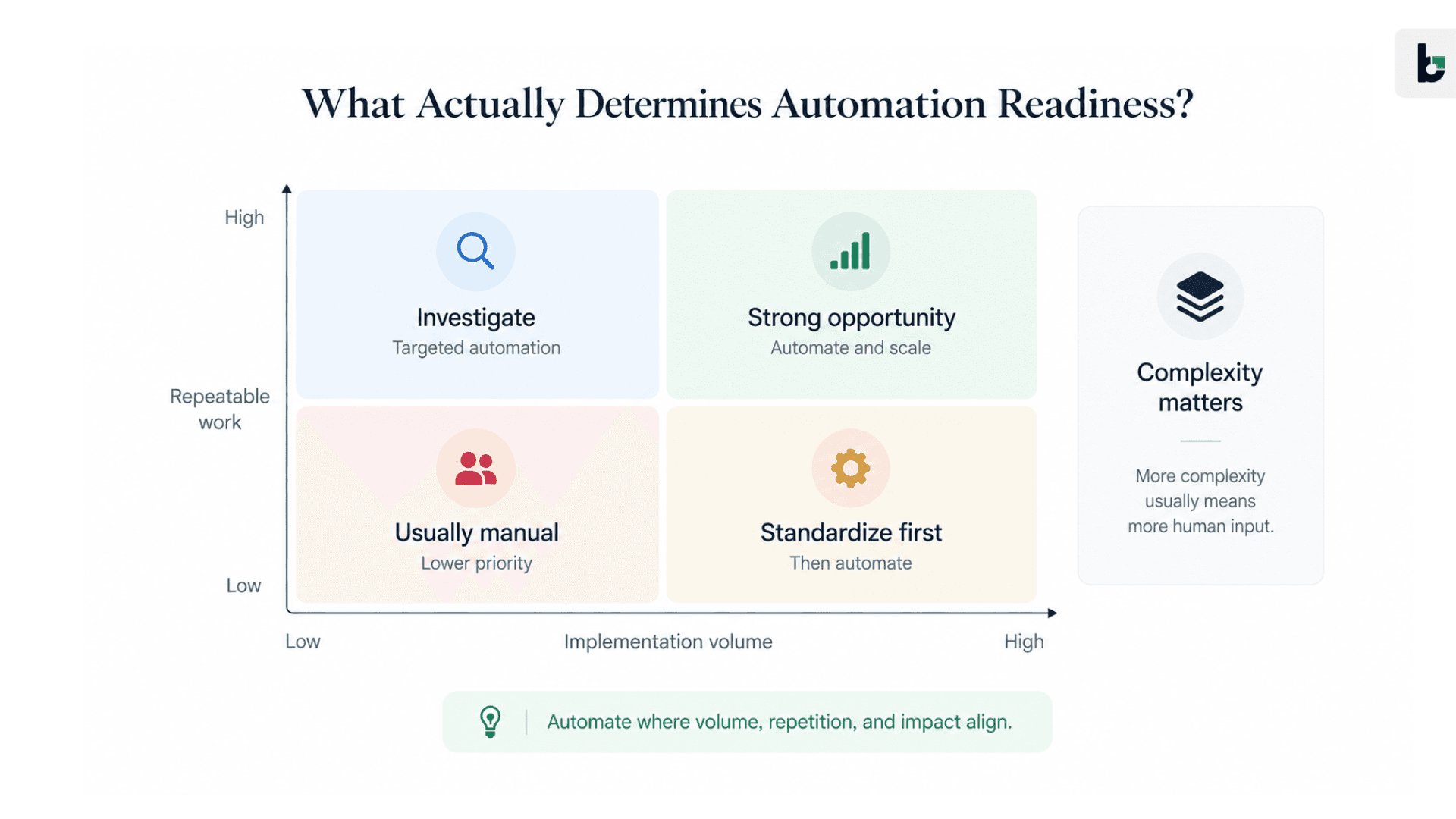
7. Your process is standardized enough to automate
This final signal is the one companies often skip.
Before automating a process, make sure you understand the process.
If every implementation is different, every customer requires a completely different sequence, and nobody agrees on what “done” means at each stage, automation may simply turn confusion into software.
Standardization should generally come before large-scale automation.
That does not mean every customer needs the same implementation. It means the organization should know which parts are standard and which parts are exceptions.
A mature implementation process might say:
“We always collect these requirements.”
“These configuration steps happen for every customer.”
“These tests must pass before go-live.”
“These approvals are mandatory.”
“These three paths are the standard variations.”
“Everything outside those paths is an exception requiring human review.”
Once those boundaries exist, automation becomes much easier.
This is also where best-in-class enterprise onboarding becomes a useful reference. The strongest onboarding organizations do not simply document more steps; they turn implementation experience into repeatable implementation intelligence.
When Manual Implementation Stops Scaling
Manual implementation stops scaling when adding customers consistently requires adding people, coordination, and management effort at approximately the same rate.
The clearest way to see this is to imagine two SaaS companies.
Company A has 50 implementations per year. Each requires 100 hours of delivery effort. The organization therefore consumes roughly 5,000 implementation hours.
The following year, it wins 100 implementations. If nothing changes, it now needs approximately 10,000 hours.
Company B has the same initial workload but identifies 30% of its implementation work as repeatable administrative and procedural work. Over time, it automates part of that work and standardizes the rest. The implementation team still performs complex customer-facing work, but the amount of human effort required per customer falls.
These numbers are illustrative rather than industry benchmarks. The point is the shape of the curve.
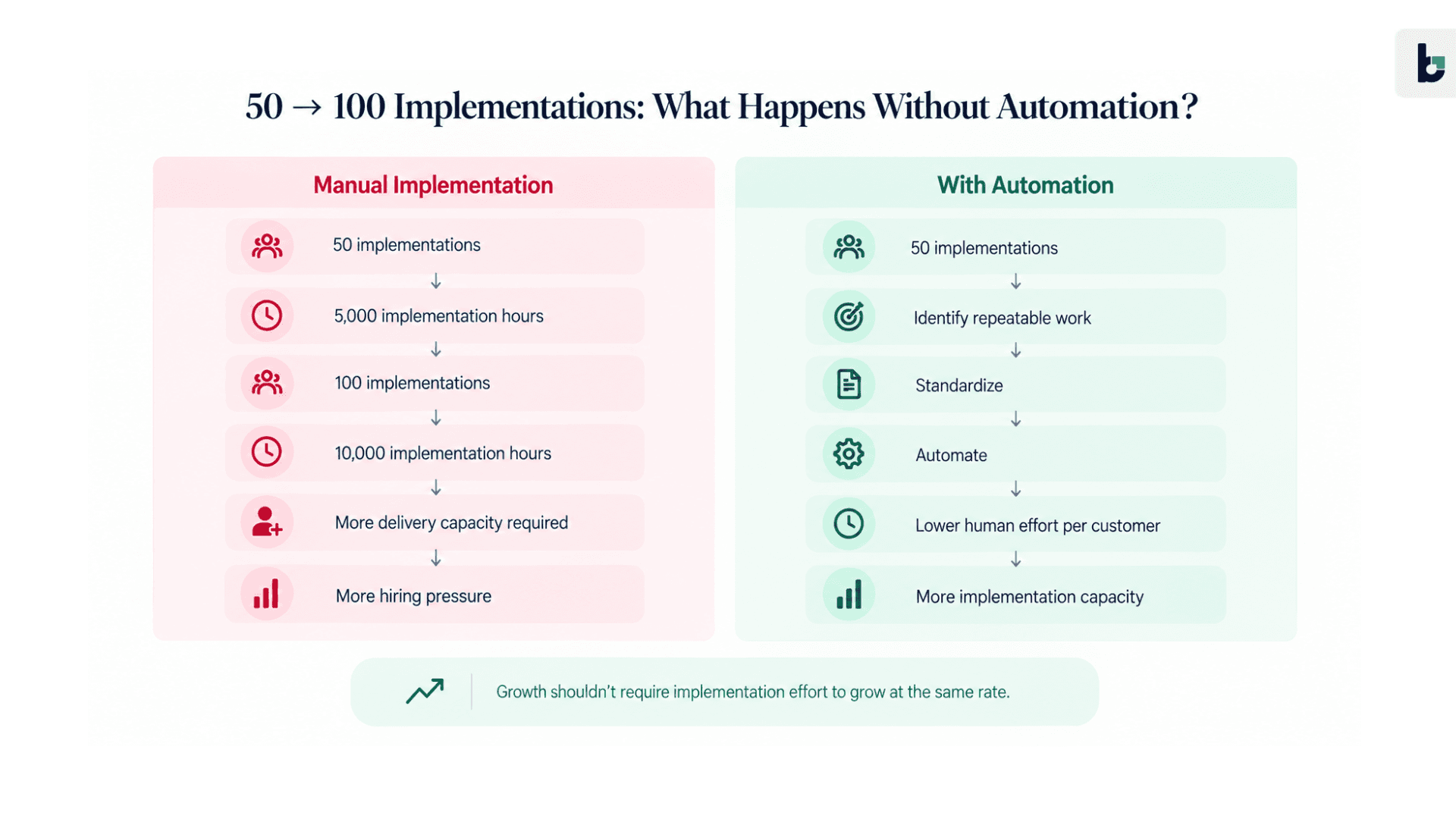
In a purely manual model, workload tends to grow with customer count.
In a leveraged model, customer volume can grow faster than the amount of human effort required to deliver each implementation.
That is what SaaS implementation scalability actually means.
It does not mean making every implementation identical. It means increasing the amount of customer value your organization can deliver without increasing operational complexity at the same rate.
The most important metric may therefore be implementation effort per customer, not implementation duration alone.
Two teams can both achieve a 90-day go-live. One may use 250 hours and the other 700 hours. If your dashboard only records the go-live date, those implementations look identical. Operationally, they are not.
This is why measuring implementation efficiency beyond time to go-live matters. The date tells you when the customer went live. The effort tells you what the organization had to spend to get there.
How Implementation Volume, Complexity, and Headcount Affect the Decision
So what implementation volume justifies automation?
There is no universal number.
A company doing 25 implementations a year may have an excellent automation business case if each implementation is expensive, highly repetitive, and consumes hundreds of hours. Another company doing 250 implementations may have a weaker case if every project is radically different and requires substantial human judgment.
The decision is better understood through four variables: volume, complexity, repetition, and cost.
Volume tells you how frequently the process occurs. Complexity tells you how much judgment is required. Repetition tells you how much of the work can potentially be standardized. Cost tells you whether the opportunity is economically meaningful.
You can think about the opportunity as:
Automation opportunity = implementation volume × repeatable work × cost per unit of manual effort × cost of delay
This is not a financial accounting formula. It is a decision framework.
Imagine a company with 120 implementations per year. Each implementation takes 150 hours. That is 18,000 hours of delivery effort.
Now suppose an internal time study finds that 25% of those hours are spent on activities that are highly repeatable.
That represents 4,500 hours of potentially addressable work.
The next question is not whether all 4,500 hours can be automated. They cannot. Some work will always require review, exceptions will exist, and automation itself requires maintenance.
But even if the organization can eliminate or materially reduce a portion of those hours, the scale of the opportunity becomes measurable.
This is also where SaaS implementation capacity becomes a strategic planning issue.
If sales forecasts 180 new enterprise customers next year, the implementation leader should be able to model not only how many people are required but how much implementation effort those customers represent, which work is repeatable, where capacity will be constrained, and which bottlenecks can be removed through process redesign or automation.
That creates a much better conversation with finance and executive leadership than simply saying, “We need three more implementation managers.”
For teams evaluating whether the next step should be a project-management layer, point automation, or full implementation orchestration, Beacon's implementation orchestration use case is a useful example of the latter approach: executing configuration, data readiness, UAT, cutover, and hypercare as connected implementation work rather than simply tracking those activities.
How to Calculate the ROI of Implementation Automation
Implementation automation ROI should be calculated as an operating model, not as a vague promise that “AI will save time.”
Start with the current state.
How many implementations do you run each year? How many hours does each implementation consume? What percentage of those hours are spent on repetitive activities? What is the loaded cost of the people performing that work? How much implementation backlog exists? How long does an average customer wait between major stages? How much rework happens? How often do projects require escalation?
Once those numbers are available, calculate the addressable cost.
A simple starting point is:
Annual manual-work cost = annual implementations × addressable hours per implementation × loaded hourly cost
For example, imagine an enterprise SaaS company running 100 implementations a year. Suppose a time study shows that 20 hours per implementation are spent on highly repetitive coordination and administrative work, and the loaded cost of that work is $60 per hour.
That creates an illustrative annual cost of:
100 × 20 × $60 = $120,000
The $120,000 is not automatically the savings opportunity. Automation will not eliminate every one of those hours, and the company may choose to redeploy some of the recovered capacity toward higher-value customer work.
That distinction is important.
There are at least four sources of value from implementation automation.
The first is direct labor efficiency. Fewer hours are required to perform the same implementation work.
The second is capacity creation. The existing team can support more customers before another hire becomes necessary.
The third is cycle-time reduction. Customers move through the implementation process faster because work is executed and handed off more efficiently.
The fourth is quality and rework reduction. Structured processes can reduce the number of times teams have to reinterpret requirements, correct configuration errors, or repeat work.
The financial model should include all four where they can be measured credibly.
A practical ROI calculation is:
Implementation automation ROI = (annual financial benefit − annual automation cost) ÷ total implementation investment
The investment should include more than software licensing. Include implementation, engineering effort, integration work, change management, training, governance, and ongoing maintenance.
Then calculate payback:
Payback period = initial investment ÷ monthly financial benefit
The most important part of this exercise is not producing an impressive ROI percentage. It is understanding which assumptions create the ROI.
If the business case depends entirely on eliminating headcount, it may be fragile.
If the business case comes from a combination of reduced manual work, increased implementation capacity, faster customer value realization, and reduced rework, it is usually more representative of how implementation automation actually creates value.
This is also why it is useful to look at implementation automation alongside enterprise implementation KPIs. Delivery effort, cost per customer, rework, post-go-live escalations, and execution automation rate tell a more complete story than one ROI percentage.
When Automation Is Not Yet Worth the Investment
There are situations where implementation automation is the wrong investment.
The first is low volume. If a company performs only a handful of implementations a year, the opportunity may simply not be large enough to justify building or adopting sophisticated automation.
The second is extreme variability. If every customer requires a different process, different architecture, different configuration, and different delivery model, the company may need to standardize its offering before automating execution.
The third is process instability. If implementation leaders are still changing the process every few weeks, automation can become technical debt. The software ends up encoding a process that the organization is about to replace.
The fourth is poor data quality. Automation is only as reliable as the information driving it. If customer requirements are incomplete, contradictory, or scattered across meeting notes, emails, spreadsheets, and chat messages, automating the workflow without fixing the information problem may simply accelerate mistakes.
The fifth is engineering opportunity cost. A SaaS company should compare implementation automation with other possible uses of its engineering and operational resources. An automation project that saves $50,000 a year but consumes a year of critical engineering capacity may not be the right investment.
The sixth is that the real bottleneck may be the product itself.
If customers cannot complete implementation because the product lacks required configuration capabilities, integrations, APIs, or deployment flexibility, automating project management will not solve the underlying problem.
The right question is therefore not:
“Can this process be automated?”
Almost every process can be automated to some degree.
The better question is:
“Will automating this process remove a meaningful constraint on customer value or business growth?”
What to Automate First in an Enterprise SaaS Implementation
Once the business case is established, resist the temptation to automate everything.
Start where repetition is highest and judgment is lowest.
The first layer is administrative work: reminders, notifications, task creation, scheduling, status updates, approval requests, and routine handoffs.
The second layer is information management. Requirements gathering is particularly valuable because the quality of information captured early affects every downstream implementation phase. A requirement that is ambiguous during discovery becomes a clarification request during configuration, a rework cycle during testing, and potentially a support issue after go-live.
That makes structured requirements one of the highest-leverage automation opportunities.
Beacon's enterprise SaaS implementation checklist emphasizes turning requirements into structured, executable specifications rather than leaving them as unstructured notes from customer conversations.
The third layer is workflow orchestration.
Instead of a project manager checking whether a customer completed an activity and then manually triggering the next step, the system can detect completion and move the workflow forward. Instead of a team member checking five systems for dependencies, the workflow can surface the dependency automatically.
The fourth layer is configuration.
Once implementation requirements are standardized, repeatable configuration can often be generated or executed from those requirements. This is where AI-based implementation approaches become particularly interesting because they can connect natural-language requirements with structured execution.
The fifth layer is testing.
Testing should not be treated as a final ceremony before go-live. If implementation automation can generate tests from known requirements and identify failures earlier in the lifecycle, the organization can move from discovering problems late to continuously validating the implementation as it is built.
Finally, there is hypercare.
A surprising amount of implementation knowledge disappears when the project closes. The people who know why a particular configuration exists move to another customer. The implementation document becomes outdated. The support team inherits the customer without the complete decision trail.
Automation becomes much more powerful when it preserves the operational memory of the implementation.
This is one reason Beacon's implementation orchestration approach extends beyond project management into execution across configuration, data validation, testing, cutover, and hypercare. The goal is not simply to track implementation work. It is to create a system in which implementation knowledge and execution can compound from one customer to the next.
How to Build the Business Case for Implementation Automation
When you take implementation automation to a CFO, COO, CRO, or CEO, do not start with the technology.
Start with the constraint.
For example:
“Our enterprise bookings are increasing, but implementation capacity is becoming the limiting factor. At the current workload, we expect implementation demand to exceed available capacity next year. A meaningful portion of current delivery effort is repetitive coordination and configuration work. We want to automate that work so the existing team can support more customers while preserving human attention for complex implementation decisions.”
That is a business case.
“AI can automate implementation” is not.
The next step is to quantify the current state.
Document your annual implementation volume, average implementation duration, implementation hours per customer, headcount, loaded delivery cost, rework, backlog, time spent waiting for customer inputs, and the percentage of projects that require escalation.
Then identify the repeatable work.
A useful exercise is to take ten recently completed implementations and compare the actual work performed rather than the work that was supposed to happen according to the official playbook.
Look for recurring patterns.
What was copied? What was manually re-entered? What was repeatedly requested? What was repeatedly checked? What was repeatedly configured? What was repeatedly documented? What was repeatedly explained?
That list becomes your automation backlog.
Then rank those opportunities using three criteria: frequency, effort, and consequence.
A task performed once a year is rarely worth automating.
A task performed every day across 100 implementations may be.
A task that consumes five minutes but creates no downstream delay may not matter.
A task that consumes five minutes but blocks a five-day workflow might be extremely valuable.
This is how an implementation automation business case moves from “we should use AI” to “this specific bottleneck costs us this much, occurs this frequently, and can be reduced through this specific intervention.”
For SaaS leaders who want to see what this looks like beyond the business-case spreadsheet, Beacon offers a more concrete evaluation path: the company says it can set up its platform on a demo version of a customer's product and demonstrate an implementation cycle in seven days. See how Beacon approaches enterprise implementation orchestration.
Implementation Automation Readiness Checklist
An enterprise SaaS company is worth evaluating for implementation automation when several of the following conditions are true.
Your implementation volume is increasing, multiple implementations are running simultaneously, or your implementation backlog is beginning to grow. Your implementation team is approaching capacity and additional customer volume is creating pressure to hire. Your implementation managers spend substantial time on administrative coordination rather than customer-facing problem solving. The same requirements, configurations, communications, validation steps, and handoffs occur repeatedly across customers.
Your company can measure implementation cost and effort at least approximately. You know how long implementations take, how many people are involved, and where the largest amounts of rework occur. You can distinguish time spent actively working from time spent waiting for customers, approvals, dependencies, or internal handoffs.
Your implementation process has recognizable stages and approval gates. Your organization knows what a successful discovery looks like, what information configuration requires, what must be tested before go-live, and what information needs to be handed to customer success or support afterward.
Most importantly, you can identify a meaningful amount of work that is both repeatable and economically significant.
If all of those conditions are present, the next step is not necessarily to purchase an automation platform.
The next step is to quantify the opportunity.
Measure the work. Identify the bottlenecks. Separate judgment from repetition. Calculate the cost. Estimate the capacity that could be recovered. Then determine whether the economics justify investment.
That is the point at which implementation automation stops being an innovation project and becomes an operating decision.
Frequently Asked Questions About SaaS Implementation Automation
When should a SaaS company automate implementation?
A SaaS company should consider automation when implementation workload is becoming a constraint on growth, repeatable work is consuming meaningful delivery capacity, coordination delays are affecting time-to-value, and the process is standardized enough for software to execute reliably.
There is no universal implementation-volume threshold. The strongest business cases usually combine meaningful volume with repetition, measurable manual effort, and a clear economic cost associated with delay or additional delivery capacity.
When is implementation automation worth the investment?
Implementation automation is worth evaluating when the financial value of recovered capacity, lower implementation effort, faster delivery, and reduced rework can reasonably exceed the cost of the automation itself.
The important calculation is not simply “How much labor can we remove?” It is “How much additional customer volume, delivery capacity, speed, and quality can we create from the same implementation organization?”
What are the signs a SaaS company needs implementation automation?
The clearest signs are implementation headcount rising alongside customer volume, recurring administrative work across projects, experienced consultants spending too much time on low-judgment tasks, coordination delays between implementation stages, growing backlog, increasing rework, and pressure to reduce time-to-value without simply adding more people.
What implementation volume justifies automation?
There is no fixed number.
A company doing 25 implementations a year could justify automation if each implementation consumes hundreds of hours and contains highly repeatable work. A company doing 250 implementations could have a weaker business case if every project is highly bespoke.
Volume matters, but volume multiplied by repeatable work and manual effort is more informative than volume alone.
How do you calculate the ROI of implementation automation?
Start with annual implementation volume, addressable manual hours per implementation, loaded delivery cost, current rework, implementation backlog, and automation investment.
A simple starting point is:
Annual manual-work cost = annual implementations × addressable hours per implementation × loaded hourly cost
Then model the benefits from reduced effort, increased capacity, faster cycle time, and reduced rework. Compare those benefits with software, implementation, engineering, training, governance, and maintenance costs.
How can SaaS companies scale implementations without adding headcount?
The objective is not necessarily to stop hiring. It is to reduce the amount of implementation work that requires a person to execute every step.
That means automating repeatable configuration, data preparation, validation, testing, workflow coordination, and other execution work while keeping solution design, exception handling, stakeholder management, and complex decisions human-led.
Beacon is specifically positioned around this model, using AI orchestration to execute implementation work across the lifecycle rather than simply providing another project-management layer. Its platform materials describe execution across configuration, data validation, UAT, cutover, and hypercare. Explore Beacon's implementation orchestration platform.
What should an enterprise SaaS company automate first?
Start with high-frequency, low-judgment activities.
Administrative coordination, requirements structuring, repeatable configuration, dependency checks, data validation, testing, routine approvals, cutover checks, and predictable hypercare activities are potential candidates.
Strategic solution design, ambiguous requirements, stakeholder negotiations, exception decisions, and governance should generally remain human-led.
What is AI implementation orchestration?
AI implementation orchestration is the use of AI to coordinate and execute implementation work across multiple stages rather than automating isolated tasks.
Instead of automating only a reminder or configuration script, an orchestration layer can connect requirements to configuration, validation, testing, cutover, and post-go-live work.
This is the category Beacon operates in: its platform describes itself as an AI-powered implementation orchestration platform for enterprise SaaS deployments, spanning configuration through hypercare. See Beacon's full implementation platform.
How is Beacon different from a project-management or PSA tool?
Project-management and PSA tools are useful for tracking work, resources, timelines, approvals, and financial information. But tracking implementation work is different from executing implementation work.
Beacon positions itself around the execution layer: learning how a SaaS product is configured, executing repeatable implementation actions, validating outcomes, and coordinating work across the implementation lifecycle.
That distinction matters when the bottleneck is not visibility into the work but the amount of human effort required to perform it. See how Beacon approaches implementation automation beyond project management.
Can Beacon automate SaaS onboarding?
Beacon is designed to automate execution across enterprise SaaS implementation and onboarding workflows, including configuration, data readiness, testing, cutover, and hypercare. Its onboarding material describes an end-to-end approach rather than a collection of disconnected onboarding tools. Read Beacon's guide to accelerating enterprise SaaS customer onboarding.
How do you know when to automate SaaS implementations?
Look at four things together: volume, repetition, human effort, and cost of delay.
If implementation demand is increasing, the same work is being repeated across customers, experienced people are spending significant time executing procedural tasks, and those constraints have a measurable economic impact, you likely have an automation opportunity.
The final test is simple: does automating the work remove a meaningful constraint on customer value or business growth?
The Real Question Is Not Whether to Automate. It Is What Your Implementation Team Should Still Be Doing Manually.
The most important shift in thinking is simple.
Enterprise SaaS companies do not become scalable because they hire enough implementation managers to keep up with demand. They become scalable when the implementation system itself gets better at absorbing demand.
That does not mean replacing implementation professionals with software. In complex enterprise environments, the opposite can be true. Automation can make experienced implementation professionals more valuable because it removes the administrative work that prevents them from applying their judgment where it matters.
The implementation manager should be solving the customer's difficult problem, not updating the same status field in three systems.
The consultant should be deciding how to handle an unusual business rule, not copying requirements from a meeting transcript into a spreadsheet.
The customer success leader should be preparing for adoption and expansion, not reconstructing what happened during implementation from a collection of Slack messages and project documents.
And the organization should be learning from every implementation instead of starting the next one from a blank project plan.
That is ultimately the difference between automation as a productivity feature and automation as an operating model.
Beacon's own platform is built around this broader idea. Rather than positioning automation as a collection of individual shortcuts, Beacon connects requirements, configuration, testing, data, cutover, and hypercare into an execution layer for enterprise SaaS implementation.
The companies that benefit most will not necessarily be the ones that automate the greatest number of tasks.
They will be the ones that understand which work should remain human, which work should become software, and where the boundary between the two creates the greatest operating leverage.
So, when should a SaaS company automate implementation?
When implementation has become a constraint on growth, when repeatable work is consuming meaningful human capacity, when the cost of delay is measurable, when the process is standardized enough to automate, and when the expected capacity and economic gains exceed the cost of building and maintaining the automation.
At that point, the question is no longer whether implementation automation is interesting.
It becomes whether continuing to run a growing implementation operation manually is the more expensive choice.
Ready to see what implementation automation could look like on your own product?
If your implementation team is already dealing with growing volume, repetitive configuration, manual validation, dependency management, or increasing pressure to add delivery headcount, the next step is to test the economics rather than debate automation in the abstract. Book a demo with Beacon.li and see how an AI implementation orchestration layer can execute real implementation workflows across your product. Beacon currently offers a seven-day demo approach using a demo version of the product so teams can see configuration, migration, validation, and support workflows in action rather than evaluating the platform from slides alone.
There is a point in the life of almost every growing enterprise SaaS company when implementation stops feeling like a customer-success function and starts behaving like a capacity constraint.
Sales is doing its job. The pipeline is healthy. New contracts are being signed. The product is mature enough to support larger customers. Then the implementation team starts asking a different set of questions: How many customers can we actually onboard next quarter? How many implementation managers do we need to hire? Why are projects taking longer even though the team has more experience? Why are experienced consultants spending their days chasing approvals, updating project plans, copying requirements between systems, and answering questions that were already resolved three weeks ago?
This is usually the point at which the question changes from “How do we improve implementation?” to “When should we automate SaaS implementation?”
The answer is not determined by a magic number of implementations per month. A company does not suddenly become ready for automation at 50, 100, or 500 implementations. The decision depends on the relationship between implementation volume, complexity, repetition, human capacity, cost, and the economic consequences of delay.
A useful way to think about it is this: implementation automation becomes worth investigating when the amount of repeatable work inside your implementation process is growing faster than your organization's ability to absorb it efficiently.
That distinction matters. A highly bespoke enterprise implementation with dozens of stakeholders may require significant human judgment even if you automate every administrative task around it. Conversely, a relatively small implementation team can have a compelling automation case if its members spend a large proportion of their time repeating the same work across customers.
The goal, therefore, is not to automate implementation because automation is fashionable. The goal is to create implementation capacity without allowing implementation costs, timelines, and headcount to grow in direct proportion to customer volume.
What Is SaaS Implementation Automation?
SaaS implementation automation is the use of software, workflow automation, AI, and orchestration to execute repeatable parts of the journey from signed contract to successful customer deployment.
That journey can include requirements gathering, discovery, configuration, provisioning, data preparation, integration setup, testing, approvals, customer communication, go-live coordination, and post-launch support. In a mature enterprise SaaS organization, implementation is rarely one process owned by one team. It is a chain of interdependent activities involving sales, solutions engineering, implementation, professional services, product, engineering, IT, security, customer success, and the customer itself.
That is why implementation automation should not be confused with simply automating a few administrative tasks.
Sending an automated reminder is automation. Automatically converting a discovery conversation into structured requirements is automation. Creating a project plan from those requirements is automation. Applying standardized configuration based on approved requirements is automation. Generating test cases from the implementation blueprint and identifying exceptions before go-live is a much deeper form of automation.
The distinction becomes especially important in enterprise SaaS because implementation is where commercial promises become operational reality. A contract may say what the customer bought, but implementation determines what actually gets configured, integrated, tested, adopted, and ultimately used.
A useful implementation automation strategy therefore starts with the entire implementation lifecycle rather than a collection of disconnected tasks. Beacon's Enterprise SaaS Implementation Checklist maps the implementation journey across requirements, blueprinting, configuration, testing, go-live, and hypercare, treating those stages as connected parts of one delivery system rather than isolated activities.
That way of thinking is important because the biggest sources of implementation inefficiency often occur at the boundaries between phases rather than inside any individual task.
The same principle applies to SaaS onboarding. Automating SaaS onboarding is not simply about sending customers more emails or giving them a better checklist. It is about reducing the amount of manual coordination required to move a customer from one implementation state to the next. Beacon describes this distinction in its guide to accelerating enterprise SaaS customer onboarding: tracking implementation work is different from actually executing it.
The best automation therefore removes repetitive execution while preserving human judgment where it actually matters.
An implementation manager should not have to spend an hour every morning checking which customers have completed a form, copying information into another system, updating five project plans, and sending six nearly identical emails. That work is a poor use of implementation capacity. The manager's time is more valuable when a customer has an unusual requirement, a critical integration has failed, a stakeholder is disagreeing about scope, or a deployment needs a decision that cannot be derived from a rule.
That is the central idea behind implementation automation: automate the repeatable work so people can concentrate on the consequential work.
Why Implementation Becomes a Growth Bottleneck
Imagine a SaaS company that signs ten enterprise customers in a quarter. Its implementation team can handle them comfortably. Everyone knows the customers. Project plans are manageable. Consultants have enough time to understand each account. The occasional spreadsheet or manual handoff does not feel expensive.
Now imagine the same company signs forty customers in a quarter.
The company has not necessarily made its implementation process four times harder. But the number of handoffs, approvals, configuration activities, status updates, dependencies, and exceptions can increase rapidly as more projects run in parallel.
The first response is usually to hire.
One implementation manager becomes two. Two become four. A professional services leader adds another project manager. Customer success adds another onboarding specialist. Operations introduces a new dashboard. Someone creates a larger spreadsheet to track everything.
For a while, this works.
Then the company grows again.
This is how implementation becomes a growth bottleneck. The organization is not necessarily running out of people. It is running out of operational leverage.
Professional Services organizations have long treated utilization, resource allocation, profitability, and delivery efficiency as critical operating metrics. That distinction is particularly important in SaaS implementation because an implementation manager may appear fully utilized while a substantial portion of the day is spent on work that creates little incremental customer value: moving information between systems, preparing status reports, requesting missing information, coordinating meetings, updating documentation, and translating one team's output into another team's input.
From the outside, the person is busy.
From an operational perspective, the organization may be wasting scarce implementation capacity.
This is why SaaS implementation scalability should not be measured only by the number of customers that successfully go live. Two customers can go live on the same day while consuming dramatically different amounts of implementation effort.
Beacon's analysis of how to measure implementation efficiency beyond time to go-live makes this distinction explicit: time to go-live alone cannot reveal how much rework, human effort, or post-launch support an implementation consumed. Implementation efficiency is better understood through effort, cost, capacity, quality, and customer value.
That changes the question leaders should ask.
Instead of asking, “How quickly are we getting customers live?”, ask:
“How much implementation capacity does each successful go-live consume?”
That is where the automation opportunity begins.
7 Signs Your Enterprise SaaS Company Is Ready for Implementation Automation
1. Implementation volume is growing faster than implementation capacity
The most obvious signal is also the easiest to misinterpret.
More implementations do not automatically mean you need automation. What matters is whether implementation workload is growing faster than the team's practical capacity to deliver it.
Suppose an implementation team can comfortably manage 20 concurrent projects. The sales organization begins closing enough enterprise business to create 30, then 40, then 50 concurrent implementations. If the only solution is to keep adding implementation managers, the company has created a linear relationship between revenue growth and delivery headcount.
That may be perfectly rational for highly bespoke professional services. But if a significant proportion of those projects contain the same discovery questions, the same configuration patterns, the same customer communications, the same validation steps, and the same handoffs, the company may be paying people to repeatedly execute a process that could be partially standardized and automated.
The question to ask is not, “How many implementations do we have?”
It is, “How many implementation hours are we buying with every new customer?”
That is a much more revealing metric.
2. Implementation headcount is rising almost in lockstep with customer volume
Hiring is not a failure.
Sometimes hiring is exactly what a growing SaaS company should do. Enterprise customers have legitimate complexity, and complex implementations require people.
The warning sign appears when headcount becomes the default answer to every increase in demand.
If implementation volume rises by 50% and implementation headcount must rise by roughly 50% just to preserve service levels, the organization has limited operating leverage. The company is scaling people alongside customers rather than making the implementation system itself more productive.
This is where the phrase scale SaaS implementations without hiring needs to be interpreted carefully. The goal is not necessarily to avoid hiring forever. The goal is to avoid hiring people simply because the organization has not automated work that does not require human judgment.
Beacon's approach to scaling SaaS Professional Services without proportional hiring is built around this distinction: automate environment setup, data validation, configuration, and workflow execution so delivery teams can reserve human capacity for work that actually requires expertise.
A healthy automation strategy can make each implementation employee more capable without expecting that person to work more hours.
3. Your implementation team repeats the same work on almost every customer
This is perhaps the strongest signal of all.
Listen to implementation managers describe their week.
If you repeatedly hear phrases such as “I have to update this in three places,” “I need to send the same email again,” “I have to turn those notes into a project plan,” “we are waiting for the customer to complete the same form,” or “I need to check whether that configuration was completed,” you have discovered repetition.
Repetition is the raw material of automation.
A good exercise is to take the last ten implementations and list every major activity performed by the team. Put a mark beside activities that appeared in at least seven of those ten projects.
You will probably discover that implementation contains two very different categories of work.
The first category requires judgment: interpreting ambiguous requirements, resolving conflicts, designing solutions, managing executives, handling exceptions, and deciding what to do when reality does not match the playbook.
The second category is procedural: collecting information, creating tasks, updating systems, generating documents, checking prerequisites, notifying stakeholders, validating standard configurations, and moving work between stages.
The second category is where automation should begin.
Beacon's broader implementation model extends this principle into AI for enterprise SaaS implementations, where requirements, configuration, testing, data, and execution are treated as connected inputs rather than separate manual activities.
4. Implementation delays are caused by coordination rather than technical complexity
Not every delay is an automation problem.
Some enterprise implementations take time because the customer has complex security requirements, difficult integrations, extensive data migration, or genuine organizational change to manage.
But a different kind of delay appears when projects sit idle because someone has not completed a form, an approval has not been requested, a requirement is sitting in a meeting transcript, a configuration task has not been assigned, or one team does not know that another team finished its dependency.
These are coordination bottlenecks.
They are particularly expensive because the underlying work may be simple while the waiting time is not.
The distinction between task effort and elapsed time matters enormously in enterprise implementation. A five-minute action can create a five-day delay if it sits inside a sequential workflow.
That is why implementation automation should focus not only on reducing the time required to perform tasks but also on reducing the time work spends waiting between tasks.
5. Experienced implementation managers spend too much time on administrative work
This is the human version of the same problem.
A senior implementation leader is often one of the most experienced people in the delivery organization. Their value comes from solving difficult customer problems, not from manually maintaining project hygiene.
If experienced consultants spend significant time creating status reports, moving data between systems, preparing repetitive documentation, checking task completion, or chasing information, the organization is using expensive judgment capacity to perform low-judgment work.
This is where implementation efficiency becomes an economic issue.
Busy does not necessarily mean productive.
The more useful question is: How much of that person's day is spent executing work that a reliable system could execute instead?
6. Time-to-value is becoming a commercial metric
Implementation is not an isolated operational event. It sits between the sale and the customer's realization of value.
The longer that gap becomes, the longer the customer waits before the product becomes useful in the customer's real environment.
That matters because implementation delays can affect onboarding, adoption, Professional Services economics, and the point at which customers can begin realizing the outcomes that justified the purchase. Beacon's research on how AI is transforming enterprise software implementation similarly frames implementation efficiency as a financial and growth concern rather than simply a delivery metric.
That does not mean faster implementation automatically causes higher retention. It does mean implementation deserves to be viewed as part of the broader customer-value system rather than merely a delivery department.
If implementation is delaying the moment at which customers can realize value, adoption and expansion conversations are starting later than they otherwise might.
That makes time-to-value a useful metric for an implementation automation business case.
7. Your process is standardized enough to automate
This final signal is the one companies often skip.
Before automating a process, make sure you understand the process.
If every implementation is different, every customer requires a completely different sequence, and nobody agrees on what “done” means at each stage, automation may simply turn confusion into software.
Standardization should generally come before large-scale automation.
That does not mean every customer needs the same implementation. It means the organization should know which parts are standard and which parts are exceptions.
A mature implementation process might say:
“We always collect these requirements.”
“These configuration steps happen for every customer.”
“These tests must pass before go-live.”
“These approvals are mandatory.”
“These three paths are the standard variations.”
“Everything outside those paths is an exception requiring human review.”
Once those boundaries exist, automation becomes much easier.
This is also where best-in-class enterprise onboarding becomes a useful reference. The strongest onboarding organizations do not simply document more steps; they turn implementation experience into repeatable implementation intelligence.
When Manual Implementation Stops Scaling
Manual implementation stops scaling when adding customers consistently requires adding people, coordination, and management effort at approximately the same rate.
The clearest way to see this is to imagine two SaaS companies.
Company A has 50 implementations per year. Each requires 100 hours of delivery effort. The organization therefore consumes roughly 5,000 implementation hours.
The following year, it wins 100 implementations. If nothing changes, it now needs approximately 10,000 hours.
Company B has the same initial workload but identifies 30% of its implementation work as repeatable administrative and procedural work. Over time, it automates part of that work and standardizes the rest. The implementation team still performs complex customer-facing work, but the amount of human effort required per customer falls.
These numbers are illustrative rather than industry benchmarks. The point is the shape of the curve.
In a purely manual model, workload tends to grow with customer count.
In a leveraged model, customer volume can grow faster than the amount of human effort required to deliver each implementation.
That is what SaaS implementation scalability actually means.
It does not mean making every implementation identical. It means increasing the amount of customer value your organization can deliver without increasing operational complexity at the same rate.
The most important metric may therefore be implementation effort per customer, not implementation duration alone.
Two teams can both achieve a 90-day go-live. One may use 250 hours and the other 700 hours. If your dashboard only records the go-live date, those implementations look identical. Operationally, they are not.
This is why measuring implementation efficiency beyond time to go-live matters. The date tells you when the customer went live. The effort tells you what the organization had to spend to get there.
How Implementation Volume, Complexity, and Headcount Affect the Decision
So what implementation volume justifies automation?
There is no universal number.
A company doing 25 implementations a year may have an excellent automation business case if each implementation is expensive, highly repetitive, and consumes hundreds of hours. Another company doing 250 implementations may have a weaker case if every project is radically different and requires substantial human judgment.
The decision is better understood through four variables: volume, complexity, repetition, and cost.
Volume tells you how frequently the process occurs. Complexity tells you how much judgment is required. Repetition tells you how much of the work can potentially be standardized. Cost tells you whether the opportunity is economically meaningful.
You can think about the opportunity as:
Automation opportunity = implementation volume × repeatable work × cost per unit of manual effort × cost of delay
This is not a financial accounting formula. It is a decision framework.
Imagine a company with 120 implementations per year. Each implementation takes 150 hours. That is 18,000 hours of delivery effort.
Now suppose an internal time study finds that 25% of those hours are spent on activities that are highly repeatable.
That represents 4,500 hours of potentially addressable work.
The next question is not whether all 4,500 hours can be automated. They cannot. Some work will always require review, exceptions will exist, and automation itself requires maintenance.
But even if the organization can eliminate or materially reduce a portion of those hours, the scale of the opportunity becomes measurable.
This is also where SaaS implementation capacity becomes a strategic planning issue.
If sales forecasts 180 new enterprise customers next year, the implementation leader should be able to model not only how many people are required but how much implementation effort those customers represent, which work is repeatable, where capacity will be constrained, and which bottlenecks can be removed through process redesign or automation.
That creates a much better conversation with finance and executive leadership than simply saying, “We need three more implementation managers.”
For teams evaluating whether the next step should be a project-management layer, point automation, or full implementation orchestration, Beacon's implementation orchestration use case is a useful example of the latter approach: executing configuration, data readiness, UAT, cutover, and hypercare as connected implementation work rather than simply tracking those activities.
How to Calculate the ROI of Implementation Automation
Implementation automation ROI should be calculated as an operating model, not as a vague promise that “AI will save time.”
Start with the current state.
How many implementations do you run each year? How many hours does each implementation consume? What percentage of those hours are spent on repetitive activities? What is the loaded cost of the people performing that work? How much implementation backlog exists? How long does an average customer wait between major stages? How much rework happens? How often do projects require escalation?
Once those numbers are available, calculate the addressable cost.
A simple starting point is:
Annual manual-work cost = annual implementations × addressable hours per implementation × loaded hourly cost
For example, imagine an enterprise SaaS company running 100 implementations a year. Suppose a time study shows that 20 hours per implementation are spent on highly repetitive coordination and administrative work, and the loaded cost of that work is $60 per hour.
That creates an illustrative annual cost of:
100 × 20 × $60 = $120,000
The $120,000 is not automatically the savings opportunity. Automation will not eliminate every one of those hours, and the company may choose to redeploy some of the recovered capacity toward higher-value customer work.
That distinction is important.
There are at least four sources of value from implementation automation.
The first is direct labor efficiency. Fewer hours are required to perform the same implementation work.
The second is capacity creation. The existing team can support more customers before another hire becomes necessary.
The third is cycle-time reduction. Customers move through the implementation process faster because work is executed and handed off more efficiently.
The fourth is quality and rework reduction. Structured processes can reduce the number of times teams have to reinterpret requirements, correct configuration errors, or repeat work.
The financial model should include all four where they can be measured credibly.
A practical ROI calculation is:
Implementation automation ROI = (annual financial benefit − annual automation cost) ÷ total implementation investment
The investment should include more than software licensing. Include implementation, engineering effort, integration work, change management, training, governance, and ongoing maintenance.
Then calculate payback:
Payback period = initial investment ÷ monthly financial benefit
The most important part of this exercise is not producing an impressive ROI percentage. It is understanding which assumptions create the ROI.
If the business case depends entirely on eliminating headcount, it may be fragile.
If the business case comes from a combination of reduced manual work, increased implementation capacity, faster customer value realization, and reduced rework, it is usually more representative of how implementation automation actually creates value.
This is also why it is useful to look at implementation automation alongside enterprise implementation KPIs. Delivery effort, cost per customer, rework, post-go-live escalations, and execution automation rate tell a more complete story than one ROI percentage.
When Automation Is Not Yet Worth the Investment
There are situations where implementation automation is the wrong investment.
The first is low volume. If a company performs only a handful of implementations a year, the opportunity may simply not be large enough to justify building or adopting sophisticated automation.
The second is extreme variability. If every customer requires a different process, different architecture, different configuration, and different delivery model, the company may need to standardize its offering before automating execution.
The third is process instability. If implementation leaders are still changing the process every few weeks, automation can become technical debt. The software ends up encoding a process that the organization is about to replace.
The fourth is poor data quality. Automation is only as reliable as the information driving it. If customer requirements are incomplete, contradictory, or scattered across meeting notes, emails, spreadsheets, and chat messages, automating the workflow without fixing the information problem may simply accelerate mistakes.
The fifth is engineering opportunity cost. A SaaS company should compare implementation automation with other possible uses of its engineering and operational resources. An automation project that saves $50,000 a year but consumes a year of critical engineering capacity may not be the right investment.
The sixth is that the real bottleneck may be the product itself.
If customers cannot complete implementation because the product lacks required configuration capabilities, integrations, APIs, or deployment flexibility, automating project management will not solve the underlying problem.
The right question is therefore not:
“Can this process be automated?”
Almost every process can be automated to some degree.
The better question is:
“Will automating this process remove a meaningful constraint on customer value or business growth?”
What to Automate First in an Enterprise SaaS Implementation
Once the business case is established, resist the temptation to automate everything.
Start where repetition is highest and judgment is lowest.
The first layer is administrative work: reminders, notifications, task creation, scheduling, status updates, approval requests, and routine handoffs.
The second layer is information management. Requirements gathering is particularly valuable because the quality of information captured early affects every downstream implementation phase. A requirement that is ambiguous during discovery becomes a clarification request during configuration, a rework cycle during testing, and potentially a support issue after go-live.
That makes structured requirements one of the highest-leverage automation opportunities.
Beacon's enterprise SaaS implementation checklist emphasizes turning requirements into structured, executable specifications rather than leaving them as unstructured notes from customer conversations.
The third layer is workflow orchestration.
Instead of a project manager checking whether a customer completed an activity and then manually triggering the next step, the system can detect completion and move the workflow forward. Instead of a team member checking five systems for dependencies, the workflow can surface the dependency automatically.
The fourth layer is configuration.
Once implementation requirements are standardized, repeatable configuration can often be generated or executed from those requirements. This is where AI-based implementation approaches become particularly interesting because they can connect natural-language requirements with structured execution.
The fifth layer is testing.
Testing should not be treated as a final ceremony before go-live. If implementation automation can generate tests from known requirements and identify failures earlier in the lifecycle, the organization can move from discovering problems late to continuously validating the implementation as it is built.
Finally, there is hypercare.
A surprising amount of implementation knowledge disappears when the project closes. The people who know why a particular configuration exists move to another customer. The implementation document becomes outdated. The support team inherits the customer without the complete decision trail.
Automation becomes much more powerful when it preserves the operational memory of the implementation.
This is one reason Beacon's implementation orchestration approach extends beyond project management into execution across configuration, data validation, testing, cutover, and hypercare. The goal is not simply to track implementation work. It is to create a system in which implementation knowledge and execution can compound from one customer to the next.
How to Build the Business Case for Implementation Automation
When you take implementation automation to a CFO, COO, CRO, or CEO, do not start with the technology.
Start with the constraint.
For example:
“Our enterprise bookings are increasing, but implementation capacity is becoming the limiting factor. At the current workload, we expect implementation demand to exceed available capacity next year. A meaningful portion of current delivery effort is repetitive coordination and configuration work. We want to automate that work so the existing team can support more customers while preserving human attention for complex implementation decisions.”
That is a business case.
“AI can automate implementation” is not.
The next step is to quantify the current state.
Document your annual implementation volume, average implementation duration, implementation hours per customer, headcount, loaded delivery cost, rework, backlog, time spent waiting for customer inputs, and the percentage of projects that require escalation.
Then identify the repeatable work.
A useful exercise is to take ten recently completed implementations and compare the actual work performed rather than the work that was supposed to happen according to the official playbook.
Look for recurring patterns.
What was copied? What was manually re-entered? What was repeatedly requested? What was repeatedly checked? What was repeatedly configured? What was repeatedly documented? What was repeatedly explained?
That list becomes your automation backlog.
Then rank those opportunities using three criteria: frequency, effort, and consequence.
A task performed once a year is rarely worth automating.
A task performed every day across 100 implementations may be.
A task that consumes five minutes but creates no downstream delay may not matter.
A task that consumes five minutes but blocks a five-day workflow might be extremely valuable.
This is how an implementation automation business case moves from “we should use AI” to “this specific bottleneck costs us this much, occurs this frequently, and can be reduced through this specific intervention.”
For SaaS leaders who want to see what this looks like beyond the business-case spreadsheet, Beacon offers a more concrete evaluation path: the company says it can set up its platform on a demo version of a customer's product and demonstrate an implementation cycle in seven days. See how Beacon approaches enterprise implementation orchestration.
Implementation Automation Readiness Checklist
An enterprise SaaS company is worth evaluating for implementation automation when several of the following conditions are true.
Your implementation volume is increasing, multiple implementations are running simultaneously, or your implementation backlog is beginning to grow. Your implementation team is approaching capacity and additional customer volume is creating pressure to hire. Your implementation managers spend substantial time on administrative coordination rather than customer-facing problem solving. The same requirements, configurations, communications, validation steps, and handoffs occur repeatedly across customers.
Your company can measure implementation cost and effort at least approximately. You know how long implementations take, how many people are involved, and where the largest amounts of rework occur. You can distinguish time spent actively working from time spent waiting for customers, approvals, dependencies, or internal handoffs.
Your implementation process has recognizable stages and approval gates. Your organization knows what a successful discovery looks like, what information configuration requires, what must be tested before go-live, and what information needs to be handed to customer success or support afterward.
Most importantly, you can identify a meaningful amount of work that is both repeatable and economically significant.
If all of those conditions are present, the next step is not necessarily to purchase an automation platform.
The next step is to quantify the opportunity.
Measure the work. Identify the bottlenecks. Separate judgment from repetition. Calculate the cost. Estimate the capacity that could be recovered. Then determine whether the economics justify investment.
That is the point at which implementation automation stops being an innovation project and becomes an operating decision.
Frequently Asked Questions About SaaS Implementation Automation
When should a SaaS company automate implementation?
A SaaS company should consider automation when implementation workload is becoming a constraint on growth, repeatable work is consuming meaningful delivery capacity, coordination delays are affecting time-to-value, and the process is standardized enough for software to execute reliably.
There is no universal implementation-volume threshold. The strongest business cases usually combine meaningful volume with repetition, measurable manual effort, and a clear economic cost associated with delay or additional delivery capacity.
When is implementation automation worth the investment?
Implementation automation is worth evaluating when the financial value of recovered capacity, lower implementation effort, faster delivery, and reduced rework can reasonably exceed the cost of the automation itself.
The important calculation is not simply “How much labor can we remove?” It is “How much additional customer volume, delivery capacity, speed, and quality can we create from the same implementation organization?”
What are the signs a SaaS company needs implementation automation?
The clearest signs are implementation headcount rising alongside customer volume, recurring administrative work across projects, experienced consultants spending too much time on low-judgment tasks, coordination delays between implementation stages, growing backlog, increasing rework, and pressure to reduce time-to-value without simply adding more people.
What implementation volume justifies automation?
There is no fixed number.
A company doing 25 implementations a year could justify automation if each implementation consumes hundreds of hours and contains highly repeatable work. A company doing 250 implementations could have a weaker business case if every project is highly bespoke.
Volume matters, but volume multiplied by repeatable work and manual effort is more informative than volume alone.
How do you calculate the ROI of implementation automation?
Start with annual implementation volume, addressable manual hours per implementation, loaded delivery cost, current rework, implementation backlog, and automation investment.
A simple starting point is:
Annual manual-work cost = annual implementations × addressable hours per implementation × loaded hourly cost
Then model the benefits from reduced effort, increased capacity, faster cycle time, and reduced rework. Compare those benefits with software, implementation, engineering, training, governance, and maintenance costs.
How can SaaS companies scale implementations without adding headcount?
The objective is not necessarily to stop hiring. It is to reduce the amount of implementation work that requires a person to execute every step.
That means automating repeatable configuration, data preparation, validation, testing, workflow coordination, and other execution work while keeping solution design, exception handling, stakeholder management, and complex decisions human-led.
Beacon is specifically positioned around this model, using AI orchestration to execute implementation work across the lifecycle rather than simply providing another project-management layer. Its platform materials describe execution across configuration, data validation, UAT, cutover, and hypercare. Explore Beacon's implementation orchestration platform.
What should an enterprise SaaS company automate first?
Start with high-frequency, low-judgment activities.
Administrative coordination, requirements structuring, repeatable configuration, dependency checks, data validation, testing, routine approvals, cutover checks, and predictable hypercare activities are potential candidates.
Strategic solution design, ambiguous requirements, stakeholder negotiations, exception decisions, and governance should generally remain human-led.
What is AI implementation orchestration?
AI implementation orchestration is the use of AI to coordinate and execute implementation work across multiple stages rather than automating isolated tasks.
Instead of automating only a reminder or configuration script, an orchestration layer can connect requirements to configuration, validation, testing, cutover, and post-go-live work.
This is the category Beacon operates in: its platform describes itself as an AI-powered implementation orchestration platform for enterprise SaaS deployments, spanning configuration through hypercare. See Beacon's full implementation platform.
How is Beacon different from a project-management or PSA tool?
Project-management and PSA tools are useful for tracking work, resources, timelines, approvals, and financial information. But tracking implementation work is different from executing implementation work.
Beacon positions itself around the execution layer: learning how a SaaS product is configured, executing repeatable implementation actions, validating outcomes, and coordinating work across the implementation lifecycle.
That distinction matters when the bottleneck is not visibility into the work but the amount of human effort required to perform it. See how Beacon approaches implementation automation beyond project management.
Can Beacon automate SaaS onboarding?
Beacon is designed to automate execution across enterprise SaaS implementation and onboarding workflows, including configuration, data readiness, testing, cutover, and hypercare. Its onboarding material describes an end-to-end approach rather than a collection of disconnected onboarding tools. Read Beacon's guide to accelerating enterprise SaaS customer onboarding.
How do you know when to automate SaaS implementations?
Look at four things together: volume, repetition, human effort, and cost of delay.
If implementation demand is increasing, the same work is being repeated across customers, experienced people are spending significant time executing procedural tasks, and those constraints have a measurable economic impact, you likely have an automation opportunity.
The final test is simple: does automating the work remove a meaningful constraint on customer value or business growth?
The Real Question Is Not Whether to Automate. It Is What Your Implementation Team Should Still Be Doing Manually.
The most important shift in thinking is simple.
Enterprise SaaS companies do not become scalable because they hire enough implementation managers to keep up with demand. They become scalable when the implementation system itself gets better at absorbing demand.
That does not mean replacing implementation professionals with software. In complex enterprise environments, the opposite can be true. Automation can make experienced implementation professionals more valuable because it removes the administrative work that prevents them from applying their judgment where it matters.
The implementation manager should be solving the customer's difficult problem, not updating the same status field in three systems.
The consultant should be deciding how to handle an unusual business rule, not copying requirements from a meeting transcript into a spreadsheet.
The customer success leader should be preparing for adoption and expansion, not reconstructing what happened during implementation from a collection of Slack messages and project documents.
And the organization should be learning from every implementation instead of starting the next one from a blank project plan.
That is ultimately the difference between automation as a productivity feature and automation as an operating model.
Beacon's own platform is built around this broader idea. Rather than positioning automation as a collection of individual shortcuts, Beacon connects requirements, configuration, testing, data, cutover, and hypercare into an execution layer for enterprise SaaS implementation.
The companies that benefit most will not necessarily be the ones that automate the greatest number of tasks.
They will be the ones that understand which work should remain human, which work should become software, and where the boundary between the two creates the greatest operating leverage.
So, when should a SaaS company automate implementation?
When implementation has become a constraint on growth, when repeatable work is consuming meaningful human capacity, when the cost of delay is measurable, when the process is standardized enough to automate, and when the expected capacity and economic gains exceed the cost of building and maintaining the automation.
At that point, the question is no longer whether implementation automation is interesting.
It becomes whether continuing to run a growing implementation operation manually is the more expensive choice.
Ready to see what implementation automation could look like on your own product?
If your implementation team is already dealing with growing volume, repetitive configuration, manual validation, dependency management, or increasing pressure to add delivery headcount, the next step is to test the economics rather than debate automation in the abstract. Book a demo with Beacon.li and see how an AI implementation orchestration layer can execute real implementation workflows across your product. Beacon currently offers a seven-day demo approach using a demo version of the product so teams can see configuration, migration, validation, and support workflows in action rather than evaluating the platform from slides alone.







Copyright © 2026 Beacon.li. All rights reserved.
Copyright © 2026 Beacon.li. All rights reserved.
