

What Best-in-Class Enterprise Onboarding Looks Like



Why the highest-performing enterprise software vendors treat onboarding as an implementation discipline and why implementation intelligence is becoming a competitive advantage.
A few years ago, during a conversation with the head of delivery at a large enterprise software company, the discussion turned toward onboarding. The company had invested heavily in improving its implementation process. It had project managers, implementation consultants, customer success managers, training programs, governance frameworks, and detailed project plans. On paper, the organization looked mature.
Yet despite all of that structure, implementation timelines continued to vary dramatically. Some customers reached value quickly. Others struggled through months of delays, escalations, rework, and post-go-live issues. The difference rarely came down to the quality of the people involved. The same teams, methodologies, and tools were often working across both successful and struggling projects.
What ultimately separated the two was something far less visible.
The strongest implementations accumulated clarity. The weaker ones accumulated ambiguity.
Requirements were interpreted differently. Exceptions were handled inconsistently. Configuration decisions were made without historical context. Knowledge from previous implementations remained trapped inside documents, ticketing systems, and individual experience.
The observation is relevant because enterprise software companies have spent decades building systems that capture operational information. Customer data lives in CRM platforms. Financial data lives in ERP systems. Employee information lives in HR software. Product usage flows into analytics platforms.
Implementation knowledge, however, remains surprisingly fragmented.
And that may be one of the biggest reasons enterprise onboarding continues to be difficult despite years of investment in process improvement.
Why Enterprise Onboarding Is Often Misunderstood
When organizations discuss onboarding, the conversation usually focuses on activities that occur after a contract has been signed. Stakeholder alignment, training plans, communication cadences, executive reviews, adoption programs, and customer success playbooks all tend to feature prominently in onboarding discussions.
These activities matter. They shape the customer experience and influence long-term adoption.
However, when implementation teams look back at projects that struggled, the root causes often originate much earlier.
A requirement that seemed clear during discovery reveals hidden dependencies during configuration. Historical data contains inconsistencies that only become visible during migration. Business processes that appeared straightforward on a whiteboard become considerably more complicated when translated into workflows, permissions, approval structures, and reporting hierarchies.
By the time these issues surface, implementation teams are often several weeks or months into delivery.
This is why the highest-performing organizations tend to think about onboarding differently. Rather than viewing onboarding as a customer-facing program, they view it as the result of implementation excellence. The quality of onboarding is largely determined by the quality of the implementation system operating behind it.
Best-in-Class Organizations Turn Requirements Into Execution Inputs
Enterprise software implementations begin with requirements, but requirements alone rarely determine implementation success.
What matters is how effectively those requirements are translated into actions that can be executed, validated, tested, and ultimately deployed.
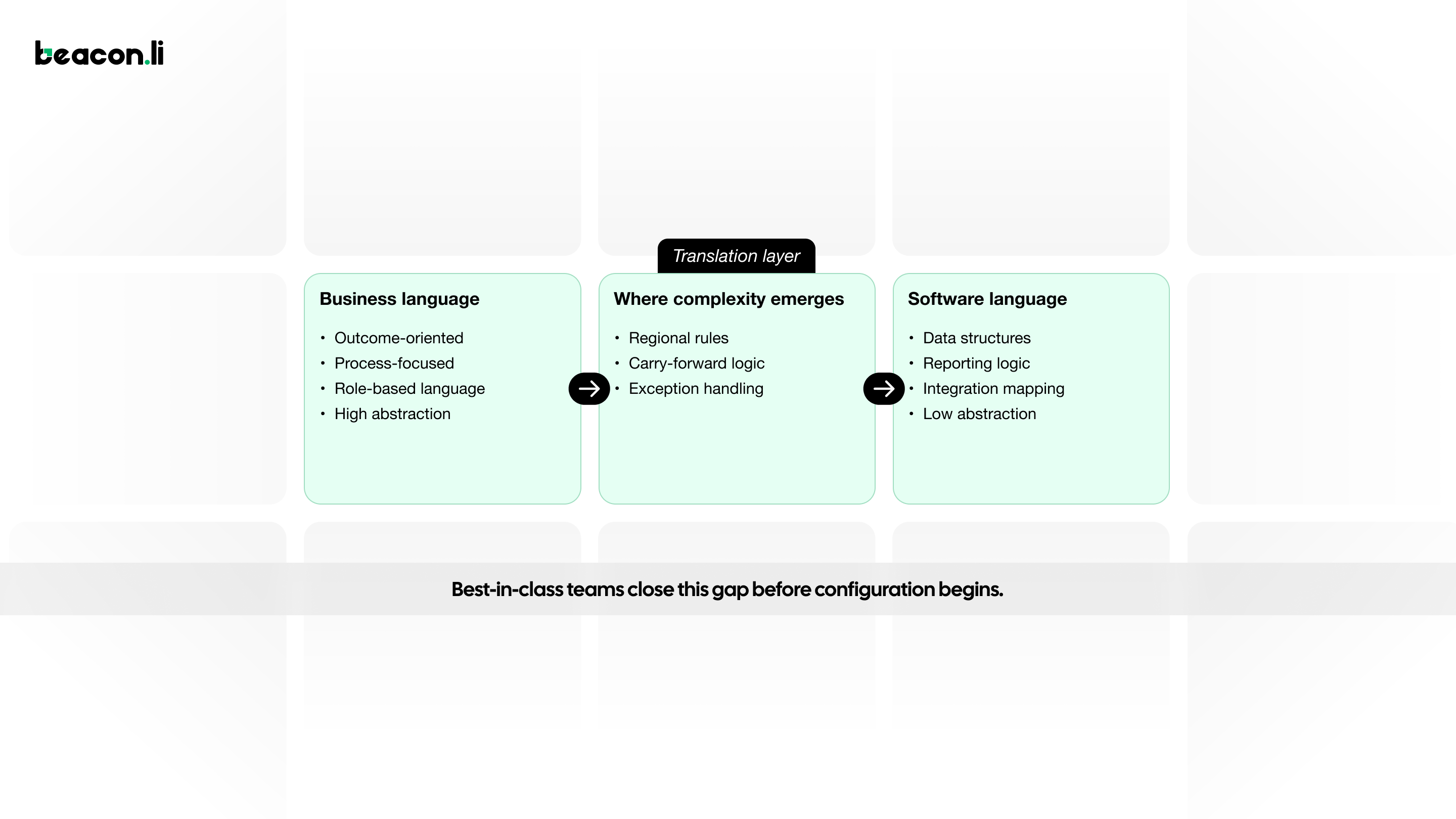
A common challenge is that business requirements are often expressed in the language of outcomes. Customers describe how they want processes to function, how teams should collaborate, how approvals should work, and how information should flow across the organization.
Software platforms, however, operate through configurations, workflows, rules, permissions, data structures, and validation logic.
The distance between those two worlds is where implementation complexity emerges.
Consider a financial operations platform being deployed for a global enterprise. At first glance, the requirement may seem straightforward: automate the handling of customer deductions and payment disputes. As implementation begins, additional layers quickly emerge. Different business units follow different resolution workflows. Customer hierarchies influence routing logic. Regional teams use distinct reason codes and approval structures. ERP integrations introduce dependencies on master data quality. Historical transaction records need to be mapped correctly, and exception handling rules must align with existing operational practices. What initially appears to be a workflow configuration exercise gradually reveals itself as a network of interconnected business decisions that must remain consistent across the entire system.
What began as a simple requirement becomes a network of interconnected implementation decisions.
The strongest onboarding organizations invest heavily in reducing ambiguity before configuration begins. Requirements are translated into implementation-ready specifications, acceptance criteria are defined early, contradictions are surfaced quickly, and edge cases are discussed before they become production issues.
This work is often invisible when implementations succeed. It becomes highly visible when they do not.
Best-in-Class Organizations Treat Complexity as a Systematic Challenge
Complexity is frequently described as an unavoidable characteristic of enterprise software. While complexity is certainly real, leading implementation organizations rarely treat it as an obstacle. They treat it as something that can be understood, structured, and managed systematically.
Across enterprise software categories, the underlying challenge remains remarkably consistent. Every customer has unique processes, organizational structures, business rules, and operational requirements. The implementation team's responsibility is to translate those realities into software behavior.
In financial operations platforms, this may involve transaction routing rules, approval chains, enrichment logic, and exception handling workflows. In insurance systems, it may involve policy structures, compliance requirements, claims processes, and regulatory considerations. In retail technology platforms, it may involve territory management, permissions, workflow design, and reporting structures.
The details vary, but the implementation challenge remains fundamentally the same.
Organizations that consistently deliver faster time-to-value develop repeatable approaches for managing this complexity. They identify recurring patterns, standardize successful implementation methods, and create operational processes that reduce reliance on tribal knowledge.
Over time, implementation becomes less dependent on individual expertise and more dependent on organizational capability.
Best-in-Class Organizations Generate Customer-Specific Validation
Testing is often described as a phase of implementation. High-performing organizations approach it differently.
They treat testing as an ongoing validation process that begins long before user acceptance testing officially starts.
Traditional testing methodologies often focus on verifying product functionality. Modern enterprise implementations require something more nuanced. The objective is not simply to determine whether a feature works. The objective is to determine whether a configured environment behaves correctly within a specific customer context.
Two organizations using the same software platform may have entirely different workflows, reporting structures, approval chains, compliance requirements, and business rules. Effective validation reflects those differences.
As a result, leading implementation teams build testing strategies around customer requirements, configuration states, and expected business outcomes. Testing becomes an extension of implementation rather than a checkpoint at the end of it.
This approach improves implementation quality while creating a stronger understanding of which decisions consistently contribute to successful deployments.
The Missing Layer Between Systems of Record and Customer Value
The software industry has spent the last three decades building systems of record.
CRM platforms capture customer information. ERP systems capture financial activity. HR systems capture employee records. Operational systems track workflows, transactions, and business performance.
These systems transformed how organizations manage information.
Yet there is another category of information that remains largely uncaptured.
Implementation knowledge.
Every implementation generates operational knowledge. Requirements are interpreted. Configuration decisions are made. Exceptions are handled. Validation rules are refined. Testing reveals patterns. Support teams identify recurring issues.
Collectively, this information forms something that Beacon refers to as Implementation Intelligence.
Implementation Intelligence is the accumulated operational knowledge generated during software implementations, including requirements interpretation, configuration decisions, validation outcomes, testing results, exception handling patterns, and support resolutions.
Unlike project documentation, which primarily serves a single implementation, implementation intelligence becomes more valuable as implementation volume grows. It enables organizations to learn from previous deployments, improve consistency, reduce delivery risk, and accelerate future implementations.
The most mature implementation organizations are increasingly focused on building this capability because they recognize that implementation expertise is one of the most difficult organizational assets to scale.
Why Implementation Knowledge Rarely Compounds
One of the more interesting characteristics of enterprise software implementations is how much learning occurs during delivery.
Every project teaches the organization something.
Implementation teams discover recurring customer requirements. Support teams identify common configuration issues. Consultants develop effective approaches for handling edge cases. Solution architects learn which decisions consistently produce successful outcomes.
The challenge is that this knowledge often remains fragmented.
It lives inside project documents, internal discussions, support tickets, meeting recordings, spreadsheets, and personal experience. Valuable lessons are repeatedly learned because there is no structured mechanism for preserving them.
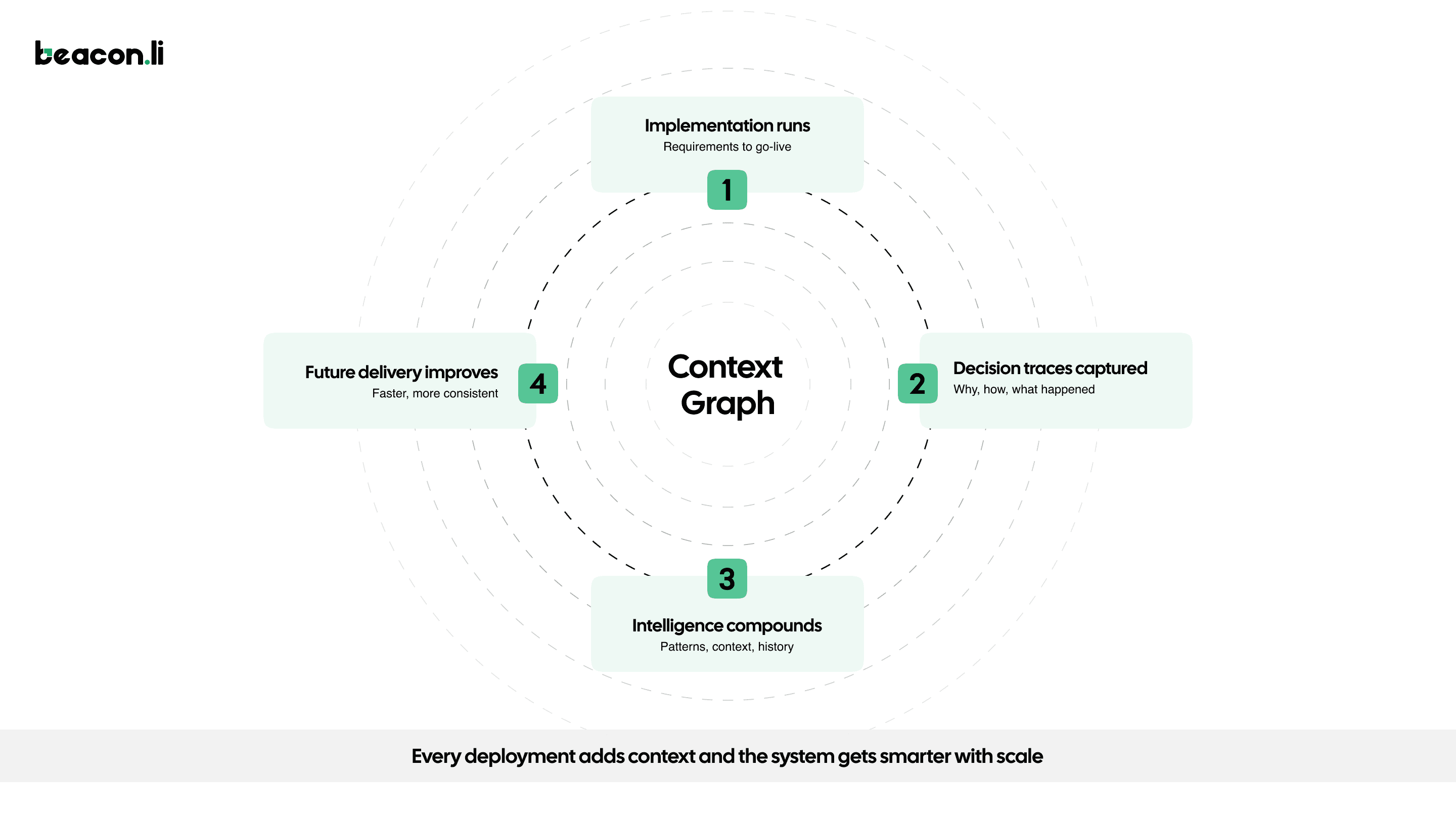
Beacon refers to the record of these implementation decisions as Decision Traces.
Decision Traces are the historical records of how implementation decisions were made, why exceptions occurred, how requirements were interpreted, and how issues were ultimately resolved.
Experienced consultants rarely create value solely through technical expertise. They create value because they remember previous decisions, previous exceptions, and previous implementation outcomes. Decision traces provide a way to preserve that knowledge and make it available beyond the individuals who originally generated it.
As organizations accumulate decision traces across implementations, they begin creating something larger.
They begin creating an implementation knowledge system.
Building Implementation Intelligence at Scale
Over the past several years, Beacon has worked with enterprise software vendors across HR technology, financial operations, insurance, and retail technology. While each category presents unique implementation challenges, similar patterns consistently emerge.
The largest implementation bottlenecks rarely originate from training sessions, onboarding checklists, or customer adoption activities. They emerge during the operational work required to translate customer requirements into production-ready environments.
In one financial operations deployment, a workflow involving 188 enrichment rules across 17 customer entities traditionally required four to five days of manual configuration effort. Automated execution reduced that effort to under 22 minutes while preserving visibility into configuration outcomes and implementation decisions.
In HR technology environments, leave policy implementations that historically required weeks of setup were reduced to hours through structured requirements translation, configuration automation, and human review loops for ambiguous decisions.
These experiences reinforced a broader observation. The greatest opportunity for improvement in enterprise onboarding often exists between requirements gathering and go-live.
This is where implementation intelligence becomes valuable.
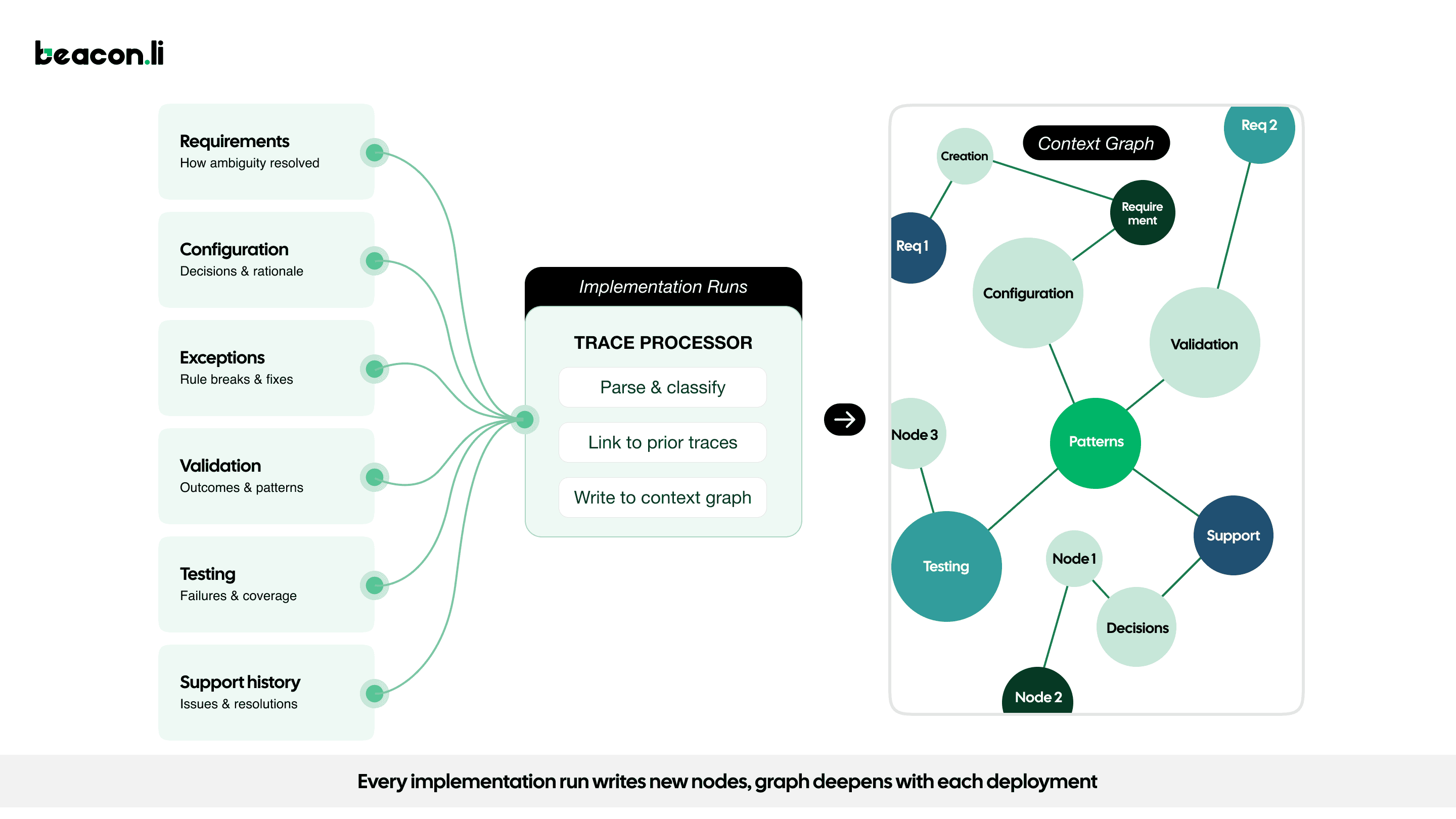
As organizations accumulate implementation intelligence, they begin building what Beacon calls an Implementation Context Graph, a structured representation of implementation knowledge built from decision traces, configuration patterns, validation outcomes, testing history, and operational experience.
The value of an implementation context graph increases with every deployment because every implementation contributes additional context. Over time, the organization develops a deeper understanding of how successful implementations are actually delivered.
The Future of Enterprise Onboarding
Enterprise software companies have spent years improving customer onboarding experiences. The next phase of improvement may come from focusing less on onboarding activities themselves and more on the implementation systems that support them.
As software becomes more configurable and customer environments become more complex, implementation knowledge becomes increasingly valuable. Organizations that capture and reuse that knowledge create advantages that compound over time. They become better at reducing ambiguity, managing complexity, validating outcomes, and delivering predictable implementations.
The strongest onboarding organizations rarely succeed because they run more meetings, produce more project plans, or create more documentation. They succeed because they have developed effective ways to transform implementation experience into implementation intelligence.
That capability is becoming increasingly important in a world where customers expect faster time-to-value, implementation teams are under pressure to scale efficiently, and software vendors are searching for new ways to differentiate beyond product features alone.
The companies that learn from every implementation will ultimately deliver better onboarding experiences than those that approach each deployment as a standalone project. In that sense, best-in-class enterprise onboarding is not simply a customer success function. It is the visible outcome of an organization that has learned how to capture, preserve, and scale implementation intelligence.
How Beacon Helps Enterprise Software Vendors Scale Delivery
If implementation intelligence is becoming the next competitive advantage in enterprise software, the question is how to capture it. Beacon helps enterprise software vendors automate implementations while preserving the decisions, patterns, and operational knowledge generated along the way. Want to see it in action? We can demonstrate it on your own product in a 7-day proof of concept.
Why the highest-performing enterprise software vendors treat onboarding as an implementation discipline and why implementation intelligence is becoming a competitive advantage.
A few years ago, during a conversation with the head of delivery at a large enterprise software company, the discussion turned toward onboarding. The company had invested heavily in improving its implementation process. It had project managers, implementation consultants, customer success managers, training programs, governance frameworks, and detailed project plans. On paper, the organization looked mature.
Yet despite all of that structure, implementation timelines continued to vary dramatically. Some customers reached value quickly. Others struggled through months of delays, escalations, rework, and post-go-live issues. The difference rarely came down to the quality of the people involved. The same teams, methodologies, and tools were often working across both successful and struggling projects.
What ultimately separated the two was something far less visible.
The strongest implementations accumulated clarity. The weaker ones accumulated ambiguity.
Requirements were interpreted differently. Exceptions were handled inconsistently. Configuration decisions were made without historical context. Knowledge from previous implementations remained trapped inside documents, ticketing systems, and individual experience.
The observation is relevant because enterprise software companies have spent decades building systems that capture operational information. Customer data lives in CRM platforms. Financial data lives in ERP systems. Employee information lives in HR software. Product usage flows into analytics platforms.
Implementation knowledge, however, remains surprisingly fragmented.
And that may be one of the biggest reasons enterprise onboarding continues to be difficult despite years of investment in process improvement.
Why Enterprise Onboarding Is Often Misunderstood
When organizations discuss onboarding, the conversation usually focuses on activities that occur after a contract has been signed. Stakeholder alignment, training plans, communication cadences, executive reviews, adoption programs, and customer success playbooks all tend to feature prominently in onboarding discussions.
These activities matter. They shape the customer experience and influence long-term adoption.
However, when implementation teams look back at projects that struggled, the root causes often originate much earlier.
A requirement that seemed clear during discovery reveals hidden dependencies during configuration. Historical data contains inconsistencies that only become visible during migration. Business processes that appeared straightforward on a whiteboard become considerably more complicated when translated into workflows, permissions, approval structures, and reporting hierarchies.
By the time these issues surface, implementation teams are often several weeks or months into delivery.
This is why the highest-performing organizations tend to think about onboarding differently. Rather than viewing onboarding as a customer-facing program, they view it as the result of implementation excellence. The quality of onboarding is largely determined by the quality of the implementation system operating behind it.
Best-in-Class Organizations Turn Requirements Into Execution Inputs
Enterprise software implementations begin with requirements, but requirements alone rarely determine implementation success.
What matters is how effectively those requirements are translated into actions that can be executed, validated, tested, and ultimately deployed.
A common challenge is that business requirements are often expressed in the language of outcomes. Customers describe how they want processes to function, how teams should collaborate, how approvals should work, and how information should flow across the organization.
Software platforms, however, operate through configurations, workflows, rules, permissions, data structures, and validation logic.
The distance between those two worlds is where implementation complexity emerges.
Consider a financial operations platform being deployed for a global enterprise. At first glance, the requirement may seem straightforward: automate the handling of customer deductions and payment disputes. As implementation begins, additional layers quickly emerge. Different business units follow different resolution workflows. Customer hierarchies influence routing logic. Regional teams use distinct reason codes and approval structures. ERP integrations introduce dependencies on master data quality. Historical transaction records need to be mapped correctly, and exception handling rules must align with existing operational practices. What initially appears to be a workflow configuration exercise gradually reveals itself as a network of interconnected business decisions that must remain consistent across the entire system.
What began as a simple requirement becomes a network of interconnected implementation decisions.
The strongest onboarding organizations invest heavily in reducing ambiguity before configuration begins. Requirements are translated into implementation-ready specifications, acceptance criteria are defined early, contradictions are surfaced quickly, and edge cases are discussed before they become production issues.
This work is often invisible when implementations succeed. It becomes highly visible when they do not.
Best-in-Class Organizations Treat Complexity as a Systematic Challenge
Complexity is frequently described as an unavoidable characteristic of enterprise software. While complexity is certainly real, leading implementation organizations rarely treat it as an obstacle. They treat it as something that can be understood, structured, and managed systematically.
Across enterprise software categories, the underlying challenge remains remarkably consistent. Every customer has unique processes, organizational structures, business rules, and operational requirements. The implementation team's responsibility is to translate those realities into software behavior.
In financial operations platforms, this may involve transaction routing rules, approval chains, enrichment logic, and exception handling workflows. In insurance systems, it may involve policy structures, compliance requirements, claims processes, and regulatory considerations. In retail technology platforms, it may involve territory management, permissions, workflow design, and reporting structures.
The details vary, but the implementation challenge remains fundamentally the same.
Organizations that consistently deliver faster time-to-value develop repeatable approaches for managing this complexity. They identify recurring patterns, standardize successful implementation methods, and create operational processes that reduce reliance on tribal knowledge.
Over time, implementation becomes less dependent on individual expertise and more dependent on organizational capability.
Best-in-Class Organizations Generate Customer-Specific Validation
Testing is often described as a phase of implementation. High-performing organizations approach it differently.
They treat testing as an ongoing validation process that begins long before user acceptance testing officially starts.
Traditional testing methodologies often focus on verifying product functionality. Modern enterprise implementations require something more nuanced. The objective is not simply to determine whether a feature works. The objective is to determine whether a configured environment behaves correctly within a specific customer context.
Two organizations using the same software platform may have entirely different workflows, reporting structures, approval chains, compliance requirements, and business rules. Effective validation reflects those differences.
As a result, leading implementation teams build testing strategies around customer requirements, configuration states, and expected business outcomes. Testing becomes an extension of implementation rather than a checkpoint at the end of it.
This approach improves implementation quality while creating a stronger understanding of which decisions consistently contribute to successful deployments.
The Missing Layer Between Systems of Record and Customer Value
The software industry has spent the last three decades building systems of record.
CRM platforms capture customer information. ERP systems capture financial activity. HR systems capture employee records. Operational systems track workflows, transactions, and business performance.
These systems transformed how organizations manage information.
Yet there is another category of information that remains largely uncaptured.
Implementation knowledge.
Every implementation generates operational knowledge. Requirements are interpreted. Configuration decisions are made. Exceptions are handled. Validation rules are refined. Testing reveals patterns. Support teams identify recurring issues.
Collectively, this information forms something that Beacon refers to as Implementation Intelligence.
Implementation Intelligence is the accumulated operational knowledge generated during software implementations, including requirements interpretation, configuration decisions, validation outcomes, testing results, exception handling patterns, and support resolutions.
Unlike project documentation, which primarily serves a single implementation, implementation intelligence becomes more valuable as implementation volume grows. It enables organizations to learn from previous deployments, improve consistency, reduce delivery risk, and accelerate future implementations.
The most mature implementation organizations are increasingly focused on building this capability because they recognize that implementation expertise is one of the most difficult organizational assets to scale.
Why Implementation Knowledge Rarely Compounds
One of the more interesting characteristics of enterprise software implementations is how much learning occurs during delivery.
Every project teaches the organization something.
Implementation teams discover recurring customer requirements. Support teams identify common configuration issues. Consultants develop effective approaches for handling edge cases. Solution architects learn which decisions consistently produce successful outcomes.
The challenge is that this knowledge often remains fragmented.
It lives inside project documents, internal discussions, support tickets, meeting recordings, spreadsheets, and personal experience. Valuable lessons are repeatedly learned because there is no structured mechanism for preserving them.
Beacon refers to the record of these implementation decisions as Decision Traces.
Decision Traces are the historical records of how implementation decisions were made, why exceptions occurred, how requirements were interpreted, and how issues were ultimately resolved.
Experienced consultants rarely create value solely through technical expertise. They create value because they remember previous decisions, previous exceptions, and previous implementation outcomes. Decision traces provide a way to preserve that knowledge and make it available beyond the individuals who originally generated it.
As organizations accumulate decision traces across implementations, they begin creating something larger.
They begin creating an implementation knowledge system.
Building Implementation Intelligence at Scale
Over the past several years, Beacon has worked with enterprise software vendors across HR technology, financial operations, insurance, and retail technology. While each category presents unique implementation challenges, similar patterns consistently emerge.
The largest implementation bottlenecks rarely originate from training sessions, onboarding checklists, or customer adoption activities. They emerge during the operational work required to translate customer requirements into production-ready environments.
In one financial operations deployment, a workflow involving 188 enrichment rules across 17 customer entities traditionally required four to five days of manual configuration effort. Automated execution reduced that effort to under 22 minutes while preserving visibility into configuration outcomes and implementation decisions.
In HR technology environments, leave policy implementations that historically required weeks of setup were reduced to hours through structured requirements translation, configuration automation, and human review loops for ambiguous decisions.
These experiences reinforced a broader observation. The greatest opportunity for improvement in enterprise onboarding often exists between requirements gathering and go-live.
This is where implementation intelligence becomes valuable.
As organizations accumulate implementation intelligence, they begin building what Beacon calls an Implementation Context Graph, a structured representation of implementation knowledge built from decision traces, configuration patterns, validation outcomes, testing history, and operational experience.
The value of an implementation context graph increases with every deployment because every implementation contributes additional context. Over time, the organization develops a deeper understanding of how successful implementations are actually delivered.
The Future of Enterprise Onboarding
Enterprise software companies have spent years improving customer onboarding experiences. The next phase of improvement may come from focusing less on onboarding activities themselves and more on the implementation systems that support them.
As software becomes more configurable and customer environments become more complex, implementation knowledge becomes increasingly valuable. Organizations that capture and reuse that knowledge create advantages that compound over time. They become better at reducing ambiguity, managing complexity, validating outcomes, and delivering predictable implementations.
The strongest onboarding organizations rarely succeed because they run more meetings, produce more project plans, or create more documentation. They succeed because they have developed effective ways to transform implementation experience into implementation intelligence.
That capability is becoming increasingly important in a world where customers expect faster time-to-value, implementation teams are under pressure to scale efficiently, and software vendors are searching for new ways to differentiate beyond product features alone.
The companies that learn from every implementation will ultimately deliver better onboarding experiences than those that approach each deployment as a standalone project. In that sense, best-in-class enterprise onboarding is not simply a customer success function. It is the visible outcome of an organization that has learned how to capture, preserve, and scale implementation intelligence.
How Beacon Helps Enterprise Software Vendors Scale Delivery
If implementation intelligence is becoming the next competitive advantage in enterprise software, the question is how to capture it. Beacon helps enterprise software vendors automate implementations while preserving the decisions, patterns, and operational knowledge generated along the way. Want to see it in action? We can demonstrate it on your own product in a 7-day proof of concept.









Copyright © 2026 Beacon.li. All rights reserved.
Copyright © 2026 Beacon.li. All rights reserved.
