Cutting Complex FinTech Cash Application Implementation Time by 68%

How Darwinbox Achieved 85% Faster Onboarding with Beacon.li

Leading Fintech partnered with Beacon AI orchestration to automate Cash Application onboarding and achieved 85% faster handovers, 60% fewer config defects, and 30% lower implementation costs.


A leading Order-to-Cash (O2C) SaaS provider partnered with an Beacon AI orchestration platform to streamline and accelerate the onboarding of its complex, high-stakes Cash Application Automation (CAA).

A new standard for FinTech implementation: faster deployment, fewer errors, lower cost.

A new standard for FinTech implementation: faster deployment, fewer errors, lower cost.

A new standard for FinTech implementation: faster deployment, fewer errors, lower cost.

85%

Faster Team Handover

Faster Team Handover

Faster Team Handover

30%

Lower Implementation Cost per Client

4X

4X

The Hidden Depth of Implementation Excellence:

The Hidden Depth of Implementation Excellence:

The Hidden Depth of Implementation Excellence:

The O2C suite spans products such as Cash Application Automation (CAA) and Electronic Invoice Presentment & Payment (EIPP), each deeply integrated with ERP systems like SAP. Every client implementation requires a multi-layer setup, involving:

1. Multi-Phase Implementation Stack
Every client instance goes through 10+ stages from ERP data mapping and middleware integrations to daily refresh cycles and outbound synchronizations; demanding coordination across consulting, engineering, and support teams.


2. Deep ERP & Bank Integrations
The CAA module integrates tightly with ERP systems, FTP middleware, and multiple banking APIs, where one misconfiguration can cascade across data ingestion, reconciliation, and reporting.


3. Vertical-Specific Dependencies
Each industry introduces its own configuration nuances to map hundreds of fields across customer master data, receivables, balancing, and payment histories.


4. Complex Backend Configuration Logic
Setting up eligibility filters, reason codes, root causes, and action codes could take 3–4 hours per instance, done entirely through backend forms and spreadsheets.

1. Multi-Phase Implementation Stack
Every client instance goes through 10+ stages from ERP data mapping and middleware integrations to daily refresh cycles and outbound synchronizations; demanding coordination across consulting, engineering, and support teams.


2. Deep ERP & Bank Integrations
The CAA module integrates tightly with ERP systems, FTP middleware, and multiple banking APIs, where one misconfiguration can cascade across data ingestion, reconciliation, and reporting.


3. Vertical-Specific Dependencies
Each industry introduces its own configuration nuances to map hundreds of fields across customer master data, receivables, balancing, and payment histories.


4. Complex Backend Configuration Logic
Setting up eligibility filters, reason codes, root causes, and action codes could take 3–4 hours per instance, done entirely through backend forms and spreadsheets.

1. Multi-Phase Implementation Stack
Every client instance goes through 10+ stages from ERP data mapping and middleware integrations to daily refresh cycles and outbound synchronizations; demanding coordination across consulting, engineering, and support teams.


2. Deep ERP & Bank Integrations
The CAA module integrates tightly with ERP systems, FTP middleware, and multiple banking APIs, where one misconfiguration can cascade across data ingestion, reconciliation, and reporting.


3. Vertical-Specific Dependencies
Each industry introduces its own configuration nuances to map hundreds of fields across customer master data, receivables, balancing, and payment histories.


4. Complex Backend Configuration Logic
Setting up eligibility filters, reason codes, root causes, and action codes could take 3–4 hours per instance, done entirely through backend forms and spreadsheets.

5. Steep Learning Curve & Handovers
With configurations buried deep in backend systems, new consultants or support engineers faced significant ramp-up time, slowing down go-live readiness and hypercare.

Orchestration that mirrors human precision but executes instantaneously

Orchestration that mirrors human precision but executes instantaneously

Orchestration that mirrors human precision but executes instantaneously

To address the structural inefficiencies in implementation and support, the team architected a Unified Configuration Orchestration Platform (UCOP): A self-service, metadata-driven orchestration layer designed to bring automation into the implementation process.

1. Metadata-Driven Architecture

Configurations that previously required direct backend access were abstracted into a metadata model, stored centrally and version-controlled.This allowed both consultants and engineers to work from a single source of truth, ensuring parity between environments and auditability across projects.


2. Dynamic UI Generation

A dynamic UI framework was built to auto-render configuration panels based on metadata definitions.This made the system context-aware, showing only relevant options based on client vertical, ERP type, and product scope.


3. Automated Validation & Deployment

Validation logic was moved from human checklists into code.Automated pre-deployment checks verified data mappings, FTP folder setups, and SAP extract compatibility before pushing changes live.


4. Cross-Team Visibility Layer

A unified orchestration dashboard gave visibility into every configuration parameter, making handoffs seamless.New consultants could instantly understand an instance’s configuration footprint without manual discovery or database queries.


5. API-First Design for Extensibility

All configuration actions exposed REST APIs, enabling automation scripts, integration with CI/CD pipelines, and audit trails for enterprise governance.

1. Metadata-Driven Architecture

Configurations that previously required direct backend access were abstracted into a metadata model, stored centrally and version-controlled.This allowed both consultants and engineers to work from a single source of truth, ensuring parity between environments and auditability across projects.


2. Dynamic UI Generation

A dynamic UI framework was built to auto-render configuration panels based on metadata definitions.This made the system context-aware, showing only relevant options based on client vertical, ERP type, and product scope.


3. Automated Validation & Deployment

Validation logic was moved from human checklists into code.Automated pre-deployment checks verified data mappings, FTP folder setups, and SAP extract compatibility before pushing changes live.


4. Cross-Team Visibility Layer

A unified orchestration dashboard gave visibility into every configuration parameter, making handoffs seamless.New consultants could instantly understand an instance’s configuration footprint without manual discovery or database queries.


5. API-First Design for Extensibility

All configuration actions exposed REST APIs, enabling automation scripts, integration with CI/CD pipelines, and audit trails for enterprise governance.

1. Metadata-Driven Architecture

Configurations that previously required direct backend access were abstracted into a metadata model, stored centrally and version-controlled.This allowed both consultants and engineers to work from a single source of truth, ensuring parity between environments and auditability across projects.


2. Dynamic UI Generation

A dynamic UI framework was built to auto-render configuration panels based on metadata definitions.This made the system context-aware, showing only relevant options based on client vertical, ERP type, and product scope.


3. Automated Validation & Deployment

Validation logic was moved from human checklists into code.Automated pre-deployment checks verified data mappings, FTP folder setups, and SAP extract compatibility before pushing changes live.


4. Cross-Team Visibility Layer

A unified orchestration dashboard gave visibility into every configuration parameter, making handoffs seamless.New consultants could instantly understand an instance’s configuration footprint without manual discovery or database queries.


5. API-First Design for Extensibility

All configuration actions exposed REST APIs, enabling automation scripts, integration with CI/CD pipelines, and audit trails for enterprise governance.

Setting a New Benchmark for FinTech Implementation Velocity

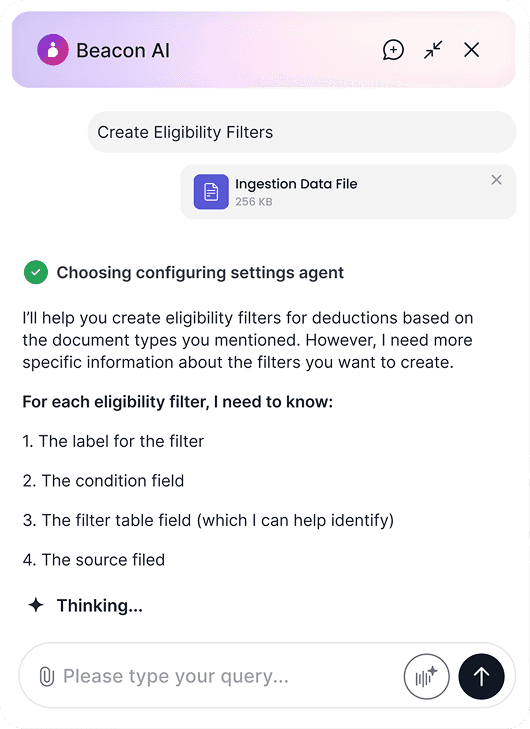
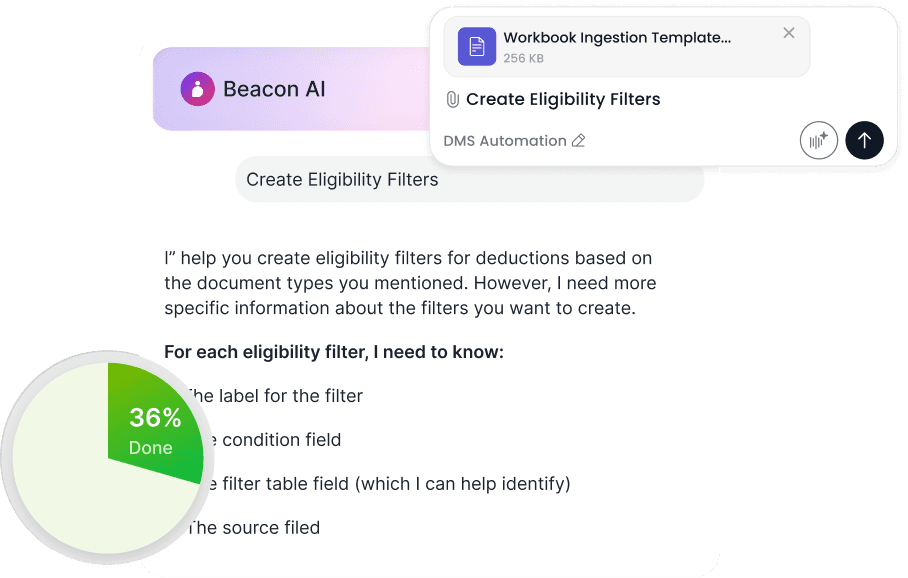
The orchestrator replicated consultant actions in real time to create and manage eligibility filters, action codes, and reason codes autonomously.

Metric

Metric

With Beacon.li

With Beacon.li

Implementation TAT

Implementation TAT

SIT Defects from Config Errors

SIT Defects from Config Errors

Implementation Cost

Implementation Cost

Cross-Team Handover Time

Cross-Team Handover Time

Consultant Productivity

Consultant Productivity

50% reduction in overall implementation effort

50% reduction in overall implementation effort

60% fewer configuration defects

60% fewer configuration defects

30% lower per client

30% lower per client

85% faster team handover

85% faster team handover

2x improvement

2x improvement

Metric

Implementation TAT

SIT Defects from Config Errors

Implementation Cost

Cross-Team Handover Time

Consultant Productivity

Before Beacon

Manual triaging delays

Multi-click workflows

Limited exploration

High “how-to” dependency

Reactive support

With Beacon.li

50% reduction in overall implementation effort

60% fewer configuration defects

30% lower per client

85% faster team handover

2x improvement

Extending Orchestration from Systems to Support

Extending Orchestration from Systems to Support

Extending Orchestration from Systems to Support

Future iterations of the Beacon platform will introduce AI Copilots to L1-L3 support, This evolution will empower business users to:


  • Receive contextual recommendations for incident resolution.

  • Auto-run diagnostic workflows and validations.

  • Escalate or close tickets with AI-verified actions.

Drive faster time-to-value across every client implementation with Beacon’s AI orchestration

Drive faster time-to-value across every client implementation with Beacon’s AI orchestration

Drive faster time-to-value across every client implementation with Beacon’s AI orchestration