
Client Implementation
Consultants Are the Temporary Glue Holding Enterprise Software Together



Despite decades of APIs, middleware, SaaS platforms, and now AI tools, most large enterprises still depend on outside consultants to make their software function as one coherent business. This happens because every company is more specific and more complicated than the generic software built to run it, and someone has to close that gap by hand. That someone is usually a consultant, and the resulting layer of human expertise is the real reason enterprise software appears to work at all.
What Is Enterprise Software Integration and Why Is It Still So Hard?
Walk into any large enterprise and you will find a CRM for customers, an ERP for finance and operations, an HRIS for people, a procurement platform for vendors, a support system for service requests, and a data warehouse trying to make sense of all of it. On paper, these systems are integrated. In practice, they speak slightly different dialects of the same business.
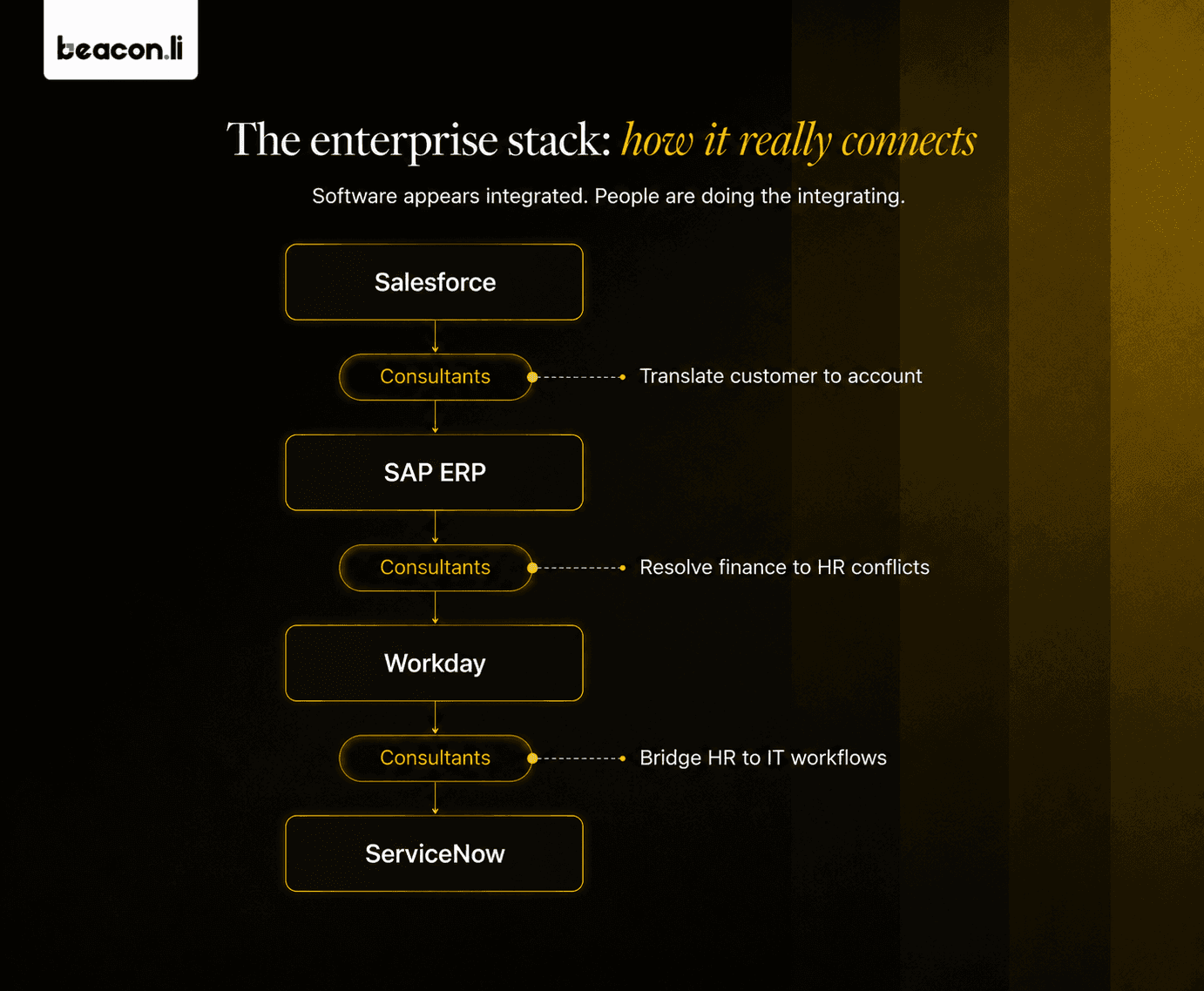
Sales calls something a customer. Finance calls the same thing an account. Support calls it a tenant. To the software, these look like three separate records, stored in three different systems, updated on three different schedules. A person has to recognize that all three are the same underlying entity and make the systems, the processes, and the teams agree on that fact long enough for the business to keep running.
That person is almost always a consultant.
Consultants Are Human Middleware!
Engineers use the term middleware to describe the technology layer that connects different systems together. Enterprise software has its own version of middleware, and it is made of people, not code.
Consultants sit between departments and vendors doing work that rarely shows up in a project plan: resolving conflicting definitions, explaining why a workflow exists, remembering which integration breaks every quarter, and knowing which spreadsheet is actually the source of truth even though three official systems claim to be.
The software stores the data. The consultant stores the context. In most organizations, that context turns out to be worth more than the system it explains.
Why Can't Enterprise Software Vendors Solve This on Their Own?
No software vendor can fully solve this problem because no platform can model every industry, every regulation, and every internal exception a specific business has accumulated over time.
A platform built to serve thousands of customers has to generalize. A real business, by definition, is full of specific exceptions: a unique approval chain, a regional compliance requirement, a workaround that became policy five years ago and nobody remembers why. Vendors ship platforms that handle the common 80 percent of cases well. Customers assemble multi-vendor stacks on top of that. Consultants get hired to close the remaining distance.
Nobody in this chain is behaving irrationally. The complexity is a property of the ecosystem itself, not a failure of any single vendor.
The Knowledge That Disappears at the End of Every Engagement
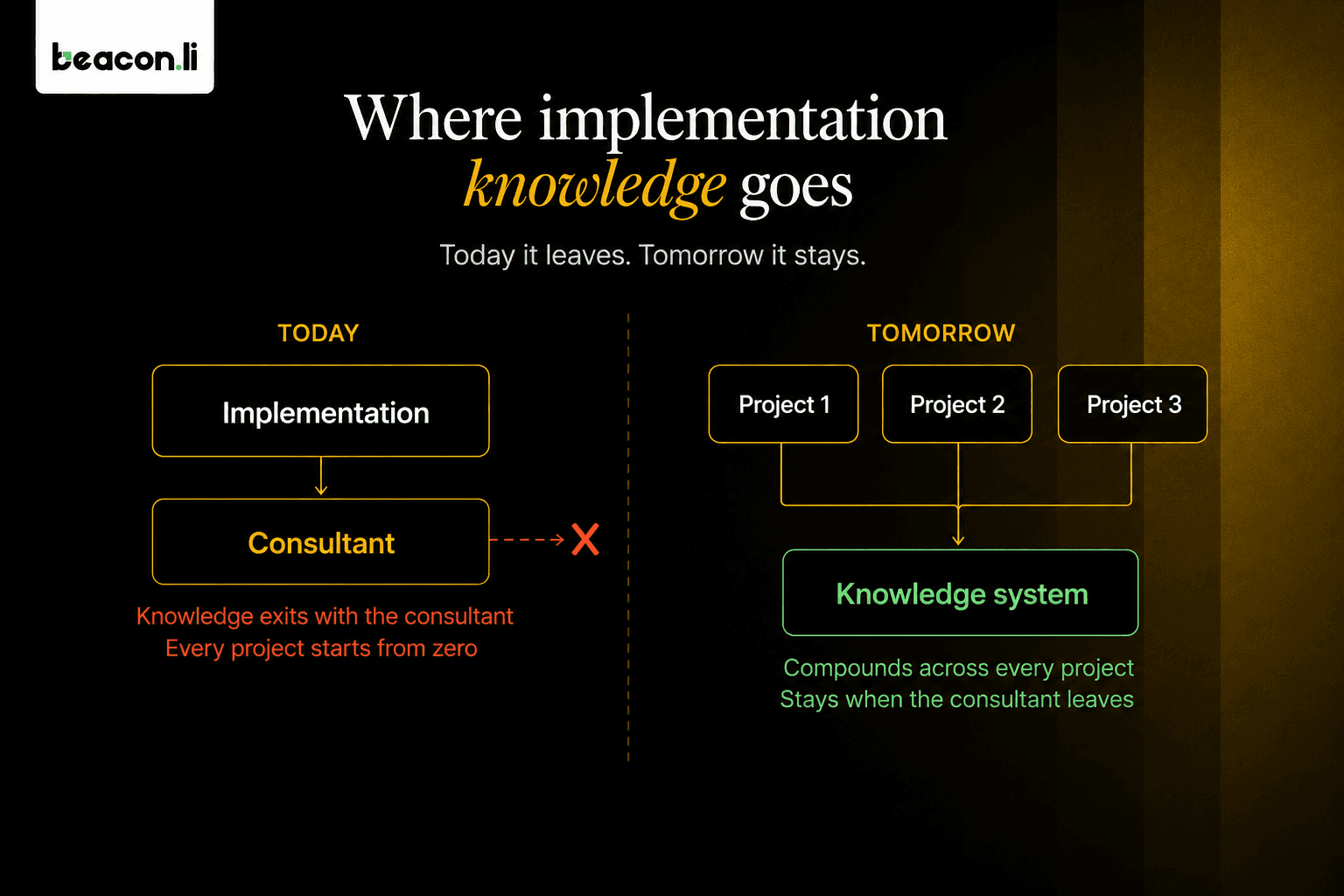
Most of the knowledge a consultant builds during a project never becomes durable institutional memory. It tends to leave the company when the consultant does.
Every project answers questions that never make it into a system of record: why a workflow was designed a particular way, which exception paths get triggered most often, which configuration decisions quietly created downstream problems, which integrations fail every few months and why. That understanding usually lives in email threads, meeting notes, Slack messages, and escalation calls, and eventually in the head of whoever did the work.
When that person rolls off the project, the company keeps the software. It loses the reasoning behind it.
Why Do Enterprise Software Implementations Fail at Such High Rates?
Enterprise software implementations fail at high rates because of a repeatable combination of factors: unclear requirements, poor change management, weak data migration planning, and under-resourced or inexperienced implementation teams. The failure is almost never caused by the underlying software being defective. It is caused by the gap between how the software was built to work and how the specific business actually operates.
The data across independent research firms is unusually consistent on this.
Estimates of the ERP implementation failure rate fall between 55 percent and 75 percent, depending on how a given study defines failure. Gartner projects that more than 70 percent of ERP implementations will fail to fully achieve their original business goals by 2027. Only around 25 to 30 percent of ERP projects finish on time and within budget, and roughly half fail outright on their first attempt before being rescued, rebuilt, or scrapped entirely.
The financial impact extends far beyond the original contract. Failed ERP projects cost organizations an average of roughly $10.6 million each, not counting lost productivity or the competitive ground given up while the project drags on. In discrete manufacturing specifically, where process complexity runs highest, Panorama Consulting found average cost overruns of 215 percent. Exceeding the original budget by 3 to 4 times is common across ERP projects broadly.
The root causes repeat across industries and software categories. Inadequate change management alone accounts for over 40 percent of failures. Roughly 60 percent of failures trace back to the earliest phase of a project, requirements gathering and system selection, where the gap between what the business needs and what the software assumes first opens and is never properly closed. Poor data migration is a recurring theme in nearly every project postmortem, with seemingly clean data turning out to be full of duplicates and inconsistencies the moment anyone looks closely.
The variable that consistently changes the outcome is the experience of the implementation team. Organizations that hire seasoned implementation partners report success rates as high as 85 percent, compared to the much lower baseline across the broader market. One major consulting firm reports that 60 percent of its new clients arrive after a failed or underperforming implementation with a different provider.
The technology is rarely the differentiator. The judgment applied to deploying it is.
How Big Is the Enterprise Software Consulting and Integration Market?
The market that exists specifically to bridge the gap between enterprise software and business reality is worth hundreds of billions of dollars, and it is growing faster than the software market it supports.
The global system integration services market was valued at roughly $553 billion in 2025 and is projected to reach close to $764 billion by 2030, a compound annual growth rate of about 6.7 percent. The broader software consulting market was sized at over $313 billion in 2025 and is forecast to surpass $1 trillion within a decade. The segment focused specifically on ERP integration and consulting alone is projected to grow by more than $15 billion between 2025 and 2030.
None of that spending exists because the software does not work in controlled conditions. It exists because making the software work for one specific, idiosyncratic business is a separate, expensive, and chronically under-acknowledged problem, repeated at nearly every company that buys enterprise software.
Will AI Replace Enterprise Software Consultants?
AI will not replace enterprise software consultants outright. It is more likely to change where the resulting knowledge ends up living, rather than removing the need for human judgment.
The easiest parts of consulting to automate are the parts closest to documentation: writing requirements, generating test scripts, summarizing meetings, drafting configuration notes. The harder part, interpreting why an organization works the way it does and which exceptions are structural versus accidental, is a judgment problem built on context that currently has nowhere to live except inside a person.
Historically the flow has looked like this: knowledge flows to the consultant, stays in the consultant, and leaves with the consultant when the engagement ends.
The more interesting shift is not replacing the consultant. It is changing where the knowledge accumulates once it is created, so that it compounds across projects instead of evaporating at the end of every engagement. The winner in this transition will not be whoever has the most capable AI model. It will be whoever figures out how to make implementation knowledge durable.
How Are Companies Starting to Solve the Enterprise Implementation Problem?
The implementation problem, the loss of knowledge at project end, the repeated cost of relearning the same things, and the dependency on a handful of people who hold the institutional memory, is not going unsolved. A new category of tooling is emerging specifically around capturing, structuring, and reusing implementation intelligence.
One example is Beacon, which is building what it calls an implementation context graph: a system that captures the decisions, exceptions, configurations, and cross-system context generated during enterprise software deployments. Instead of that knowledge living in Slack threads and escalation calls and the heads of consultants, it lives in a structured layer that persists across engagements.
The idea behind Beacon and tools like it is that every implementation generates a map of how the business actually works. Today that map is thrown away at the end of the project. The next generation of implementation tooling is designed to make that map permanent, reusable, and compounding across every future deployment.
The question for enterprise software vendors and systems integrators is not whether this layer needs to exist. It does, and right now it exists in the form of human memory. The question is whether it continues to evaporate at the end of every engagement, or whether it finally gets captured as institutional intelligence.
The Next Era: From Systems of Record to Systems of Institutional Memory
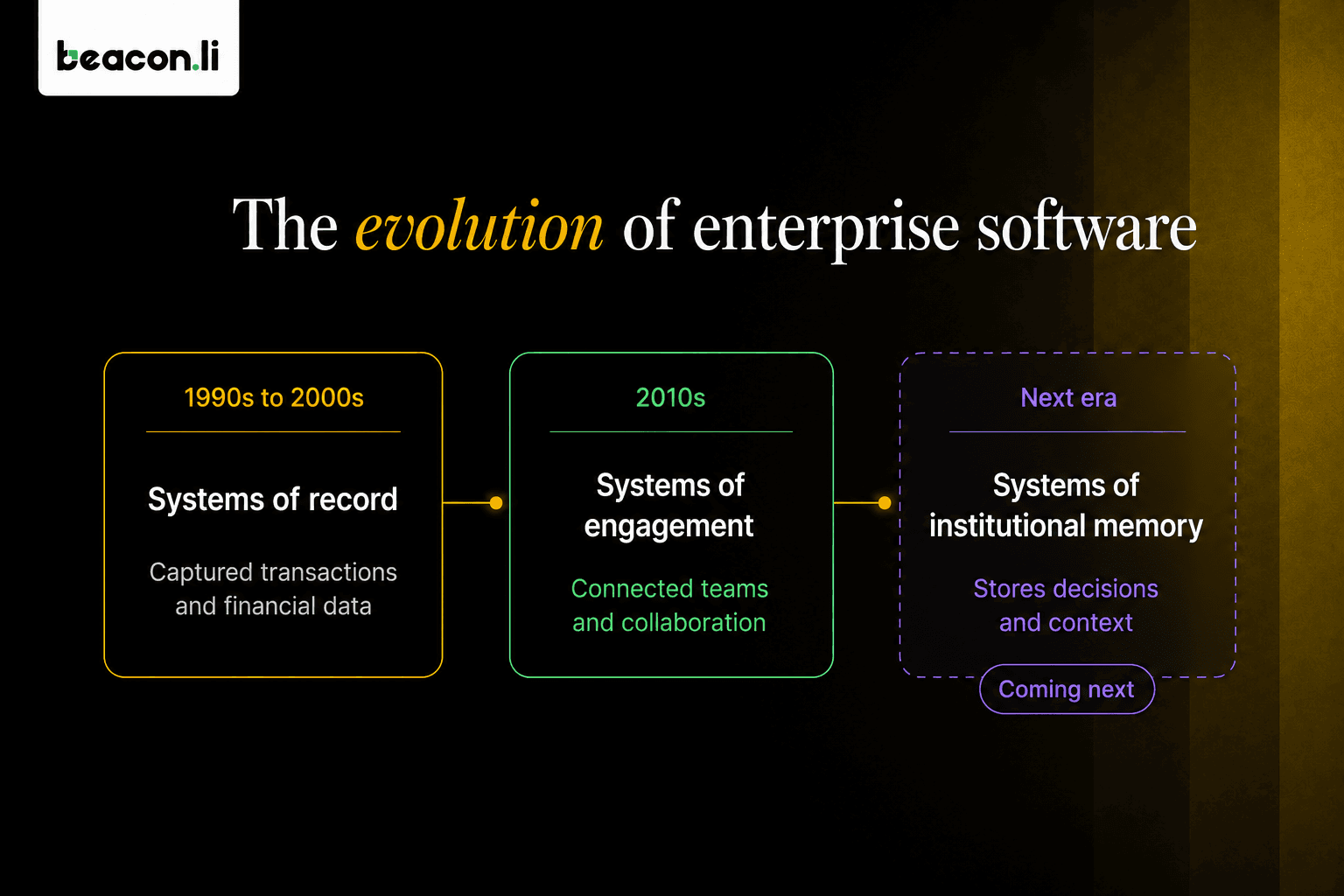
Enterprise software has moved through recognizable eras. The first generation built systems of record, software that captured transactions, customers, and financial data. The next generation built systems of engagement, tools that connected teams and improved collaboration.
The next category may not be about storing more data or connecting more people. It may be about storing decisions: why a process exists, what a configuration choice represented, what exception was deliberately built in and why. Some call this a system of execution. Others call it institutional memory as software.
The companies that win this next era will not be the ones with the most integrations or the most features. They will be the ones that figure out how to turn tribal knowledge, the kind that currently disappears every time a consultant rolls off a project, into something reusable across every future engagement.
The Real Problem Was Never About Connecting Systems
The real challenge in enterprise software was never just connecting systems. It was connecting understanding.
Consultants are not going away. Organizations will always need judgment, and judgment does not compress into a checklist or a configuration file. But the role will change shape. Today, a great consultant often functions as a living repository of organizational knowledge that only they can access. In the future, the best ones may spend less time re-deriving what was already learned on a previous project and more time applying it at speed.
The companies that figure out how to capture, preserve, and compound that knowledge, instead of paying project after project to relearn it, will have an advantage that extends well beyond any single implementation.
For decades, consultants have been the temporary glue holding enterprise software together. The question now is whether the next generation of technology can finally make that glue permanent.
Despite decades of APIs, middleware, SaaS platforms, and now AI tools, most large enterprises still depend on outside consultants to make their software function as one coherent business. This happens because every company is more specific and more complicated than the generic software built to run it, and someone has to close that gap by hand. That someone is usually a consultant, and the resulting layer of human expertise is the real reason enterprise software appears to work at all.
What Is Enterprise Software Integration and Why Is It Still So Hard?
Walk into any large enterprise and you will find a CRM for customers, an ERP for finance and operations, an HRIS for people, a procurement platform for vendors, a support system for service requests, and a data warehouse trying to make sense of all of it. On paper, these systems are integrated. In practice, they speak slightly different dialects of the same business.
Sales calls something a customer. Finance calls the same thing an account. Support calls it a tenant. To the software, these look like three separate records, stored in three different systems, updated on three different schedules. A person has to recognize that all three are the same underlying entity and make the systems, the processes, and the teams agree on that fact long enough for the business to keep running.
That person is almost always a consultant.
Consultants Are Human Middleware!
Engineers use the term middleware to describe the technology layer that connects different systems together. Enterprise software has its own version of middleware, and it is made of people, not code.
Consultants sit between departments and vendors doing work that rarely shows up in a project plan: resolving conflicting definitions, explaining why a workflow exists, remembering which integration breaks every quarter, and knowing which spreadsheet is actually the source of truth even though three official systems claim to be.
The software stores the data. The consultant stores the context. In most organizations, that context turns out to be worth more than the system it explains.
Why Can't Enterprise Software Vendors Solve This on Their Own?
No software vendor can fully solve this problem because no platform can model every industry, every regulation, and every internal exception a specific business has accumulated over time.
A platform built to serve thousands of customers has to generalize. A real business, by definition, is full of specific exceptions: a unique approval chain, a regional compliance requirement, a workaround that became policy five years ago and nobody remembers why. Vendors ship platforms that handle the common 80 percent of cases well. Customers assemble multi-vendor stacks on top of that. Consultants get hired to close the remaining distance.
Nobody in this chain is behaving irrationally. The complexity is a property of the ecosystem itself, not a failure of any single vendor.
The Knowledge That Disappears at the End of Every Engagement
Most of the knowledge a consultant builds during a project never becomes durable institutional memory. It tends to leave the company when the consultant does.
Every project answers questions that never make it into a system of record: why a workflow was designed a particular way, which exception paths get triggered most often, which configuration decisions quietly created downstream problems, which integrations fail every few months and why. That understanding usually lives in email threads, meeting notes, Slack messages, and escalation calls, and eventually in the head of whoever did the work.
When that person rolls off the project, the company keeps the software. It loses the reasoning behind it.
Why Do Enterprise Software Implementations Fail at Such High Rates?
Enterprise software implementations fail at high rates because of a repeatable combination of factors: unclear requirements, poor change management, weak data migration planning, and under-resourced or inexperienced implementation teams. The failure is almost never caused by the underlying software being defective. It is caused by the gap between how the software was built to work and how the specific business actually operates.
The data across independent research firms is unusually consistent on this.
Estimates of the ERP implementation failure rate fall between 55 percent and 75 percent, depending on how a given study defines failure. Gartner projects that more than 70 percent of ERP implementations will fail to fully achieve their original business goals by 2027. Only around 25 to 30 percent of ERP projects finish on time and within budget, and roughly half fail outright on their first attempt before being rescued, rebuilt, or scrapped entirely.
The financial impact extends far beyond the original contract. Failed ERP projects cost organizations an average of roughly $10.6 million each, not counting lost productivity or the competitive ground given up while the project drags on. In discrete manufacturing specifically, where process complexity runs highest, Panorama Consulting found average cost overruns of 215 percent. Exceeding the original budget by 3 to 4 times is common across ERP projects broadly.
The root causes repeat across industries and software categories. Inadequate change management alone accounts for over 40 percent of failures. Roughly 60 percent of failures trace back to the earliest phase of a project, requirements gathering and system selection, where the gap between what the business needs and what the software assumes first opens and is never properly closed. Poor data migration is a recurring theme in nearly every project postmortem, with seemingly clean data turning out to be full of duplicates and inconsistencies the moment anyone looks closely.
The variable that consistently changes the outcome is the experience of the implementation team. Organizations that hire seasoned implementation partners report success rates as high as 85 percent, compared to the much lower baseline across the broader market. One major consulting firm reports that 60 percent of its new clients arrive after a failed or underperforming implementation with a different provider.
The technology is rarely the differentiator. The judgment applied to deploying it is.
How Big Is the Enterprise Software Consulting and Integration Market?
The market that exists specifically to bridge the gap between enterprise software and business reality is worth hundreds of billions of dollars, and it is growing faster than the software market it supports.
The global system integration services market was valued at roughly $553 billion in 2025 and is projected to reach close to $764 billion by 2030, a compound annual growth rate of about 6.7 percent. The broader software consulting market was sized at over $313 billion in 2025 and is forecast to surpass $1 trillion within a decade. The segment focused specifically on ERP integration and consulting alone is projected to grow by more than $15 billion between 2025 and 2030.
None of that spending exists because the software does not work in controlled conditions. It exists because making the software work for one specific, idiosyncratic business is a separate, expensive, and chronically under-acknowledged problem, repeated at nearly every company that buys enterprise software.
Will AI Replace Enterprise Software Consultants?
AI will not replace enterprise software consultants outright. It is more likely to change where the resulting knowledge ends up living, rather than removing the need for human judgment.
The easiest parts of consulting to automate are the parts closest to documentation: writing requirements, generating test scripts, summarizing meetings, drafting configuration notes. The harder part, interpreting why an organization works the way it does and which exceptions are structural versus accidental, is a judgment problem built on context that currently has nowhere to live except inside a person.
Historically the flow has looked like this: knowledge flows to the consultant, stays in the consultant, and leaves with the consultant when the engagement ends.
The more interesting shift is not replacing the consultant. It is changing where the knowledge accumulates once it is created, so that it compounds across projects instead of evaporating at the end of every engagement. The winner in this transition will not be whoever has the most capable AI model. It will be whoever figures out how to make implementation knowledge durable.
How Are Companies Starting to Solve the Enterprise Implementation Problem?
The implementation problem, the loss of knowledge at project end, the repeated cost of relearning the same things, and the dependency on a handful of people who hold the institutional memory, is not going unsolved. A new category of tooling is emerging specifically around capturing, structuring, and reusing implementation intelligence.
One example is Beacon, which is building what it calls an implementation context graph: a system that captures the decisions, exceptions, configurations, and cross-system context generated during enterprise software deployments. Instead of that knowledge living in Slack threads and escalation calls and the heads of consultants, it lives in a structured layer that persists across engagements.
The idea behind Beacon and tools like it is that every implementation generates a map of how the business actually works. Today that map is thrown away at the end of the project. The next generation of implementation tooling is designed to make that map permanent, reusable, and compounding across every future deployment.
The question for enterprise software vendors and systems integrators is not whether this layer needs to exist. It does, and right now it exists in the form of human memory. The question is whether it continues to evaporate at the end of every engagement, or whether it finally gets captured as institutional intelligence.
The Next Era: From Systems of Record to Systems of Institutional Memory
Enterprise software has moved through recognizable eras. The first generation built systems of record, software that captured transactions, customers, and financial data. The next generation built systems of engagement, tools that connected teams and improved collaboration.
The next category may not be about storing more data or connecting more people. It may be about storing decisions: why a process exists, what a configuration choice represented, what exception was deliberately built in and why. Some call this a system of execution. Others call it institutional memory as software.
The companies that win this next era will not be the ones with the most integrations or the most features. They will be the ones that figure out how to turn tribal knowledge, the kind that currently disappears every time a consultant rolls off a project, into something reusable across every future engagement.
The Real Problem Was Never About Connecting Systems
The real challenge in enterprise software was never just connecting systems. It was connecting understanding.
Consultants are not going away. Organizations will always need judgment, and judgment does not compress into a checklist or a configuration file. But the role will change shape. Today, a great consultant often functions as a living repository of organizational knowledge that only they can access. In the future, the best ones may spend less time re-deriving what was already learned on a previous project and more time applying it at speed.
The companies that figure out how to capture, preserve, and compound that knowledge, instead of paying project after project to relearn it, will have an advantage that extends well beyond any single implementation.
For decades, consultants have been the temporary glue holding enterprise software together. The question now is whether the next generation of technology can finally make that glue permanent.









Copyright © 2026 Beacon.li. All rights reserved.
Copyright © 2026 Beacon.li. All rights reserved.
