
AI Orchestration
Why PSA Platforms Don’t Automate Professional Services Execution


Professional Services Automation (PSA) tools are widely used by consulting firms, SaaS companies, and implementation teams to manage service delivery.
The global Professional Services Automation market has grown rapidly in recent years and is projected to exceed $50 billion by 2034 as organisations invest in tools that improve project visibility and resource management.
These platforms help organisations track projects, allocate resources, manage billing, and maintain visibility across delivery operations.
Over the past decade, PSA platforms have become the operational backbone for many professional services teams.
However, many organisations eventually realise an important distinction:
PSA tools automate how professional services work is managed, not how the work itself is executed.
The operational work of service delivery still relies heavily on human consultants. Teams configure systems, migrate data, validate workflows, and troubleshoot issues across complex enterprise environments. PSA platforms coordinate this work, but they rarely perform the implementation tasks themselves.
Understanding this distinction is critical for organisations exploring deeper automation in professional services.
What PSA Tools Actually Automate
PSA platforms are designed to coordinate and manage professional services delivery.
Organisations adopt PSA platforms primarily to improve resource utilization, project visibility, and financial forecasting across service teams. They provide the structure required to organise complex implementations involving multiple teams, systems, and stakeholders.
Most PSA platforms include automation features such as:
Automated task creation
Workflow approvals
Notifications and alerts
Resource scheduling
Time tracking and billing automation
Reporting dashboards
These capabilities improve how services are planned, tracked, and managed.
For example, PSA platforms can automatically generate project tasks, assign resources based on availability, or trigger notifications when milestones are completed.
However, these automations operate primarily at the management layer of service delivery. They help coordinate work but do not execute the underlying operational tasks required to complete implementations.
The Difference Between Management Automation and Execution Automation
Much of the confusion around PSA tools comes from conflating management automation with execution automation.
PSA platforms automate the coordination of work. They help teams organise projects, manage resources, and monitor progress across delivery operations.
Execution automation refers to something fundamentally different: systems that can perform parts of the operational work required to deliver implementations.
For example, a PSA platform might:
Assign tasks to consultants
Track milestone completion
Generate project reports
But consultants still perform the actual implementation work, such as:
Configuring enterprise software
Migrating customer data
Validating system integrations
Troubleshooting deployment issues
In other words, PSA tools automate project management, while the execution of service delivery still depends largely on human expertise.
Why Professional Services Work Has Been Difficult to Automate
The historical focus of PSA platforms on management rather than execution is not accidental.
Professional services implementations are inherently complex. This complexity is reflected across enterprise technology projects. McKinsey estimates that nearly 70% of digital transformation initiatives fail to achieve their intended outcomes, often due to implementation and operational challenges.
Each customer environment introduces unique variables including system configurations, workflows, approval hierarchies, integrations, and data structures.
This complexity contributes to high implementation risk. Studies estimate that 55–75% of ERP implementations fail to meet their original objectives, often due to integration challenges and operational complexity.
Delivering these implementations requires continuous interpretation and decision-making.
Consultants translate business requirements into system configurations, resolve data inconsistencies, and coordinate changes across multiple enterprise applications.
Because of this complexity, software tools historically struggled to automate the operational work behind implementations.
As a result, PSA platforms evolved primarily as systems for managing service delivery rather than executing it.
The Hidden Cost of Managing Work Without Automating It
PSA platforms deliver valuable operational visibility, but organisations that rely solely on them often encounter scaling challenges.
Delivery Capacity Scales With Headcount
Because the execution of implementation work remains manual, delivery capacity typically grows only by hiring more consultants.
Operational Bottlenecks
Project timelines often depend on the availability of specialised consultants who perform configuration, integration, and testing tasks.
Revenue Delays
For SaaS companies, revenue is frequently recognised only after successful customer implementation. Enterprise software implementations often take 9 months or longer to complete, delaying time-to-value for customers and revenue recognition for vendors.
When deployments take months to complete, revenue remains locked in deferred accounts.
Manager Burnout
Project managers often spend large portions of their time coordinating teams, resolving delivery conflicts, and managing implementation timelines.
While PSA tools improve coordination, they do not significantly increase execution capacity.
The Emerging Execution Layer in Professional Services
As enterprise software environments grow more complex, a new category of technology is beginning to emerge.
Instead of focusing only on coordinating service delivery, these platforms focus on automating parts of the execution layer itself.
This includes capabilities such as:
Translating requirements into system configurations
Orchestrating workflows across enterprise applications
Preparing and transforming operational data
Generating and validating test scenarios
Coordinating deployment and go-live activities
Rather than simply tracking implementation tasks, these systems participate directly in performing them.
The Rise of the AI Orchestration Layer
This shift is giving rise to a new architectural layer in the professional services stack: AI orchestration for service delivery execution.
If PSA platforms function as the system of record for service operations, AI orchestration platforms function as the system of execution.
Instead of assigning tasks to consultants, these systems coordinate and execute workflows across enterprise software environments.
Platforms like Beacon are designed to operate in this execution layer.
Beacon uses AI agents to orchestrate implementation workflows across enterprise systems, enabling automation of tasks such as:
Enterprise system configuration
Customer data transformation and migration
UAT test generation
Workflow validation
Hypercare support automation
By automating parts of the operational work behind implementations, this approach expands delivery capacity without relying entirely on additional consultants.
PSA Tools vs Beacon AI Orchestration Layer
The distinction between management automation and execution automation becomes clearer when comparing PSA platforms with AI orchestration layers like Beacon.
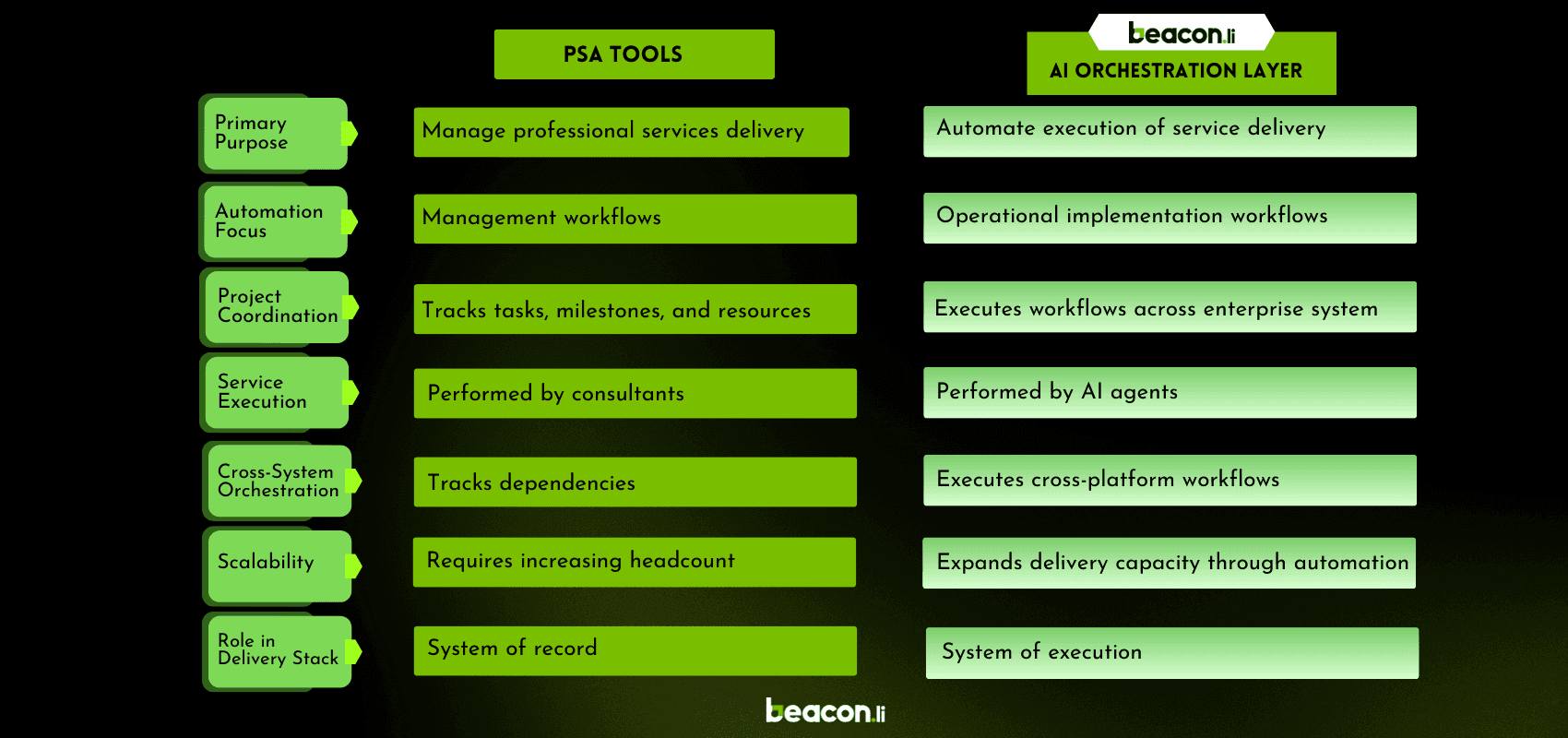
PSA tools remain essential for managing delivery operations. AI orchestration platforms introduce automation into the operational work behind implementations.
Together, these layers represent the next evolution of professional services infrastructure.
Are There Alternatives to PSA Tools?
According to Deloitte’s Tech Trends research, modern enterprises operate across increasingly complex technology ecosystems involving dozens of interconnected platforms, making implementation and orchestration significantly more difficult.
Many organisations searching for PSA alternatives are not actually trying to replace PSA platforms entirely.
Instead, they are looking for ways to automate the operational work that PSA systems only coordinate.
In practice, many modern service organisations combine two layers:
PSA platforms for project management, resource planning, and financial tracking
Execution automation platforms like Beacon for implementing and orchestrating delivery workflows
This architecture allows organisations to maintain visibility into service operations while expanding their capacity to deliver implementations.
The Future of Professional Services Automation
Professional services automation has evolved significantly over the past decade.
As the PSA market continues to expand at double-digit growth rates, organisations are increasingly exploring technologies that can automate not just coordination, but also the execution of service delivery workflows.
Early PSA platforms focused on organising delivery operations through project tracking, resource allocation, and billing management. These systems brought much-needed visibility to service organisations.
The next phase of innovation focuses on automating the execution of service delivery itself.
By combining PSA management systems with AI orchestration layers like Beacon, organisations can begin transforming professional services from a labour-intensive process into a scalable digital system.
For service-driven companies, the future of professional services automation lies not just in managing work more effectively, but in automating the execution of the work itself.
Frequently Asked Questions
What are PSA tools?
PSA tools (Professional Services Automation software) are platforms used to manage service delivery operations. They typically include features such as project tracking, resource allocation, time tracking, billing automation, and reporting.
Do PSA tools automate professional services?
PSA tools automate many management workflows such as task assignment, scheduling, approvals, and reporting. However, they generally do not automate the operational execution of implementation work.
What are the limitations of PSA tools?
Common limitations include reliance on human consultants for implementation tasks, limited cross-system automation, and difficulty scaling delivery capacity without increasing headcount.
What is an AI orchestration layer for professional services?
An AI orchestration layer automates parts of the operational work involved in service delivery. Platforms like Beacon use AI agents to execute workflows across enterprise systems, including configuration, testing, and data migration.
Professional Services Automation (PSA) tools are widely used by consulting firms, SaaS companies, and implementation teams to manage service delivery.
The global Professional Services Automation market has grown rapidly in recent years and is projected to exceed $50 billion by 2034 as organisations invest in tools that improve project visibility and resource management.
These platforms help organisations track projects, allocate resources, manage billing, and maintain visibility across delivery operations.
Over the past decade, PSA platforms have become the operational backbone for many professional services teams.
However, many organisations eventually realise an important distinction:
PSA tools automate how professional services work is managed, not how the work itself is executed.
The operational work of service delivery still relies heavily on human consultants. Teams configure systems, migrate data, validate workflows, and troubleshoot issues across complex enterprise environments. PSA platforms coordinate this work, but they rarely perform the implementation tasks themselves.
Understanding this distinction is critical for organisations exploring deeper automation in professional services.
What PSA Tools Actually Automate
PSA platforms are designed to coordinate and manage professional services delivery.
Organisations adopt PSA platforms primarily to improve resource utilization, project visibility, and financial forecasting across service teams. They provide the structure required to organise complex implementations involving multiple teams, systems, and stakeholders.
Most PSA platforms include automation features such as:
Automated task creation
Workflow approvals
Notifications and alerts
Resource scheduling
Time tracking and billing automation
Reporting dashboards
These capabilities improve how services are planned, tracked, and managed.
For example, PSA platforms can automatically generate project tasks, assign resources based on availability, or trigger notifications when milestones are completed.
However, these automations operate primarily at the management layer of service delivery. They help coordinate work but do not execute the underlying operational tasks required to complete implementations.
The Difference Between Management Automation and Execution Automation
Much of the confusion around PSA tools comes from conflating management automation with execution automation.
PSA platforms automate the coordination of work. They help teams organise projects, manage resources, and monitor progress across delivery operations.
Execution automation refers to something fundamentally different: systems that can perform parts of the operational work required to deliver implementations.
For example, a PSA platform might:
Assign tasks to consultants
Track milestone completion
Generate project reports
But consultants still perform the actual implementation work, such as:
Configuring enterprise software
Migrating customer data
Validating system integrations
Troubleshooting deployment issues
In other words, PSA tools automate project management, while the execution of service delivery still depends largely on human expertise.
Why Professional Services Work Has Been Difficult to Automate
The historical focus of PSA platforms on management rather than execution is not accidental.
Professional services implementations are inherently complex. This complexity is reflected across enterprise technology projects. McKinsey estimates that nearly 70% of digital transformation initiatives fail to achieve their intended outcomes, often due to implementation and operational challenges.
Each customer environment introduces unique variables including system configurations, workflows, approval hierarchies, integrations, and data structures.
This complexity contributes to high implementation risk. Studies estimate that 55–75% of ERP implementations fail to meet their original objectives, often due to integration challenges and operational complexity.
Delivering these implementations requires continuous interpretation and decision-making.
Consultants translate business requirements into system configurations, resolve data inconsistencies, and coordinate changes across multiple enterprise applications.
Because of this complexity, software tools historically struggled to automate the operational work behind implementations.
As a result, PSA platforms evolved primarily as systems for managing service delivery rather than executing it.
The Hidden Cost of Managing Work Without Automating It
PSA platforms deliver valuable operational visibility, but organisations that rely solely on them often encounter scaling challenges.
Delivery Capacity Scales With Headcount
Because the execution of implementation work remains manual, delivery capacity typically grows only by hiring more consultants.
Operational Bottlenecks
Project timelines often depend on the availability of specialised consultants who perform configuration, integration, and testing tasks.
Revenue Delays
For SaaS companies, revenue is frequently recognised only after successful customer implementation. Enterprise software implementations often take 9 months or longer to complete, delaying time-to-value for customers and revenue recognition for vendors.
When deployments take months to complete, revenue remains locked in deferred accounts.
Manager Burnout
Project managers often spend large portions of their time coordinating teams, resolving delivery conflicts, and managing implementation timelines.
While PSA tools improve coordination, they do not significantly increase execution capacity.
The Emerging Execution Layer in Professional Services
As enterprise software environments grow more complex, a new category of technology is beginning to emerge.
Instead of focusing only on coordinating service delivery, these platforms focus on automating parts of the execution layer itself.
This includes capabilities such as:
Translating requirements into system configurations
Orchestrating workflows across enterprise applications
Preparing and transforming operational data
Generating and validating test scenarios
Coordinating deployment and go-live activities
Rather than simply tracking implementation tasks, these systems participate directly in performing them.
The Rise of the AI Orchestration Layer
This shift is giving rise to a new architectural layer in the professional services stack: AI orchestration for service delivery execution.
If PSA platforms function as the system of record for service operations, AI orchestration platforms function as the system of execution.
Instead of assigning tasks to consultants, these systems coordinate and execute workflows across enterprise software environments.
Platforms like Beacon are designed to operate in this execution layer.
Beacon uses AI agents to orchestrate implementation workflows across enterprise systems, enabling automation of tasks such as:
Enterprise system configuration
Customer data transformation and migration
UAT test generation
Workflow validation
Hypercare support automation
By automating parts of the operational work behind implementations, this approach expands delivery capacity without relying entirely on additional consultants.
PSA Tools vs Beacon AI Orchestration Layer
The distinction between management automation and execution automation becomes clearer when comparing PSA platforms with AI orchestration layers like Beacon.
PSA tools remain essential for managing delivery operations. AI orchestration platforms introduce automation into the operational work behind implementations.
Together, these layers represent the next evolution of professional services infrastructure.
Are There Alternatives to PSA Tools?
According to Deloitte’s Tech Trends research, modern enterprises operate across increasingly complex technology ecosystems involving dozens of interconnected platforms, making implementation and orchestration significantly more difficult.
Many organisations searching for PSA alternatives are not actually trying to replace PSA platforms entirely.
Instead, they are looking for ways to automate the operational work that PSA systems only coordinate.
In practice, many modern service organisations combine two layers:
PSA platforms for project management, resource planning, and financial tracking
Execution automation platforms like Beacon for implementing and orchestrating delivery workflows
This architecture allows organisations to maintain visibility into service operations while expanding their capacity to deliver implementations.
The Future of Professional Services Automation
Professional services automation has evolved significantly over the past decade.
As the PSA market continues to expand at double-digit growth rates, organisations are increasingly exploring technologies that can automate not just coordination, but also the execution of service delivery workflows.
Early PSA platforms focused on organising delivery operations through project tracking, resource allocation, and billing management. These systems brought much-needed visibility to service organisations.
The next phase of innovation focuses on automating the execution of service delivery itself.
By combining PSA management systems with AI orchestration layers like Beacon, organisations can begin transforming professional services from a labour-intensive process into a scalable digital system.
For service-driven companies, the future of professional services automation lies not just in managing work more effectively, but in automating the execution of the work itself.
Frequently Asked Questions
What are PSA tools?
PSA tools (Professional Services Automation software) are platforms used to manage service delivery operations. They typically include features such as project tracking, resource allocation, time tracking, billing automation, and reporting.
Do PSA tools automate professional services?
PSA tools automate many management workflows such as task assignment, scheduling, approvals, and reporting. However, they generally do not automate the operational execution of implementation work.
What are the limitations of PSA tools?
Common limitations include reliance on human consultants for implementation tasks, limited cross-system automation, and difficulty scaling delivery capacity without increasing headcount.
What is an AI orchestration layer for professional services?
An AI orchestration layer automates parts of the operational work involved in service delivery. Platforms like Beacon use AI agents to execute workflows across enterprise systems, including configuration, testing, and data migration.








Copyright © 2026 Beacon.li. All rights reserved.
Copyright © 2026 Beacon.li. All rights reserved.
