

The Most Expensive Mistake in Enterprise Software? It’s Relearning the Same Implementation Every Time!



The best software systems get better every time they’re used. They capture signals, learn from them, and improve continuously. Over time, that creates real compounding advantage, the system doesn’t just execute, it evolves.
Implementation never worked that way. It sits right between a signed contract and realized revenue, and yet it’s the one place where almost nothing actually compounds.
This isn’t execution. It's an interpretation.
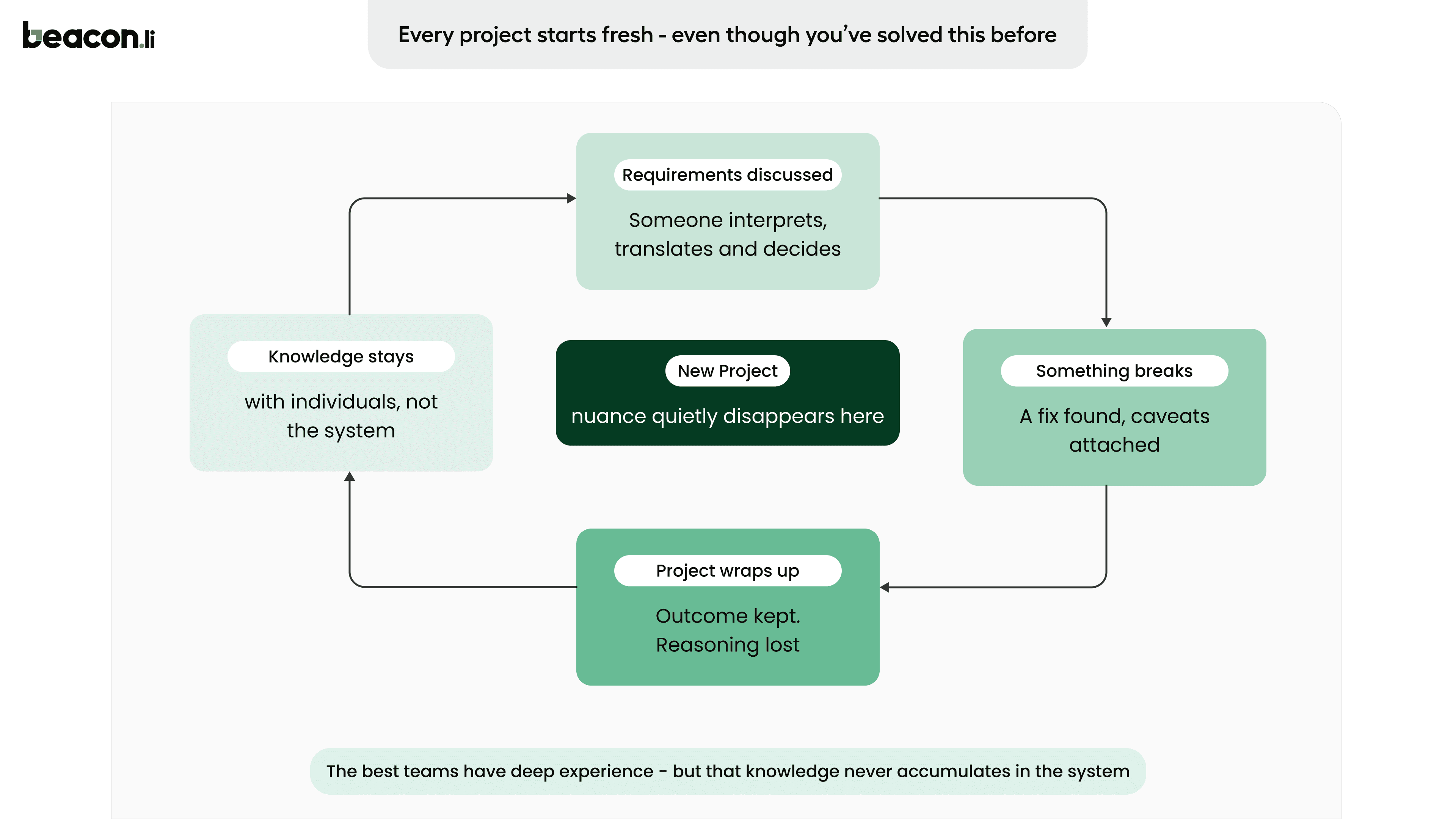
What looks like execution on the surface is actually a series of decisions. A requirement is discussed, but rarely in a way that maps cleanly to the system. Someone interprets it, translates it into workflows or configurations, and makes a set of trade-offs along the way. Something breaks, it gets debugged, and a fix is found usually with a caveat attached to it.
That understanding, the nuance behind what worked and what didn’t, is where most of the value sits. And then the project moves on, and that layer quietly disappears.
We keep the outcome. We lose the reasoning.
What gets preserved after an implementation is the final state—the configured system, maybe a few documents. But the path that led there is rarely retained in a usable way.
Also Read: Why Enterprise SaaS Implementations Take Too Long and How to Actually Fix It
The best implementation teams have deep experience. They’ve seen patterns, they know where things break, and they’ve built strong instincts around how to fix them. But that knowledge doesn’t accumulate in the system. It stays with individuals. One person remembers the edge case, another remembers the workaround, someone else knows which signals actually matter. Over time, this creates dependence on people rather than progress in the system itself.
This was never an automation problem.
For a long time, the instinct was to automate implementation. But automation assumes the steps are known and repeatable. Implementation fails because decisions are unclear. Those decisions were historically made in fragmented ways, across calls, emails, and side conversations, with no mechanism to capture them in a structured form. There was no feedback loop. No way for the system to learn from what had already happened.
Now the decisions are starting to show up.
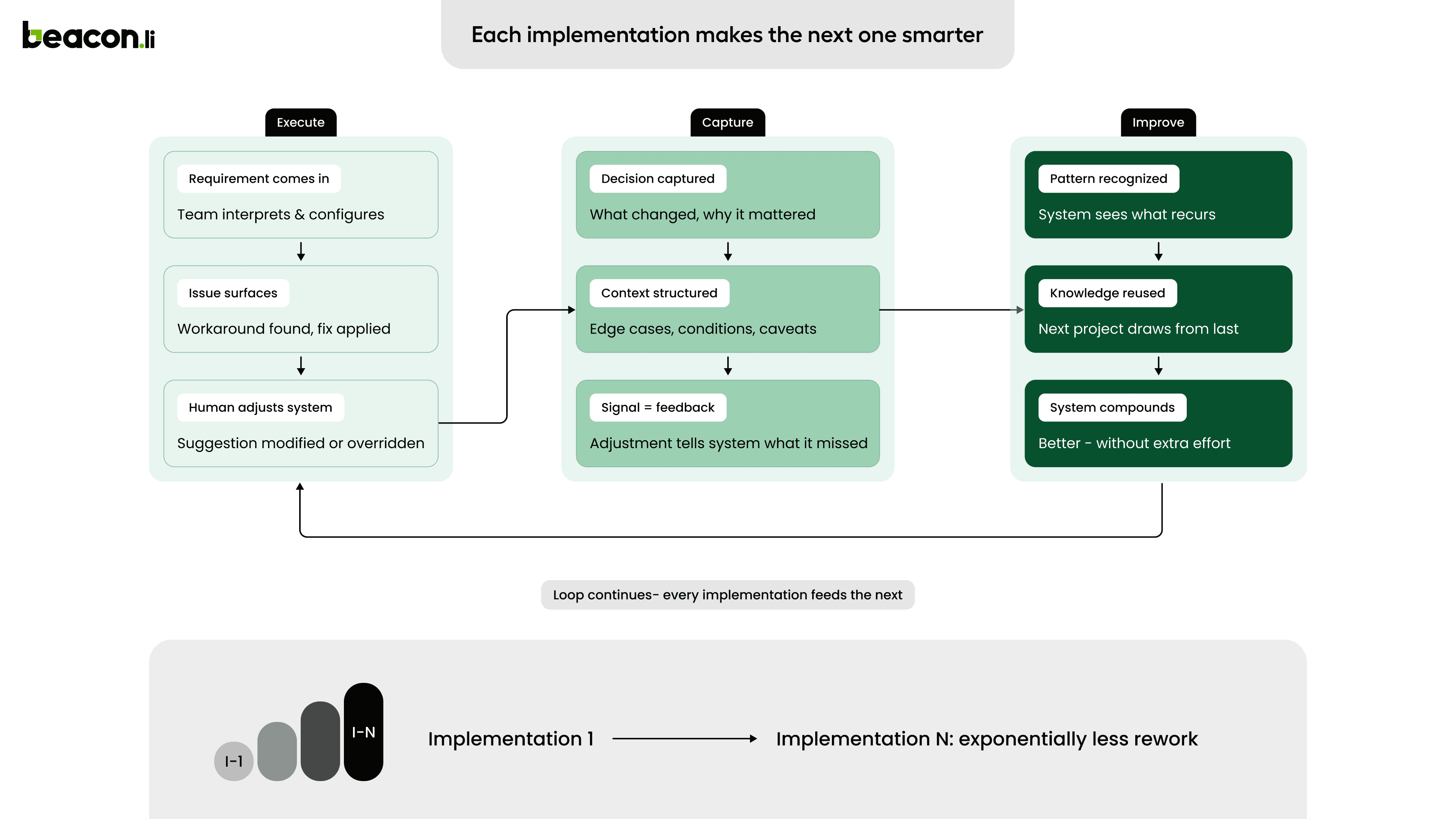
What’s changing now is visibility. Work is no longer confined to informal channels; it increasingly lives in transcripts, edits, approvals, and system interactions. More importantly, systems are beginning to participate in the workflow itself. When a system suggests something and a human adjusts it, that adjustment becomes a signal. It reflects what the system missed and what actually matters in that context.
As @Jaya Gupta has pointed out in the context of measurement systems, without capturing the right signals, you don’t get a learning loop, you simply repeat the same work. That’s exactly how implementation has operated for a long time.
What we realized while building Beacon.
When we started building Beacon, this became the core insight. The issue wasn’t just speed, it was memory. Teams weren’t starting from scratch because they lacked experience, but because the system had no way to use that experience. There was no structured way to understand what had failed before, why a fix worked, or under what conditions it applied. That knowledge existed, but only in fragmented form, often tied to specific individuals. So the focus shifted from just executing implementation steps to capturing the decisions behind them and structuring that knowledge in a way the system could actually use.
When implementation starts learning.
Once that layer is captured, the nature of implementation begins to change. You don’t approach each new project as if it’s entirely new. You don’t rely on someone remembering how a similar issue was handled in the past. Instead, each implementation contributes to a growing base of understanding that the system can draw from. The improvement is subtle at first, but it compounds over time. The system becomes better not because of additional effort, but because it has learned from what it has already done.
This is the shift.
For a long time, it has been accepted that implementation comes with an inherent learning cost – that each deployment requires rediscovering things that were already solved in some form. But that assumption is beginning to break. Once you introduce a mechanism for capturing and reusing decision-making, learning becomes part of the system itself. At that point, repeating the same implementation twice doesn’t feel like an operational inefficiency. It starts to feel like a gap in how the system was designed.
What we’re building at Beacon
We’re building @Beacon on the premise that every implementation should leave the system smarter than it was before. Not because someone documented more carefully, but because the system itself learned something it can apply again. That’s the loop that’s been missing. And that’s what we’re building now.
If this resonates, book a demo with Beacon to see what SaaS customer onboarding looks like when execution, context, and learning all live in one system.
This article was originally published on Rakesh Vaddadi's LinkedIn profile - https://www.linkedin.com/pulse/most-expensive-mistake-enterprise-software-rakesh-vaddadi-yrh2c/ and has been republished here.
The best software systems get better every time they’re used. They capture signals, learn from them, and improve continuously. Over time, that creates real compounding advantage, the system doesn’t just execute, it evolves.
Implementation never worked that way. It sits right between a signed contract and realized revenue, and yet it’s the one place where almost nothing actually compounds.
This isn’t execution. It's an interpretation.
What looks like execution on the surface is actually a series of decisions. A requirement is discussed, but rarely in a way that maps cleanly to the system. Someone interprets it, translates it into workflows or configurations, and makes a set of trade-offs along the way. Something breaks, it gets debugged, and a fix is found usually with a caveat attached to it.
That understanding, the nuance behind what worked and what didn’t, is where most of the value sits. And then the project moves on, and that layer quietly disappears.
We keep the outcome. We lose the reasoning.
What gets preserved after an implementation is the final state—the configured system, maybe a few documents. But the path that led there is rarely retained in a usable way.
Also Read: Why Enterprise SaaS Implementations Take Too Long and How to Actually Fix It
The best implementation teams have deep experience. They’ve seen patterns, they know where things break, and they’ve built strong instincts around how to fix them. But that knowledge doesn’t accumulate in the system. It stays with individuals. One person remembers the edge case, another remembers the workaround, someone else knows which signals actually matter. Over time, this creates dependence on people rather than progress in the system itself.
This was never an automation problem.
For a long time, the instinct was to automate implementation. But automation assumes the steps are known and repeatable. Implementation fails because decisions are unclear. Those decisions were historically made in fragmented ways, across calls, emails, and side conversations, with no mechanism to capture them in a structured form. There was no feedback loop. No way for the system to learn from what had already happened.
Now the decisions are starting to show up.
What’s changing now is visibility. Work is no longer confined to informal channels; it increasingly lives in transcripts, edits, approvals, and system interactions. More importantly, systems are beginning to participate in the workflow itself. When a system suggests something and a human adjusts it, that adjustment becomes a signal. It reflects what the system missed and what actually matters in that context.
As @Jaya Gupta has pointed out in the context of measurement systems, without capturing the right signals, you don’t get a learning loop, you simply repeat the same work. That’s exactly how implementation has operated for a long time.
What we realized while building Beacon.
When we started building Beacon, this became the core insight. The issue wasn’t just speed, it was memory. Teams weren’t starting from scratch because they lacked experience, but because the system had no way to use that experience. There was no structured way to understand what had failed before, why a fix worked, or under what conditions it applied. That knowledge existed, but only in fragmented form, often tied to specific individuals. So the focus shifted from just executing implementation steps to capturing the decisions behind them and structuring that knowledge in a way the system could actually use.
When implementation starts learning.
Once that layer is captured, the nature of implementation begins to change. You don’t approach each new project as if it’s entirely new. You don’t rely on someone remembering how a similar issue was handled in the past. Instead, each implementation contributes to a growing base of understanding that the system can draw from. The improvement is subtle at first, but it compounds over time. The system becomes better not because of additional effort, but because it has learned from what it has already done.
This is the shift.
For a long time, it has been accepted that implementation comes with an inherent learning cost – that each deployment requires rediscovering things that were already solved in some form. But that assumption is beginning to break. Once you introduce a mechanism for capturing and reusing decision-making, learning becomes part of the system itself. At that point, repeating the same implementation twice doesn’t feel like an operational inefficiency. It starts to feel like a gap in how the system was designed.
What we’re building at Beacon
We’re building @Beacon on the premise that every implementation should leave the system smarter than it was before. Not because someone documented more carefully, but because the system itself learned something it can apply again. That’s the loop that’s been missing. And that’s what we’re building now.
If this resonates, book a demo with Beacon to see what SaaS customer onboarding looks like when execution, context, and learning all live in one system.
This article was originally published on Rakesh Vaddadi's LinkedIn profile - https://www.linkedin.com/pulse/most-expensive-mistake-enterprise-software-rakesh-vaddadi-yrh2c/ and has been republished here.








Copyright © 2026 Beacon.li. All rights reserved.
Copyright © 2026 Beacon.li. All rights reserved.
