Meet us at booth #515

Meet us at booth #515
Meet us at booth #515
Meet us at booth #515
Meet us at booth #515
Meet us at booth #515

Client Implementation
Why Better Project Management Alone Doesn’t Fix Professional Services Implementations


Professional Services organizations have invested heavily in project management maturity.
We have standardized delivery frameworks, certified project managers, detailed implementation plans, and powerful tools to track progress, risks, and dependencies.
Yet across Professional Services delivery teams, the story is familiar: Implementations still drag beyond expectations. Senior consultants still become the bottleneck everyone's aware of.
Outcomes swing far more than they should, given the amount of process we've built around them.
So the question becomes: Why doesn't all that project management maturity translate into the delivery we'd actually expect without implementation automation?
The Reality of Professional Services Delivery
In Professional Services implementations, we’ve become exceptionally good at planning and tracking work. We’ve been far less disciplined about how execution actually happens.
Configs, role matrices, workflow rules, feature flags, and integration settings are applied without implementation automation manually across non-prod and prod. Data loads run against evolving schemas. Validation is partial, because timelines don’t allow full reconciliation before UAT and everyone assumes cleanup will happen later.
That debt surfaces at UAT, cutover, and early hypercare:
Permissions fail under real usage
Workflows break at production data volumes
Production behavior diverges from test
Delivery slows because someone has to diff environments, trace config lineage, and re-validate data paths. Usually the same consultant who did the original setup.
This isn’t a project management failure. It’s manual execution hitting its scalability limit in enterprise software implementation, and why implementation automation and a real implementation execution layer are now required for Professional Services implementations that need predictable delivery at scale.
Where Project Management in Professional Services Reaches Its Limit
Project management (PM) tools are essential in Professional Services. They bring structure, accountability, and visibility.
They are excellent at answering:
Who owns this?
When is it due?
What is blocked?
What is the status?
But Professional Services implementations don’t fail because those questions go unanswered.
They struggle because PM tools cannot:
Execute configurations inside the product
Validate data in real time
Enforce SOPs consistently across customers
Reduce dependency on individual expertise
Make execution repeatable across implementations
In Professional Services delivery, the hardest work happens inside the system, where manual effort and variation live below the project plan.
These execution gaps are exactly where an AI implementation platform becomes necessary.
Rethinking Professional Services Implementations as a System
Professional Services implementations are not one-off projects. They are repeatable delivery systems.
The same configurations, validations, and workflows are executed across customers with small variations, again and again.
Yet we rely on:
Manual clicks
Documentation
Memory
Checklists
This is why Professional Services delivery doesn’t scale linearly. Every new customer increases risk, effort, and dependence on experts.
Predictable delivery requires predictable execution and implementation automation.
How AI Changes Professional Services Delivery
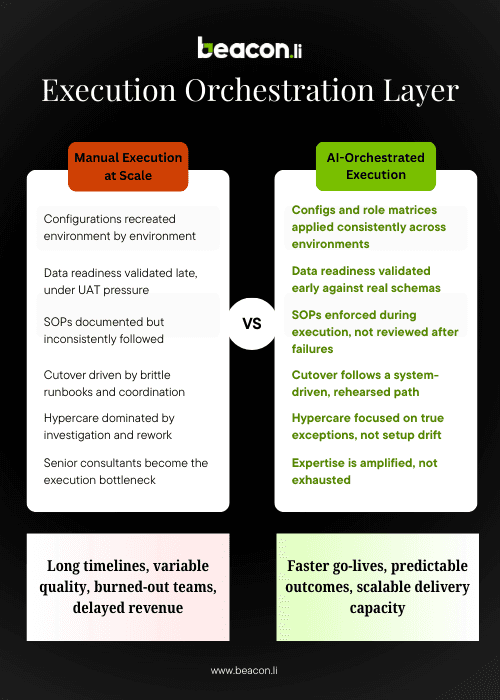
In most enterprise software implementations, professional services teams already know what needs to be done. The drag comes from how it gets done: manually applying configs, checking data readiness late, enforcing SOPs inconsistently, and carrying fragile execution through UAT, cutover, and hypercare. These steps are repetitive, deterministic, and well understood. Yet, they still rely on people remembering, rechecking, and fixing things after they break.
That’s the execution tax delivery teams keep paying.
An AI implementation platform changes this only when it operates inside the product, not around it. When AI understands the UI, the actions available on each screen, and the dependencies between configs, workflows, permissions, and data states, execution stops being tribal knowledge. It becomes structured, continuously validated, and repeatable across environments.
The goal is to remove the friction that forces senior people to spend their time retracing steps, diffing environments, and firefighting issues that should never reach UAT or hypercare.
Beacon as the Execution Orchestration Layer (What This Looks Like in Practice)
Beacon is an AI implementation platform designed specifically to orchestrate execution across Professional Services implementations.
Beacon applies this execution-first model directly to Professional Services implementations.
Instead of treating execution as a series of manual tasks, Beacon builds an executable model of how work actually happens inside the product: configs, workflows, permissions, data validation, cutover steps, and hypercare actions. Delivery plans don’t change. What changes is that execution is no longer translated into clicks by people.
Here’s what that means on the ground:
Inception outputs stop being static documents. SoWs reflect validated requirements and execution constraints, not interpretations that drift later.
Solution designs translate directly into configuration intent, reducing rework between BRD signoff and system setup.
Environment setup stops depending on who’s staffed. Approved configs and role matrices are applied consistently across non-prod and prod.
Data readiness is validated earlier against real schemas, not assumed until UAT exposes gaps.
Cutover follows a system-driven sequence instead of brittle runbooks and late-night coordination.
Hypercare stabilizes faster because execution drift has already been eliminated upstream.
The impact on Professional Services teams is very practical. Senior consultants stop being execution bottlenecks. Junior team members ramp faster. Delivery becomes predictable — not because teams are managed harder, but because execution is finally treated as a system, not an act of individual heroics.
The Future of Professional Services Implementations
The next leap in Professional Services maturity will not come from more project management tools.
It will come from embedding intelligence directly into execution — turning implementation knowledge into a scalable system.
Project management will continue to plan, govern, and communicate.
Execution orchestration will ensure that what is planned actually happens — reliably, repeatedly, and at enterprise scale.
The Professional Services teams that win will not work harder.
They will work with systems that amplify their expertise.
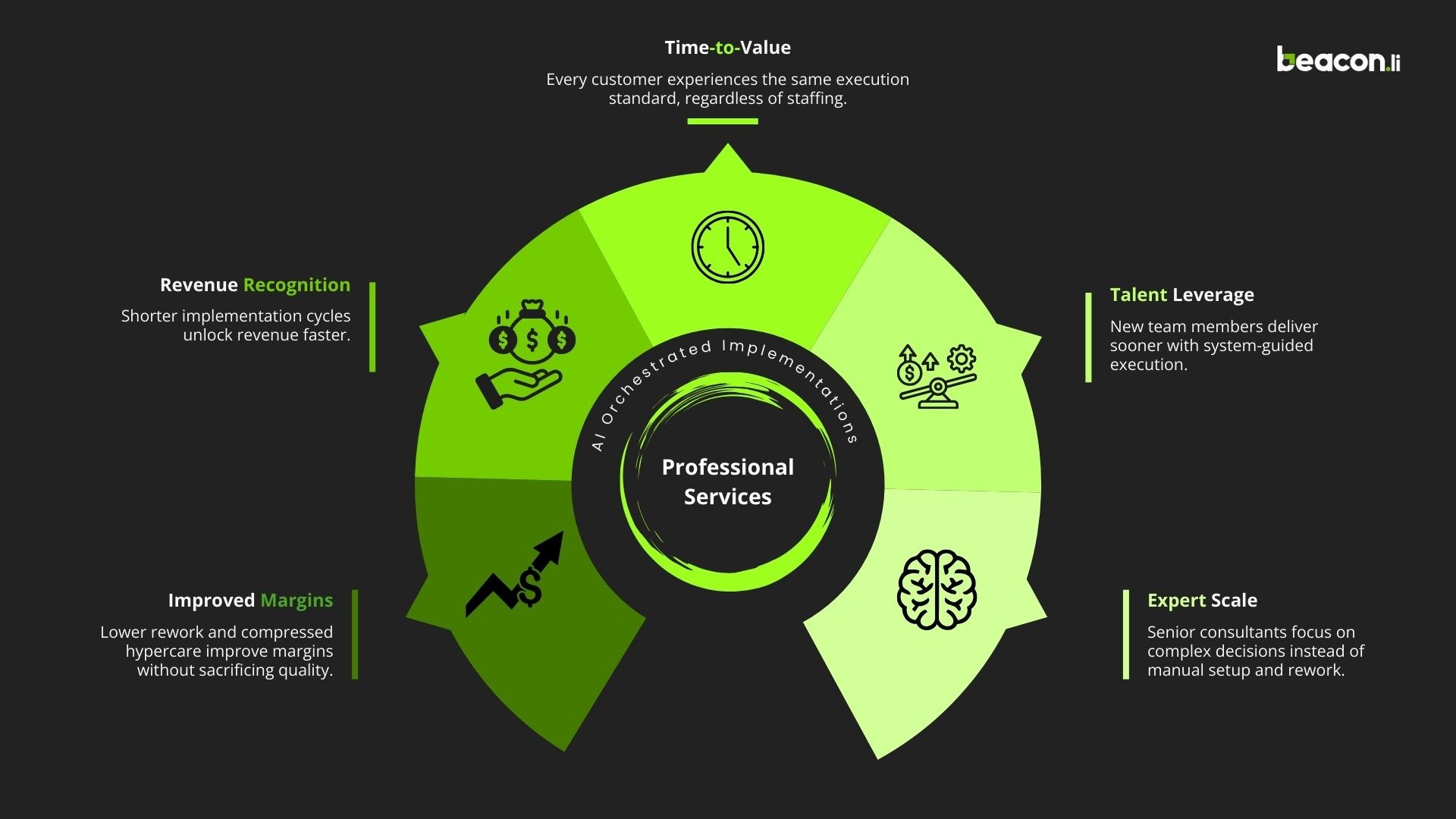
Better project management improves visibility. Empowered execution transforms Professional Services delivery.
That is the shift Beacon makes possible end to end Implementation Process.
Professional Services organizations have invested heavily in project management maturity.
We have standardized delivery frameworks, certified project managers, detailed implementation plans, and powerful tools to track progress, risks, and dependencies.
Yet across Professional Services delivery teams, the story is familiar: Implementations still drag beyond expectations. Senior consultants still become the bottleneck everyone's aware of.
Outcomes swing far more than they should, given the amount of process we've built around them.
So the question becomes: Why doesn't all that project management maturity translate into the delivery we'd actually expect without implementation automation?
The Reality of Professional Services Delivery
In Professional Services implementations, we’ve become exceptionally good at planning and tracking work. We’ve been far less disciplined about how execution actually happens.
Configs, role matrices, workflow rules, feature flags, and integration settings are applied without implementation automation manually across non-prod and prod. Data loads run against evolving schemas. Validation is partial, because timelines don’t allow full reconciliation before UAT and everyone assumes cleanup will happen later.
That debt surfaces at UAT, cutover, and early hypercare:
Permissions fail under real usage
Workflows break at production data volumes
Production behavior diverges from test
Delivery slows because someone has to diff environments, trace config lineage, and re-validate data paths. Usually the same consultant who did the original setup.
This isn’t a project management failure. It’s manual execution hitting its scalability limit in enterprise software implementation, and why implementation automation and a real implementation execution layer are now required for Professional Services implementations that need predictable delivery at scale.
Where Project Management in Professional Services Reaches Its Limit
Project management (PM) tools are essential in Professional Services. They bring structure, accountability, and visibility.
They are excellent at answering:
Who owns this?
When is it due?
What is blocked?
What is the status?
But Professional Services implementations don’t fail because those questions go unanswered.
They struggle because PM tools cannot:
Execute configurations inside the product
Validate data in real time
Enforce SOPs consistently across customers
Reduce dependency on individual expertise
Make execution repeatable across implementations
In Professional Services delivery, the hardest work happens inside the system, where manual effort and variation live below the project plan.
These execution gaps are exactly where an AI implementation platform becomes necessary.
Rethinking Professional Services Implementations as a System
Professional Services implementations are not one-off projects. They are repeatable delivery systems.
The same configurations, validations, and workflows are executed across customers with small variations, again and again.
Yet we rely on:
Manual clicks
Documentation
Memory
Checklists
This is why Professional Services delivery doesn’t scale linearly. Every new customer increases risk, effort, and dependence on experts.
Predictable delivery requires predictable execution and implementation automation.
How AI Changes Professional Services Delivery
In most enterprise software implementations, professional services teams already know what needs to be done. The drag comes from how it gets done: manually applying configs, checking data readiness late, enforcing SOPs inconsistently, and carrying fragile execution through UAT, cutover, and hypercare. These steps are repetitive, deterministic, and well understood. Yet, they still rely on people remembering, rechecking, and fixing things after they break.
That’s the execution tax delivery teams keep paying.
An AI implementation platform changes this only when it operates inside the product, not around it. When AI understands the UI, the actions available on each screen, and the dependencies between configs, workflows, permissions, and data states, execution stops being tribal knowledge. It becomes structured, continuously validated, and repeatable across environments.
The goal is to remove the friction that forces senior people to spend their time retracing steps, diffing environments, and firefighting issues that should never reach UAT or hypercare.
Beacon as the Execution Orchestration Layer (What This Looks Like in Practice)
Beacon is an AI implementation platform designed specifically to orchestrate execution across Professional Services implementations.
Beacon applies this execution-first model directly to Professional Services implementations.
Instead of treating execution as a series of manual tasks, Beacon builds an executable model of how work actually happens inside the product: configs, workflows, permissions, data validation, cutover steps, and hypercare actions. Delivery plans don’t change. What changes is that execution is no longer translated into clicks by people.
Here’s what that means on the ground:
Inception outputs stop being static documents. SoWs reflect validated requirements and execution constraints, not interpretations that drift later.
Solution designs translate directly into configuration intent, reducing rework between BRD signoff and system setup.
Environment setup stops depending on who’s staffed. Approved configs and role matrices are applied consistently across non-prod and prod.
Data readiness is validated earlier against real schemas, not assumed until UAT exposes gaps.
Cutover follows a system-driven sequence instead of brittle runbooks and late-night coordination.
Hypercare stabilizes faster because execution drift has already been eliminated upstream.
The impact on Professional Services teams is very practical. Senior consultants stop being execution bottlenecks. Junior team members ramp faster. Delivery becomes predictable — not because teams are managed harder, but because execution is finally treated as a system, not an act of individual heroics.
The Future of Professional Services Implementations
The next leap in Professional Services maturity will not come from more project management tools.
It will come from embedding intelligence directly into execution — turning implementation knowledge into a scalable system.
Project management will continue to plan, govern, and communicate.
Execution orchestration will ensure that what is planned actually happens — reliably, repeatedly, and at enterprise scale.
The Professional Services teams that win will not work harder.
They will work with systems that amplify their expertise.
Better project management improves visibility. Empowered execution transforms Professional Services delivery.
That is the shift Beacon makes possible end to end Implementation Process.








Copyright © 2026 Beacon.li. All rights reserved.
Copyright © 2026 Beacon.li. All rights reserved.
